
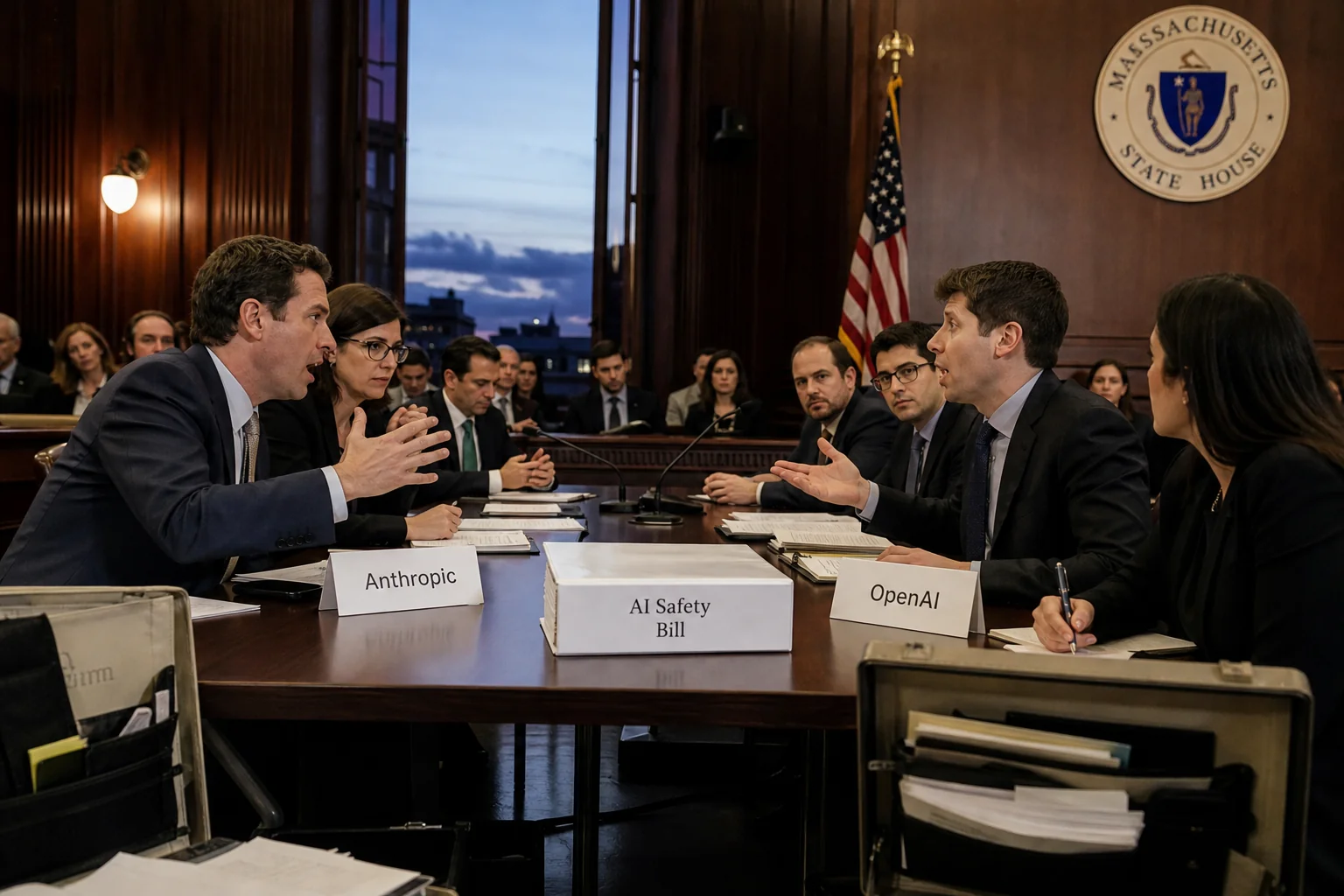
Massachusetts is not writing a white paper. It is putting frontier labs on a medical calendar.
Inside a Senate-passed economic-development package sits one of the toughest state AI safety regimes yet drafted: large frontier developers with more than $500 million in annual revenue would face not only an Illinois-style annual third-party compliance audit, but also independent catastrophic-risk evaluations on a roughly 120-day cadence. Catastrophe is defined hard — at least 50 deaths or serious injuries, or more than $1 billion in property damage. Findings would be public; the state still could not halt development. Bloomberg reporting carried by Insurance Journal adds the mechanics: evaluators can demand “all materials reasonably necessary,” the attorney general sets evaluator standards, and labs — not taxpayers — pay the bill.
The industry split is the story. Anthropic’s Cesar Fernandez called the Senate text “the clearest and strongest AI legislation in the country,” arguing the industry should not “grade its own homework.” OpenAI’s Donnie Fowler answered that inconsistency “doesn’t mean safer. It just means confusion,” and warned a 120-day cycle could slow cybersecurity models meant to defend against the same risks. OpenAI prefers Illinois’s lighter annual audit; both labs hired Boston lobbyists — Tremont for Anthropic, Benchmark Strategies for OpenAI.
Governor Maura Healey’s office is living the contradiction. Massachusetts partnered with OpenAI to put ChatGPT across the executive branch, and spring emails show economic-development secretary Eric Paley talking with Anthropic about growth and “responsible governance frameworks.” Healey’s own original package did not include the Senate AI add-on. Republican challenger Michael Minogue dismissed the reviews as non-experts advising experts every four months. PYMNTS’s September 3 update, citing The Information, says conference negotiators are still ironing the AI language while Encode and Secure AI Project lobby for the harder version — with Hugging Face’s agent intrusion as the political accelerant.
Take: This is state arms racing into a federal vacuum. After Congress killed a decade-long preemption push, Massachusetts language can travel the way California privacy law once did. If conference waters the cadence back to Illinois, OpenAI buys compliance bandwidth. If the 120-day catastrophic review sticks, Anthropic banks a trust brand that welcomes engine teardowns. Either way, faster domestic constraints — AG probes, copyright suits, supply-chain labels — will still outrun an unsigned state bill.
[1][2]