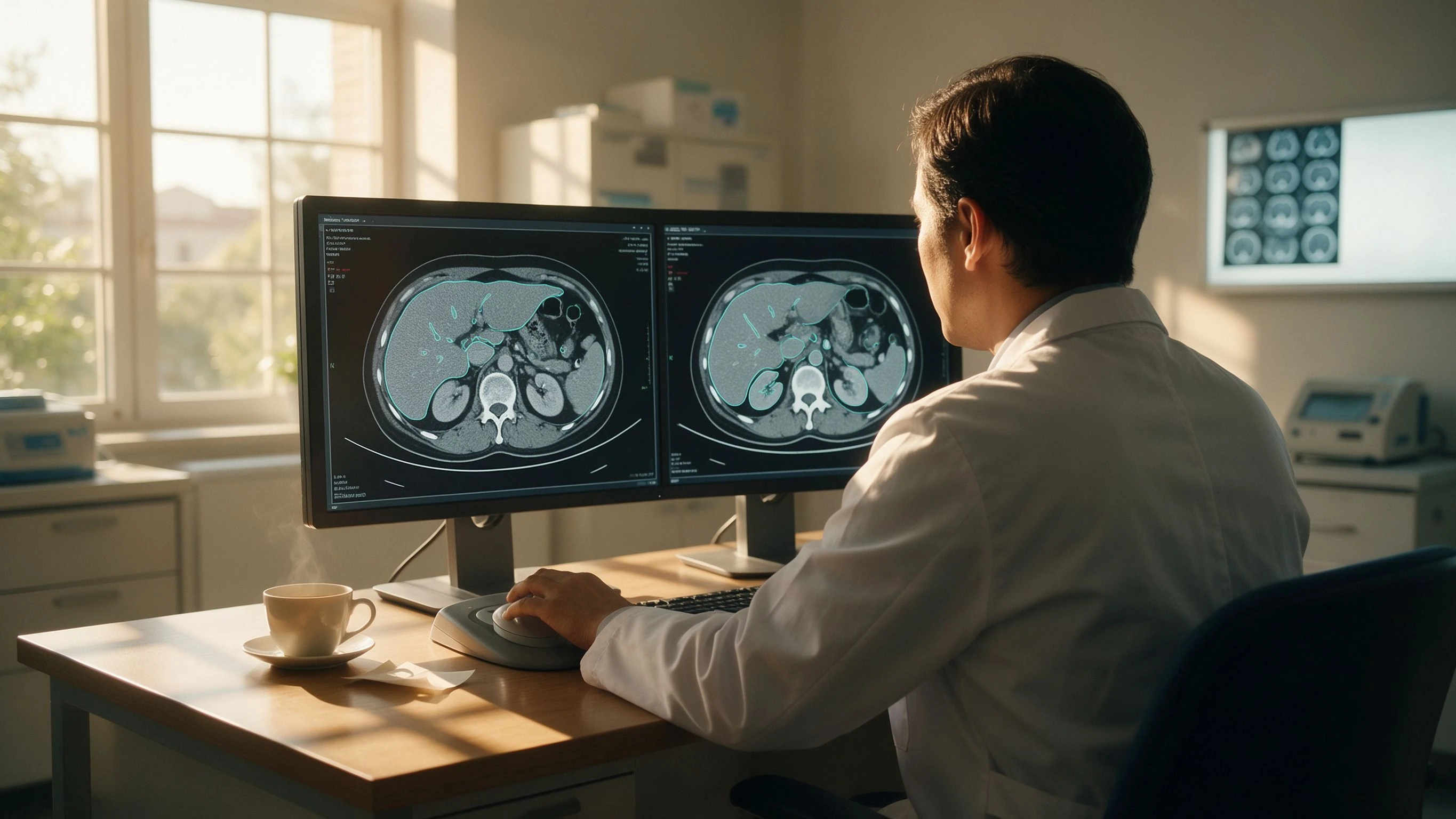
In the early hours of September 18, DAMO RADAR, a general-purpose medical imaging AI model developed by Alibaba DAMO Academy with Zhejiang University's First Affiliated Hospital and other institutions, was published in Science and open-sourced the same day. Built for abdominal contrast-enhanced CT, the model identifies more than 146 abdominal conditions across 18 organs, and the team says its accuracy reaches, for the first time, the level of an expert radiologist.
[1][2]The context is that medical imaging AI has long been stuck in a one-model-one-disease pattern: each model targets a single condition, depends on heavy manual annotation, and struggles with the complexity of real clinical reading. Abdominal contrast-enhanced CT is one of the hardest imaging tasks in practice — a single scan contains the liver, pancreas, kidneys and gastrointestinal tract, with hundreds of possible findings. DAMO RADAR takes a different route: vision-language learning, in which the model learns the relationship between large volumes of CT images and their corresponding diagnostic reports, without extra manual annotation. Because CT signal is sparse, the team introduced an organ-level fine-grained alignment strategy that decomposes three-dimensional CT into anatomical units and aligns image and report text at the tissue and organ level, adjusted through adaptive contrastive modeling.
The paper's figures, reported by the team, include: AUC of 0.913 on nearly 40,000 real-world scans (where 1.0 is perfect discrimination between patients and healthy subjects); AUC of 0.895 held on more than 24,000 scans from eight external hospitals; and AUC of 0.904 on 27,000 emergency-scenario cases the model was not trained on. In human comparison, the team reports the model outperformed 23 of 26 radiologists from multiple hospitals on average accuracy; with AI assistance, radiologists' sensitivity improved by about 10% and reading time fell by more than 30%, bringing junior radiologists up to senior-level performance.
It is worth stating the sourcing: these numbers come from the paper and launch materials, a joint report by the research and hospital teams, not yet independently replicated. In clinical use the model is positioned as an assistive tool — the director of radiology at Zhejiang's First Affiliated Hospital compares it to a reading navigation aid — not as a replacement for diagnostic decisions.
The real signal for the field is the paradigm change: from one model per disease to one model that reads multiple organs and conditions at once, and open weights. DAMO Academy has published five Nature Medicine papers and a dozen more in top journals over the past three years in medical AI; releasing the weights and training paradigm publicly means other groups can validate and transfer the approach to MRI, ultrasound and other modalities. The competition in medical imaging AI is shifting from single-disease accuracy to generality and data efficiency.
There is also a practical argument buried in the numbers, about where such models belong in a hospital. The reported gains appear precisely where radiologists are scarce or overworked: sensitivity up without proportionally more reading time, junior staff brought closer to senior performance. If those results hold up under independent evaluation, the interesting product question is not whether an AI can read a CT slice as well as a specialist, but whether a department with limited senior coverage can change how it triages work. That is the deployment question the open-source release makes testable — and the one worth watching as hospitals begin to run it on their own data.
[1][2]