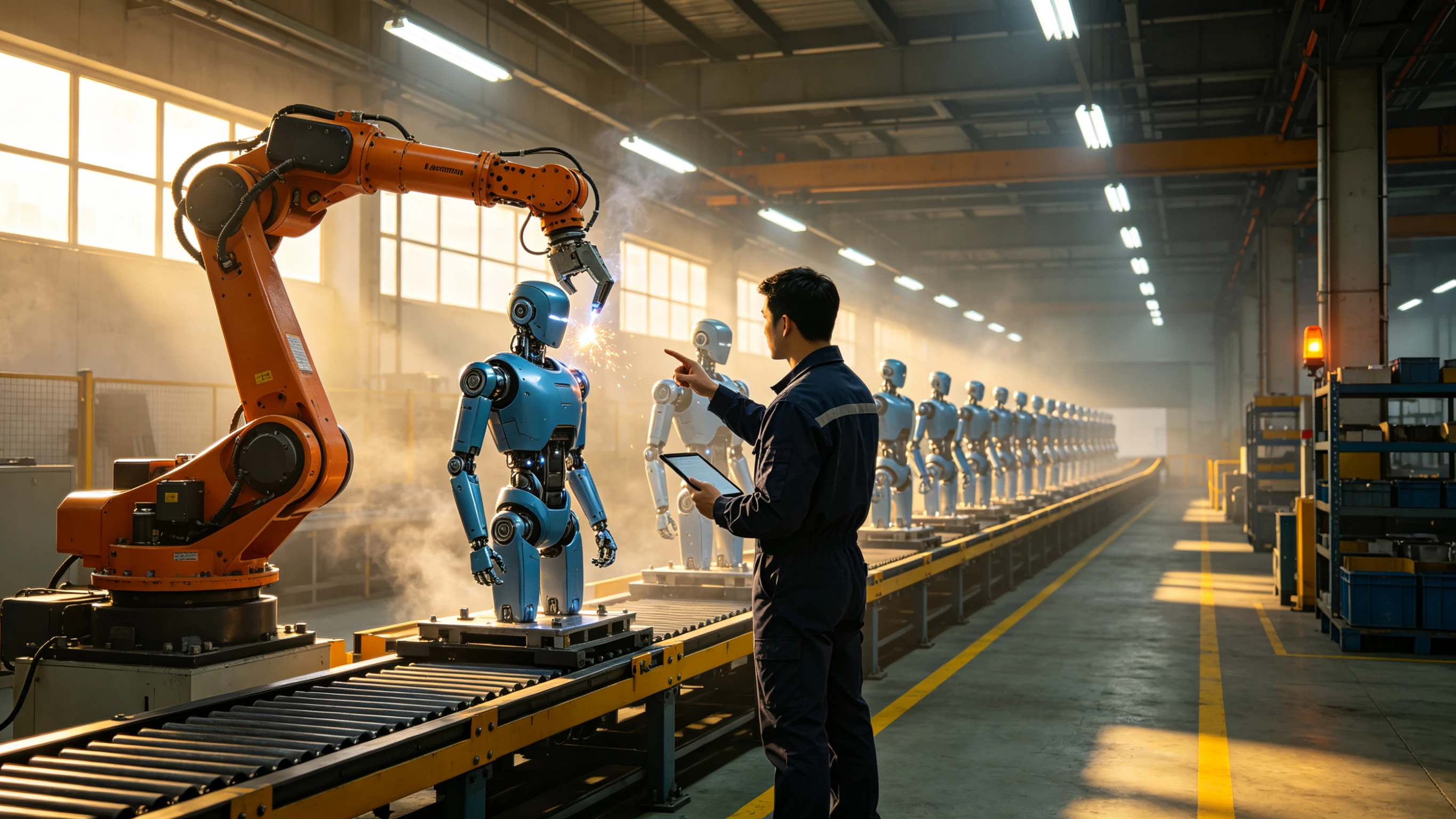
On September 20, embodied-AI robotics company GENISOM AI (Zhishen Technology) announced a Series B round of several hundred million RMB, led by UAE-based Stone Venture, with participation from Hongshan Capital, Yueke Financial, Wuzhong Rongyue, Wuzhong Jinkong and industrial investors including Neusoft, Haopeng Technology, Yuanguang Capital and Riri Electronics. According to reports citing The Paper and DoNews, the company had shipped over 15,000 embodied robots cumulatively as of June. The round itself is modest. Placed in the 2026 e
[1][2]mbodied-AI context, it marks a narrative shift: from demo shows to production orders.
First, what the company has done. Per public reports, the funding will go into robot bodies, embodied "large and small brains," and task execution, iterating the GSD (Genisom Self-Driving) navigation system across four technical lines — motion, spatial, interaction and swarm intelligence — with the stated goal of moving robots "from autonomously entering the site to autonomously completing tasks." Cumulative production over 15,000 units and a partner network of over 500 — readers should hold some skepticism about whether these figures survive independent verification, but they at least indicate that this company's business model is built on delivery, not on fundraising demos.
The lead investor's identity is worth attention. Stone Venture is not the first Middle East capital into China's embodied-AI track, but "Middle East capital leading + Chinese body manufacturer producing + global market in view" is becoming a fixed playbook in 2026. The logic is straightforward: Gulf sovereign wealth is hunting for manufacturing assets in the AI era, and embodied-AI manufacturing capability is concentrated in the Chinese supply chain; Chinese companies need not just money but a channel to Middle Eastern and global markets. In this round, the industrial investors (Neusoft, Haopeng, Riri) stand out more than the financial ones — supply-chain partners putting real money in usually says more about an industry's actual state than any financial valuation.
Against the Silicon Valley narrative, the difference is sharper. Figure and Tesla Optimus stage releases around video demos and milestones, with capital paying for expectations; companies like Zhishen present "15,000 units produced" as their primary credential. Neither narrative is inherently correct — demos set the ceiling, production sets the floor — but they give opposite answers to "where is embodied AI now," and investors are paying for both answers at once.
What is worth tracking is not the round size but three verification points: the takeover rate of GSD navigation in real industrial sites rather than showrooms; the timeline for "autonomously completing tasks" to become a verifiable SLA; and whether Middle East capital actually scales capacity and export orders in tandem. Embodied AI has passed the stage where storytelling alone raised money. The 15,000-unit figure will either compound or become baggage.
The stance of this piece should be stated: it is not an investment judgment on Zhishen Technology, but an observation of an industry pattern taking shape. When a company puts "units produced" rather than "demo video" in its press-release headline, the capital narrative of embodied AI has already turned a page.
[1][2]