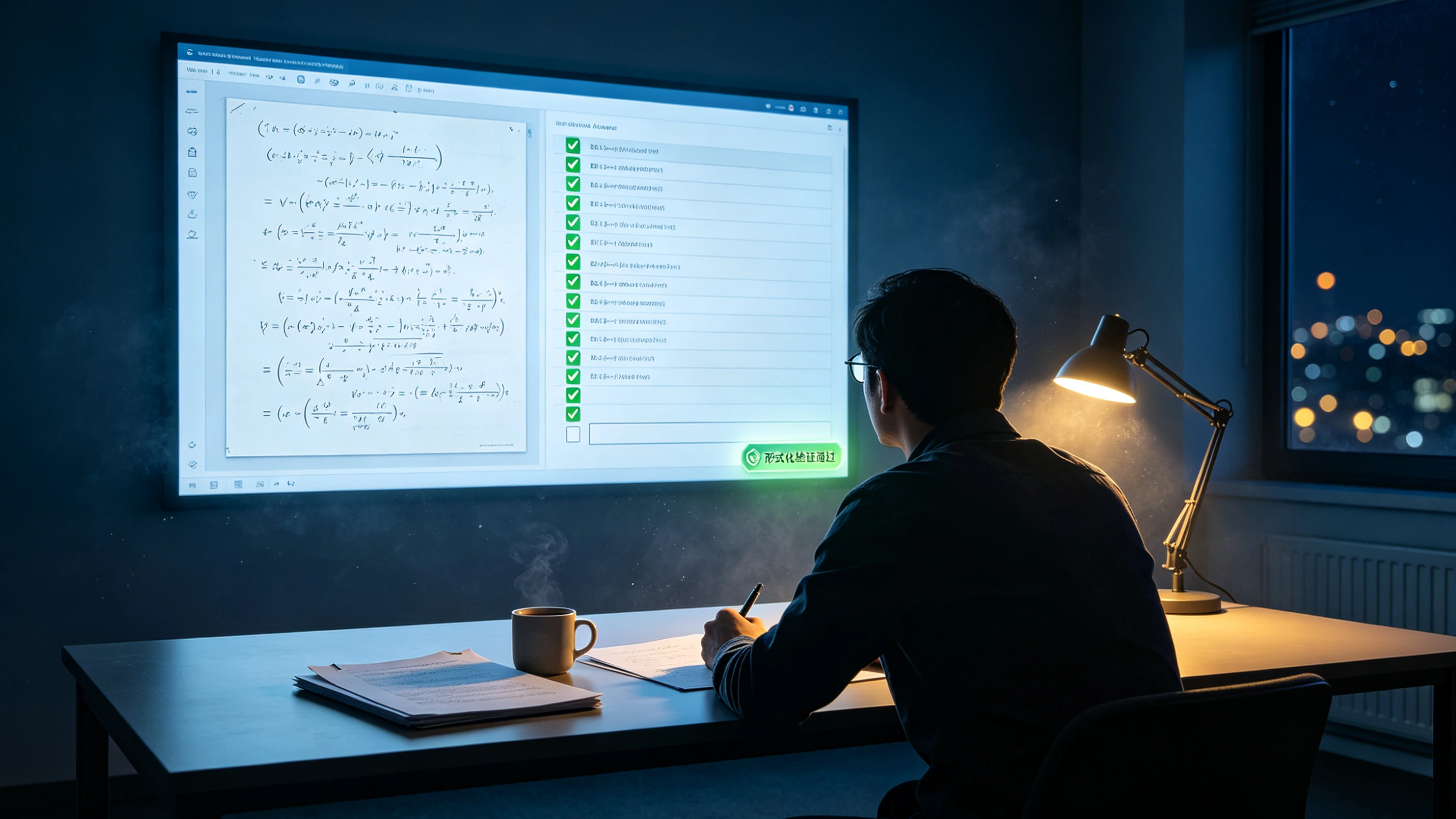
A problem human mathematicians have chased for 284 years was pushed forward by an AI in two days — that sentence is not in dispute; whether it holds is. On the afternoon of September 20, anonymous math community account Captain Sude announced on X that GPT-6 Astra had unconditionally proven the Liouville weak form of Goldbach's conjecture: every even number greater than 2 is the sum of two integers with an odd number of prime factors. The proof is two pages long and has been formally verified in Lean 4.
[1][2]Set the epistemic terms first: this is not a peer-reviewed paper. It is a mathematical claim posted by an anonymous account, backed by a Lean 4 formalization that others have independently reproduced. The evidence chain: ① the proof is two pages, and the Lean 4 formalization passes with zero "sorry" and zero custom axioms — every step machine-checked; ② a user on Zhihu independently recompiled the open-sourced code and ran numerical checks on 249 even numbers; ③ the previous best result for this proposition was a conditional proof by Alexander P. Mangerel of Durham University under the Generalized Riemann Hypothesis — removing that assumption is a genuine advance. The classic Goldbach conjecture (two primes) remains open; what Astra proved is the weakened version where "prime" is relaxed to "integer with an odd number of prime factors."
Why take this seriously rather than dismissing it as another AI marketing item? "Zero sorry in Lean 4" is hard currency: formal verification means every inference has been machine-checked, with no "obviously" gaps that human papers smuggle in. Independent recompilation turns the verification from self-reporting into a community-reproducible test. Contrast this with earlier GPT-6 Astra math milestones — solving Erdős problems on the FME benchmark, or the prime-gap work in openai/PrimeGaps186 — which leaned on lab self-reports; here the key evidence, the Lean 4 file and the numeric checks, is public and independently checkable.
But "passes Lean 4" is not "accepted by mathematics." Formal verification confirms the proof code is internally consistent; it does not by itself confirm that the proposition is mathematically meaningful with no hidden definitional trap. A two-page proof asserting a universal claim over all even numbers still needs mathematicians to read it and confirm the reduction never changed the question. History has cases of machine-checked proofs that remained contested. Also, the claim comes from an anonymous community account, not from OpenAI; the company has not commented, and Captain Sude's identity — and the project's relationship to OpenAI — is undisclosed.
Put those together and you get a clean judgment: this is one of the most interesting AI-math events of 2026, but its "confirmed" and "pending" lists matter equally. Confirmed: a large language model produced a machine-verifiable two-page proof that the community can independently reproduce. Pending: until mathematicians finish reading it, it cannot be called a solution to Goldbach. The signal worth tracking over the next few weeks is the formal review — not the cheering in the comment sections.
[1][2]