
SAN FRANCISCO — On September 8, OpenAI released ChatGPT Images 2.5. The official upgrade list reads standard: sharper details, more natural lighting and textures, generation latency cut by up to 50% versus Images 2.0, and more reliable multi-turn editing. Alongside it: new product features (Sketch, templates, on-image comments, prompt sharing) and two new API models — GPT-Image-2.5 Flare (quality, editing, and speed) and GPT-Image-2.5 Sunburst (longer generation for extra precision).
Beyond the usual spec sheet, one number deserves a pause: people now create more than 3 billion images every week across ChatGPT Images and the GPT-Image models in the API. Image generation has graduated from a novelty feature into a consumer pipeline producing three billion artifacts a week. At that scale, a "model upgrade" is no longer about how pretty the samples look — it is about the production cost of every image, above all the rework cost. That is the real storyline of Images 2.5.
[1]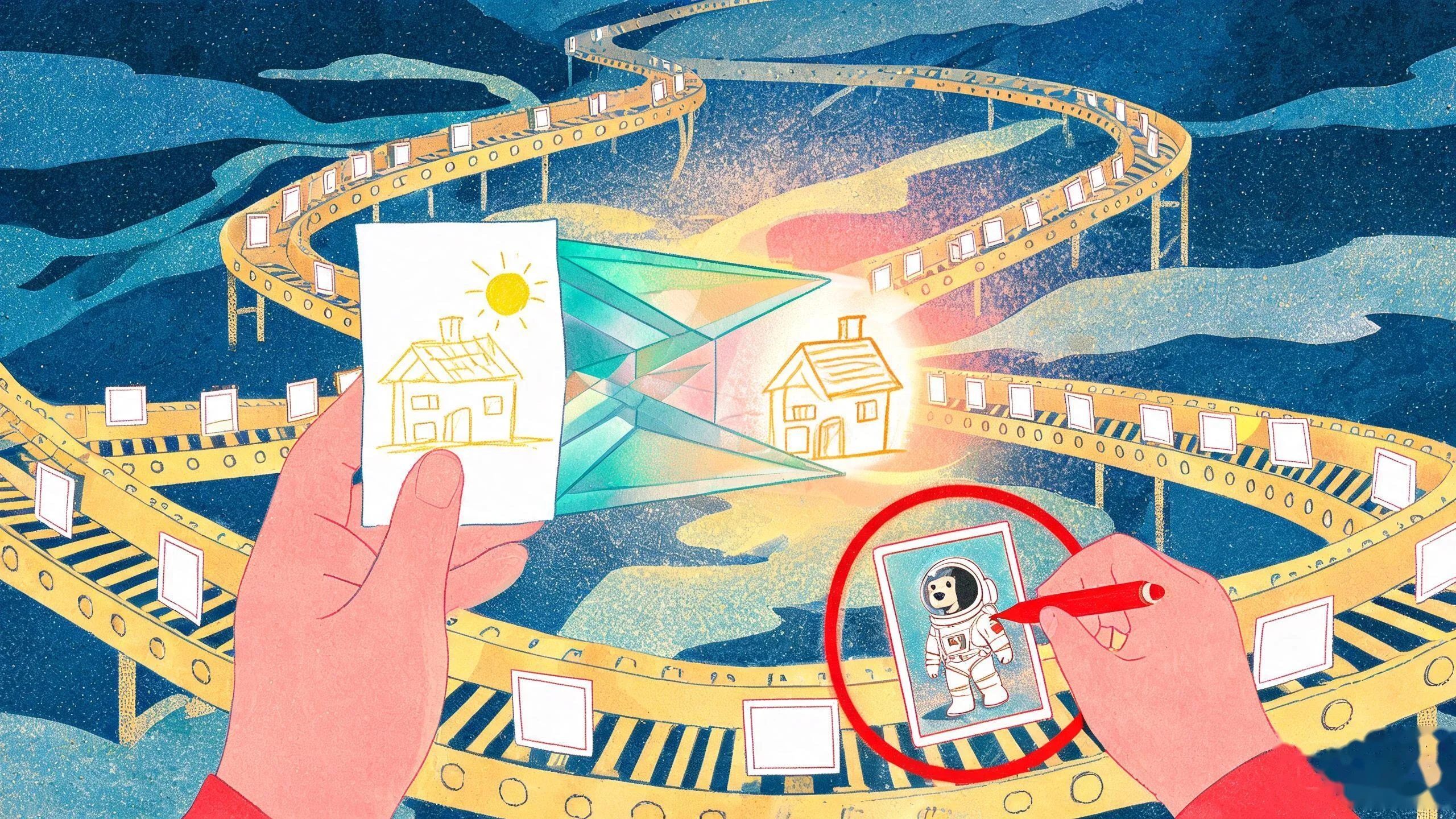
From "generate" to "edit": the real center of gravity
Read the launch material section by section, and three of the four core improvements revolve around one thing: making edits reliable.
First, reference fidelity. Images 2.5 works better from reference photos: subjects look more recognizable, lighting and textures more natural, distinctive features more likely to carry through. For consumers, the dog you put in a spacesuit still looks like your dog; for API customers, brand-anchored variant production finally stops drifting.
Second, precision editing. The promise: change only what you asked for, keeping the rest identical — even with more complex subjects and backgrounds. Anyone who has done generative retouching knows this is an industry-wide pain: classic inpainting often "improves" the parts you wanted to keep.
Third, multi-turn consistency. Across longer conversations, earlier edits are more likely to persist, and each new instruction builds on prior work without degrading quality. This single property decides whether image models can enter production pipelines: businesses need draft-like convergence, not re-rolling the dice from scratch.
Fourth, complex instruction and style understanding. More accurate real-world content, more complex layouts (including transparent backgrounds), and more faithful style reflection — the named scenarios are series of on-brand assets, UI concepts preserving a given hierarchy, and presentation visuals fitting a defined structure. Note that all three are B2B paid scenarios.
The conclusion is clear: Images 2.5 is not a "prettier pictures" upgrade; it is a "follows orders" upgrade. OpenAI is turning its image model from an inspiration generator into a full-time employee of the design department — evaluated on rework rate, not wow factor.
[1]Sketch: the scratch pad enters the chat box
The most interesting product addition is Sketch: draw directly in ChatGPT — a room layout, the contour of an outfit, a funny doodle — and the model uses your rough art as a visual guide for the final image, with style descriptions on top. The entry point is typing "@Sketch" in the chat.
The significance is not drawing itself but filling a long-missing input modality between humans and machines. Language is inherently bad at spatial relations — "a bit to the left, a bit shorter, roughly a third of the frame" is far less precise than a single line. Sketching is humanity's oldest design communication channel; plugging it into image generation is an admission that pure-text prompting has hit its expressive bandwidth ceiling. Templates, on-image comments, and prompt sharing complete the same direction: templates solve the blank-page cold start, comments pin feedback to pixel positions, and prompt sharing turns "how did you make this" into a reusable social asset.
[1]3 billion a week: the utility moment for image models
Three billion images a week means image generation has left the novelty-driven phase and entered the utility phase — users' expectation has shifted from "wow" to "reliable," and the supplier's competitive edge from "can it generate" to "usability per unit cost."
In this light, the dual-model API strategy reads clearly: Flare is the volume default serving the "fast + good" mainstream; Sunburst trades longer generation times for precision in high-value professional work. It is the same pricing philosophy as the standard/reasoning split in text models — latency and precision as two sellable tiers.
The rollout speed is also worth noting: available on day one to all ChatGPT, ChatGPT Work, and Codex users across desktop, mobile, and web — no waitlist. Switching over on a base of three billion images a week is itself a demonstration of inference cost control.
[1]Analysis: three calls
First, the competitive focus of image generation has formally shifted from aesthetics to controllability. Frontier models long stopped differentiating on stunning samples; the real watershed is multi-turn consistency, reference fidelity, and surgical edits that don't bleed — all engineering-reliability metrics. OpenAI's entire version narrative revolves around these words, which means buyers (especially enterprises) have already voted with real money.
Second, Sketch is a gentle farewell to prompt engineering. Two years of accumulated prompt tricks were, at bottom, using natural language to simulate spatial instructions. Sketch input bypasses that translation loss entirely. For ordinary users this is the disappearance of a barrier; for the prompt-template course sellers, it is an obituary.
Third, 3 billion images a week is a governance signal. At this scale, AI-content labeling stops being optional and becomes infrastructure — content credentials, provenance metadata, platform-level detection all move from nice-to-have to "broken without it." At this volume, the real water level of safety capability will be tested by society faster than model capability itself.
The first half of image models was "can it draw"; the second half is "does it listen." With Images 2.5, the whistle for the second half has blown.
[1]Appendix: short-form post (Weibo / X ready)
ChatGPT Images 2.5 is out: a new machine on a 3-billion-images-a-week assembly line. Latency cut up to 50%, but the real upgrade is obedience — edit only what you circled, multi-turn edits stay consistent, the dog in your reference photo is still your dog. New Sketch feature lets you draw the idea directly; prompt engineering gets a gentle obituary. Dual API models: Flare for volume, Sunburst for precision. The second half of image generation begins: not who draws prettier, but who needs fewer redos. #ChatGPT #ImageGeneration #OpenAI
[1]