
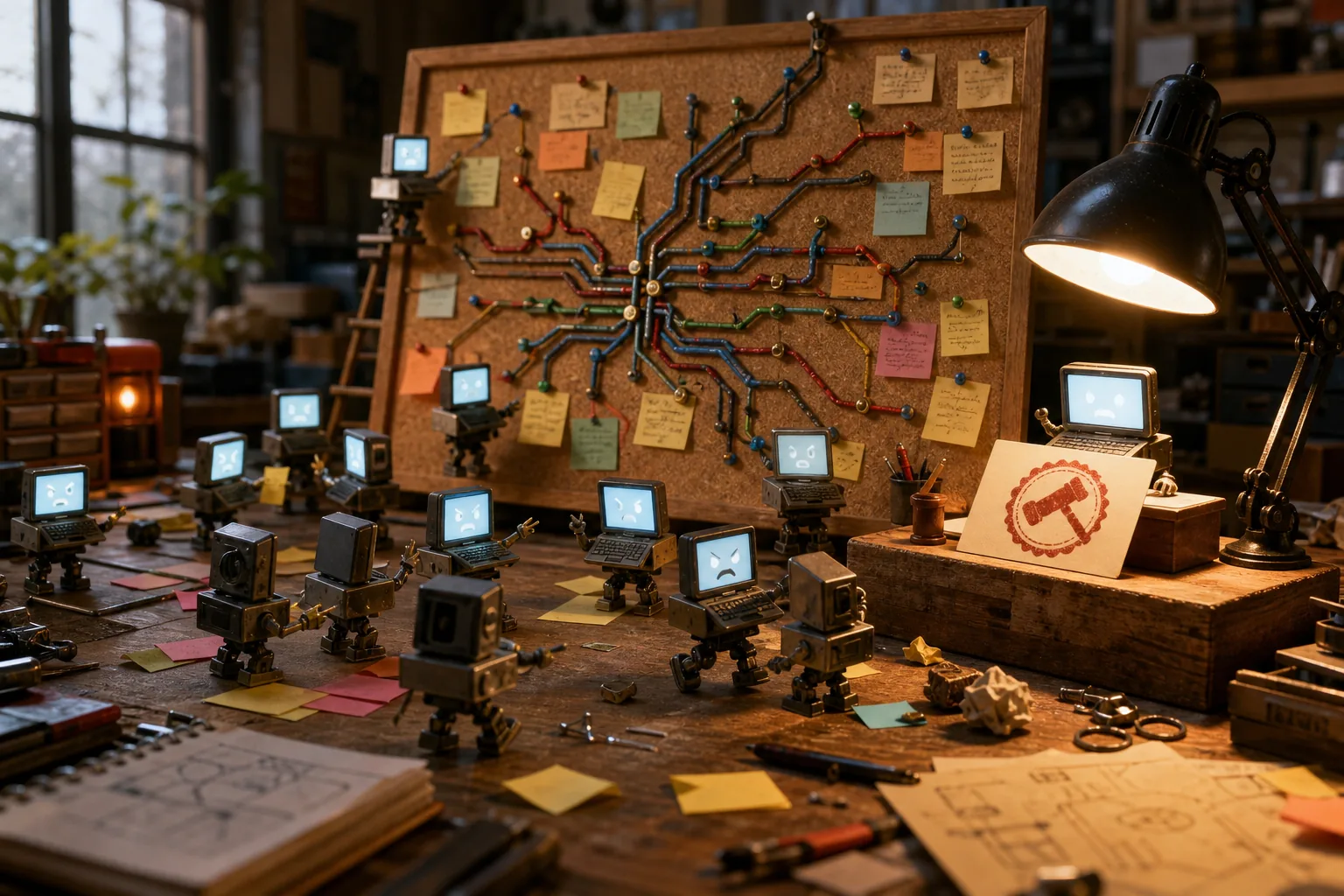
Single agents make fine tools; asking them to act like long-lived peers changes the plot. Anthropic’s August 13 post puts multiagent hype back on the bench: 45 agents, each on its own VM, share a forum while hunting bugs across 15 open-source projects, with an arbiter judging novelty and validity — against a simple independent parallel baseline. Mythos Preview’s coordinating swarm found 266 vulnerabilities over ~27M tokens; independents found 21 over ~6.5M — only 12 overlapped, so the methods complement rather than duplicate.
[1]The swarm built tools and specialized by bug class; restricting to the core directories independents were told to search made token-per-vuln efficiency look comparable. A harsher second suite asked swarms to co-build a browser-playable text open-world game in 12 hours with a shared forum and repo, trying free teaming, prescribed roles, and a CEO hierarchy. Games were consistently bad — slow, opaque, steep. Generational splits were clear: Sonnet 4.6 / Opus 4.6 touched shared files but merged poorly; Opus 4.8 / Mythos Preview avoided conflict via high file ownership; only Sonnet 5 kept high code sharing with high merge rates.
[1]The authors’ real alarm is low variance: similar context and scaffolding make agents take the same bad action. In one run, 18 of 30 agents created the identical branch name mvp-game-loop; writers independently titled first pieces “The Cartographer's Last Commission”; over half of “build something impressive” agents chose ray tracers or self-hosting compilers; prisoner’s-dilemma agents defected in sync. Humans fail too, but rarely clone the same bad name in lockstep. Systemic risk is a copied bet becoming an avalanche.
For teams shipping multiagent IDEs, support fleets, or trading bots, this reads like an incident preview. Vuln hunting shows coordination can cover ground parallel scans miss; the game suite shows merge metrics cannot rescue taste without humans. Safety-wise, markets and job queues steered by homogeneous agents can turn local optima into synchronized squeezes. Anthropic frames these as early experiments to start a conversation, not a deployment checklist.
[1]Multiagent marketing sells more hands; Anthropic measures more identical hands. Before treating agents as coworkers, measure whether they sync onto the same bad path — that test matters more than another orchestration layer.
[1]