
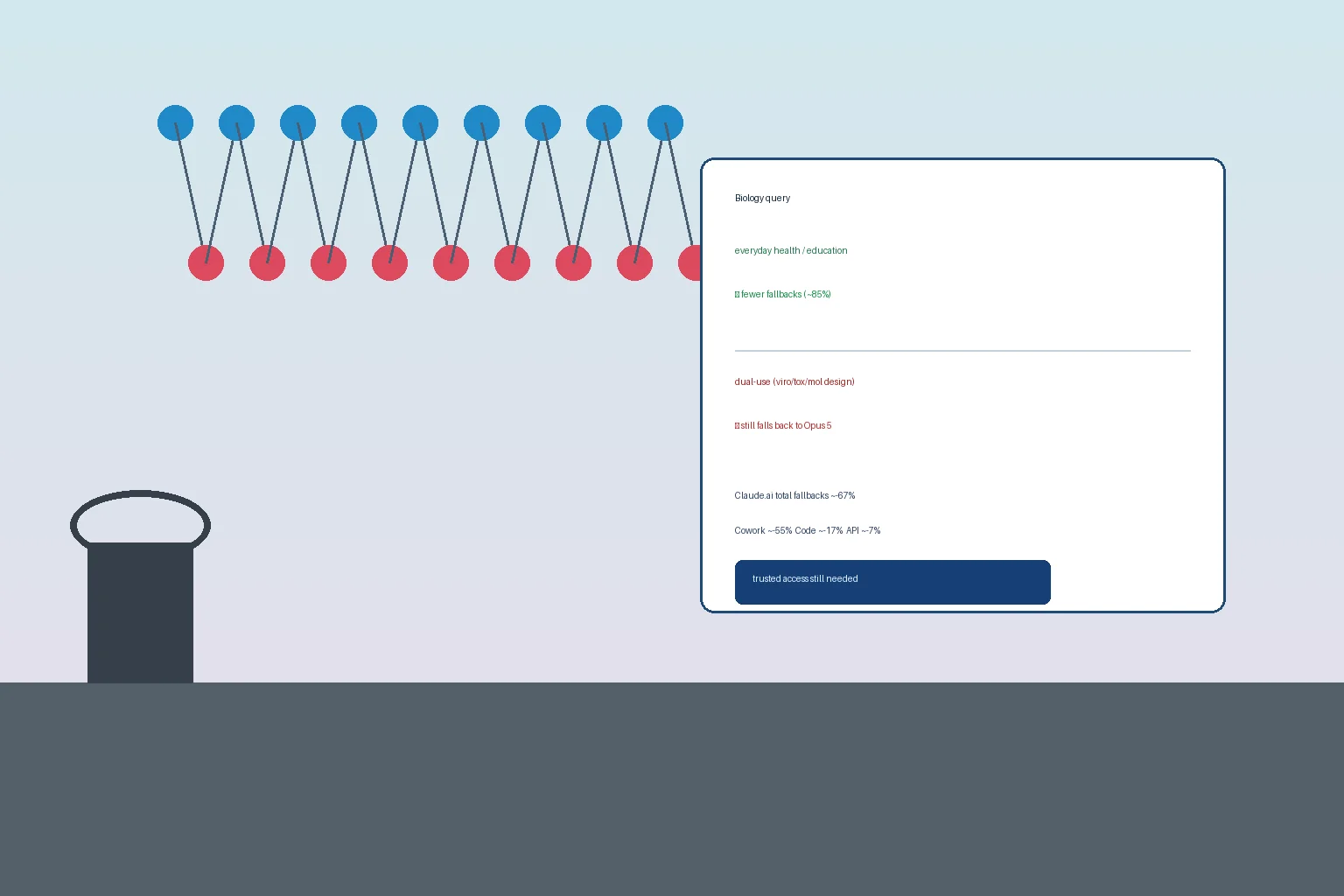
On August 7 Anthropic did not loosen Fable 5’s biology capability so much as its false positives. Improving Fable 5's biology safeguards reports ~85% fewer biology-related fallbacks (routing to a weaker model), and total fallbacks down ~67% on Claude.ai, ~55% on Cowork, ~17% on Claude Code, and ~7% on the Platform.
Users should feel it on everyday health and education prompts. The same post is explicit: dual-use requests—virology, toxicology, molecular design—still fall back to Opus 5; professional biology research and drug development still await a trusted-access pathway.
[1]What changed—and what did not
The stated goal is blunt: get Fable 5 to as many users as possible, as fast as possible, while managing biological risk. Assessments say Fable 5 can outperform experts on some hard biology tasks and offer operational support—valuable for medicine, and an uplift malicious actors cannot easily find elsewhere.
Benefit and harm often share methods: live vaccines require growing pathogens; captopril’s story begins with blood-pressure-crashing snake venom. Adversaries exploit that ambiguity. Strong classifiers were the answer; false positives were the tax—benign biology kicked to weaker models.
This update targets that tax. The dual-use door stays shut; trusted access remains an unfinished product promise.
[1]How to read the fallback math
Author’s judgment: 85% is a relative drop in biology-related fallbacks, not a full unlock of biology capability. Uneven total-fallback drops across surfaces suggest Code/API traffic was never dominated by bio false positives; chat and Cowork gain most.
Keeping dual-use on Opus 5 is an explicit compromise: everyday health opens, frontier wet-lab work stays gated. Friendly to clinical education; still insufficient for biotech research teams.
[1]Product and competitive meaning
For Claude.ai / Cowork users, this is a UX patch. For Platform developers, a 7% total-fallback drop hints API traffic had fewer false trips—or a different mix. For teams hoping Fable will design proteins and drugs, the binding clause is still trusted access—without a named, auditable pathway, capability stories never reach the bench.
Competitively, every lab is stuck between bio capability and biosecurity. Publishing a false-positive fix, not only RSP slogans, helps buyers check how often the model quietly downgrades.
[1]Columnist view
The post’s honesty is pairing “fewer false trips” with “dual-use still gated.” Drop the first, and it looks incompetent; drop the second, and it looks reckless. The real product question is when trusted access becomes an apply-able, auditable channel—who qualifies, who owns logs, who can stop misuse.
Treat 85% as a chat-experience metric, not a safety-boundary metric. Boundary metrics remain: dual-use classifier robustness, whether Opus 5 fallback can be social-engineered away, and whether trusted access brings independent evals. If the pathway is still “we are committed” in 6–12 months, this was only a classifier tune-up note.
[1]