
Unsloth’s documentation page says MiniMax-M3.1-Flash can be run locally with Unsloth Dynamic GGUF files. It describes the model as MiniMax’s new 428B mixture-of-experts multimodal model, with 23B active parameters and a 1M context, built for coding and agentic use. The page markup records a last-updated time of 2026-10-26T14:34:36.230Z beside the visible label Last updated. The page does not print a separate announcement clock. The figures below are measurements and planning numbers on this docs page. They are not sentences from a MiniMax launch post. The opening also thanks MiniMax for day-zero access and does not turn that phrase into a clock.
[1]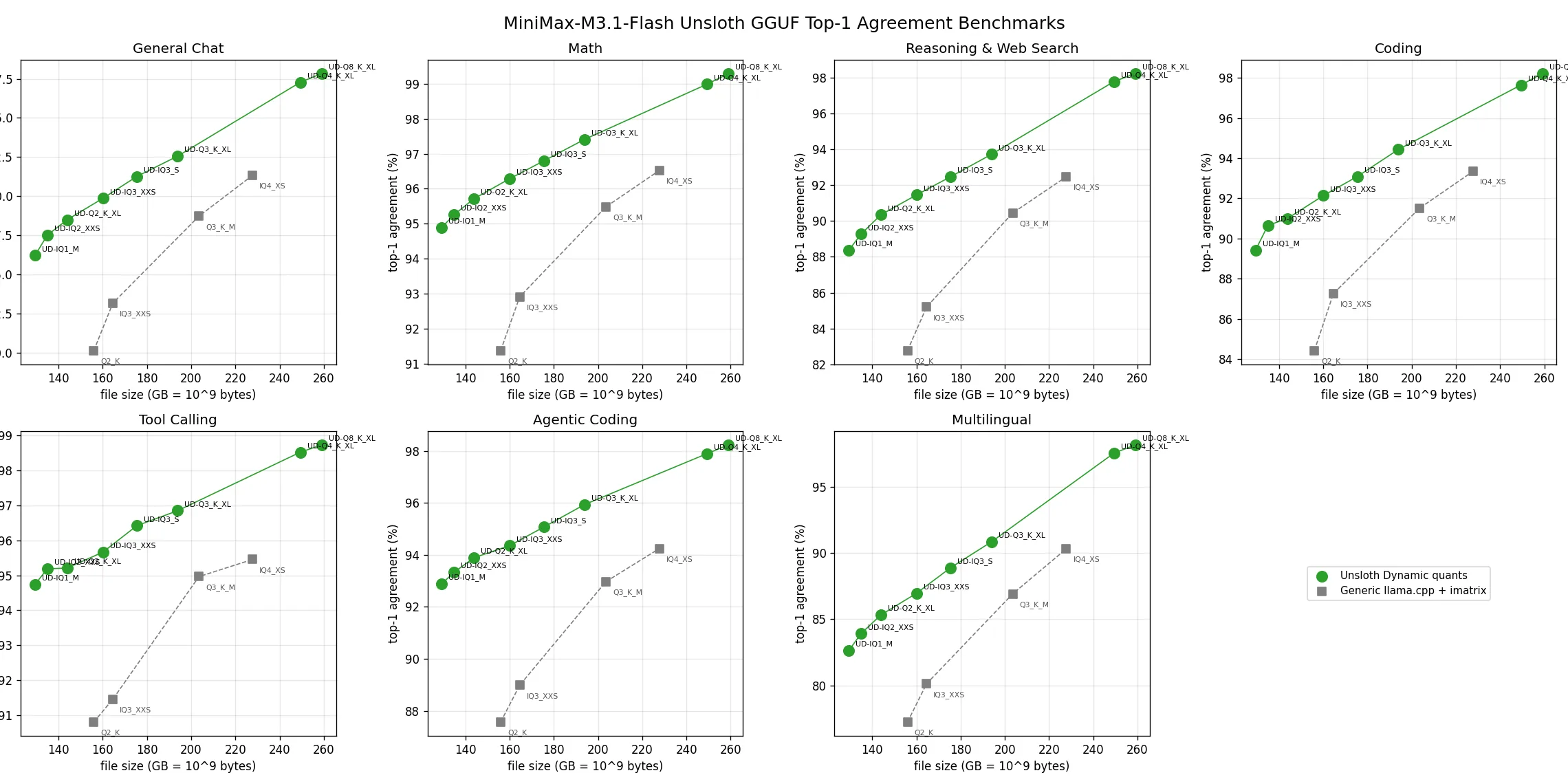
The opening states three weighted figures. A 129.4GB 1-bit file reaches about 89.9 percent top-1 accuracy. A 143.9GB 2-bit file reaches 91.5 percent. A 249.4GB 4-bit file, UD-Q4_K_XL, reaches 98.0 percent. On coding, Q2 reaches 91.2 percent and Q4 reaches 97.6 percent. The page says the weighting runs across seven categories: coding, math, chat, tools, multilingual, reasoning, and agentic use. That 91.5 percent is the weighted result across those seven categories. It is not yet a figure taken from any single column alone in the table printed later on this page.
[1]A later table on the same page is labeled top-1 agreement, not the opening’s top-1 accuracy. UD-IQ1_M is listed at 129.4GB, with 86.2 percent on general chat and 94.9 percent on math. UD-Q2_K_XL is 143.9GB, with 88.5 percent on general chat and 95.7 percent on math. UD-Q4_K_XL is 249.4GB, with 97.3 percent on general chat and 99.0 percent on math. Another sentence gives ranges: UD-Q2_K_XL reaches about 85.3 to 95.7 percent top-1 agreement across the seven categories, and UD-Q4_K_XL about 97.3 to 99.0 percent. The page then says the reported values are approximate graph readings. The 91.5 percent figure sits inside the 2-bit range. It is not the table’s 88.5 percent for general chat, and it is not the table’s 95.7 percent for math. The page does not say whether the opening accuracy and the table’s agreement are the same calculation. Treating 91.5 percent as the score in every column does not match the page.
[1]Memory is written twice. The hardware table lists 134GB for 1-bit, 150GB for 2-bit, 176GB to 208GB for 3-bit, 256GB for 4-bit, and 272GB for 8-bit, and the 8-bit column is marked lossless. The note under the table assumes 16K of text context and one slot, with roughly 20 to 32 GiB above the weights. A separate sentence says to budget 160GB or more of RAM plus VRAM for 2-bit UD-Q2_K_XL, and 256GB or more for 4-bit. For 2-bit, the table says 150GB and the prose says 160GB or more. Download size is separate: UD-Q2_K_XL is 143.9GB, with 134.0 GiB of weights. The page also says the full quantized weights still have to sit in RAM and VRAM even though only 23B parameters are active per token.
[1]The page calls UD-Q8_K_XL a direct lossless conversion from the original safetensors. It says the mixture-of-experts layers use NVFP4, the rest use MXFP8, and this file was left at NVFP4 plus BF16. It says the 194.0GB UD-Q3_K_XL beats a generic IQ4_XS of about 230GB on top-1 agreement in all seven categories. The page does not print raw logs for the seven categories, and it does not print the formula behind 91.5 percent. Recommended sampling is temperature 1.0 and top-p 0.95, and the examples use high effort. The page does not say the top-1 figures used those settings. Farther down, a table is labeled as MiniMax’s official results, and the page says scores depend on setup and reasoning effort. That table is not the top-1 agreement table.
[1]