
要点
- The authors split scientific modeling into three repeating steps: build the model's form, constrain its adjustable numbers, and interpret what it says about the real system.
- Hodgkin and Huxley's 1951 nerve-cell equations needed a fourth-power term because simpler versions fit worse. Decades later a related potassium channel was found to have four identical pieces around a central pore.
- Constraining a complex model by listing every plausible parameter set is often impossible. Simulation-based inference trains a network on many forward runs (about 100,000 for a Hodgkin-Huxley-like model, millions for larger ones) so that new data can be inverted in seconds.
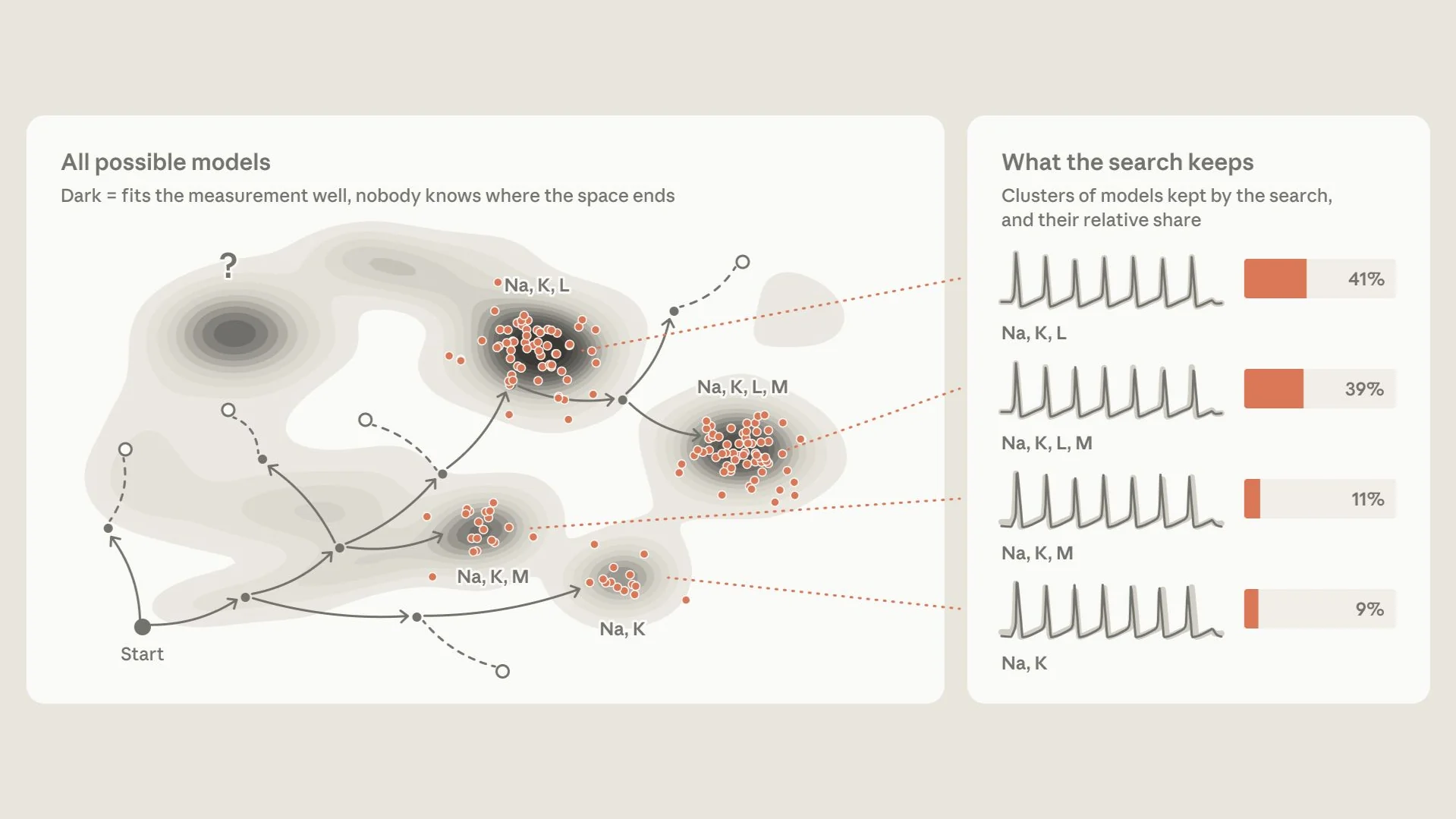
- LLM-based agents can now propose and revise candidate models from data and a natural-language description. The authors say these systems should return a weighted range of models, not one winner.
- Interpretation is the hardest step to hand over. Most such agents have been tested on rediscovering models scientists already know. Evidence that they work on problems with no known answer is still sparse.
On 6 November 2026 Anthropic's research blog published a guest post from Jakob Macke, Daniel Gedon, and Stefan Wahl, who build AI tools for scientific models in neuroscience and beyond at the ELLIS Institute Tübingen and the University of Tübingen. Their hook is an old story. In 1951 Cambridge's computer was down for six months, so Andrew Huxley spent more than three weeks on a hand-cranked calculator checking equations that he and Alan Hodgkin had written for a squid nerve cell. The authors' point is not nostalgia. It is that an AI which could now find a similar fit in an afternoon might still fail to deliver what those weeks produced: knowledge of which parts of the model were forced by the data, and which alternatives had already lost.
[1]What shipped
This is an essay, not a new benchmark table. The authors treat most scientific modeling as three steps that people repeat when the numbers fail or the story stops making sense.
The first step is building the model: deciding what it is made of and what shape its equations take. For Hodgkin and Huxley that meant treating the membrane as an electrical circuit, and raising one variable to the fourth power because a simpler form did not match the recordings as well. They offered a cautious guess, that several charged particles might need to move before a gate in the membrane would open.
The second step is constraining the model, meaning tuning its adjustable numbers to measurements. A single good set of numbers shows that a fit is possible. It does not show whether other sets would have worked as well, or would have made different predictions. The authors compare this to knowing that a dinner bill was 120 dollars without knowing who ordered what.
The third step is interpreting the model: asking what it claims about the real system. Hodgkin and Huxley's four-particle idea only carried weight because weaker powers had not been enough. Later, after both men had shared the 1963 Nobel Prize in Physiology or Medicine, another team found that a related potassium channel protein had four identical pieces around a central pore. The 1951 equations had not been fitted to that structure, yet they had pointed toward it. The authors quote Richard Hamming from 1962: "The purpose of computing is insight, not numbers."
Machines have come furthest on the second step. Standard Bayesian inference would return every parameter set that works reasonably well, shaped by fit and by prior knowledge. For models with many randomly opening channels, listing those combinations is often computationally impossible. Simulation-based inference sidesteps the missing likelihood formula. You pick random parameters, run the model, and record the output, tens or hundreds of thousands of times, then train a network that maps an output back to the range of parameters that could have produced it. All you need is a simulator you can run forward. Once that (expensive) training is done, new data can be inverted in seconds. The authors cite neutron-star collisions, where the method can estimate a rough location quickly enough to point telescopes while the signal is still there, and they note successful use in cosmology, structural biology, geophysics, and nerve-cell models themselves. Because the answer is a distribution, researchers can see which numbers are pinned down, where more than one explanation remains open, and which new experiment would help most.
Building the model is now entering the same logic. The space of possible equations is effectively infinite, and a person proposing a handful from experience will miss others that fit equally well. Several systems from the past two years use a large language model to write candidate model code from data and a verbal description, run it, constrain it, compare it with measurements, and revise it. The authors warn that two runs can return two different, equally good models. Returning only one hides the rest, just as a single best-fit parameter set does. Better, they argue, to propose many candidates, weight them by how naturally the data support them, drop the weak ones, and breed variations on the strong ones. If every surviving model shares a feature, the data likely favor it. If they disagree, the next experiment has a target.
Interpretation remains the hardest to automate. Fit can be scored. Understanding cannot, at least not yet. One proposal is to test whether a system predicts what happens when you disturb the real thing, for example by blocking some of the sodium gates. Another is to ask whether the agent's outputs help human scientists understand the problem, as in an AI that writes a short program generating a family of quantum experiments so a physicist can read the design principle off the program. In both cases a full distribution of suitable models matters, because a single model invites people to read meaning into parts that the data never constrained.
As models grow, compactness will matter less as a human writing limit and more as a limit on intelligibility. The Hodgkin-Huxley equations describe one cell. A fruit fly brain has more than 100,000 neurons, a human brain tens of billions, and researchers now have a complete wiring diagram of the fly's brain. The authors include a rendering from the male central-nervous-system connectome, credited to HHMI Janelia, the University of Cambridge, MRC LMB, and Google Research under CC BY 4.0, showing 1, 10, 255, and 124,635 cells. At that scale there is rarely one correct model. They quote George Box: all models are wrong, but some are useful. The useful question becomes which properties all data-compatible models share. Climate ensembles and maps of which versions of a particle-physics theory remain open at the Large Hadron Collider already work in that spirit.
[1]Evidence on the table
The primary source is the 6 November 2026 Anthropic guest essay itself, with the Hodgkin-Huxley history, the three-step scheme, the restaurant-bill analogy, the SBI description including the 100,000-run scale for a Hodgkin-Huxley-like model, and the fruit-fly connectome credit. Supporting citations in the footnotes include recent LLM model-discovery papers (among them Romera-Paredes et al., 2024; Shojaee et al., 2025; Ma et al., 2024; Novikov et al., 2025; Xia et al., 2026; Ziaei Bideh and Gryak, 2026) and papers on searching distributions of models (Wahl et al., 2026; Mishra-Sharma, 2026; Murphy, 2026). The fly wiring-diagram citations include Dorkenwald et al., 2024; Schlegel et al., 2024; and Azevedo et al., 2024. This page does not present a new head-to-head table in which an agent that returns a distribution beats one that returns a single fit on unseen scientific problems.
[1]Steelman and gaps
Steelman. If many parameter sets or many equation forms can match the same recordings, then handing a scientist one fitted notebook is a kind of hiding. Hodgkin and Huxley could claim something about the membrane because they knew what had not worked. Climate science and collider physics already refuse to collapse that uncertainty into a single run. An AI-for-science stack that only optimizes fit would automate the part Hamming thought was not the point.
Gaps. The authors say clearly that these agents have mostly been tested on rediscovering known models, and that evidence on problems with no known answer is sparse. The post is a guest essay hosted by Anthropic, written by researchers who build the very tools they discuss; it is not an independent audit. Several key quantitative claims about current agents live in the cited papers rather than in new figures on this page. "Understanding" is still not an agreed scoring rule, which is why interpretation is hard to hand over in the first place.
[1]Who should care, and what to watch
Builders of AI tools for science, funders who treat "the model was found" as the milestone, and journalists tempted to write that an agent discovered an equation because the residuals looked small. Watch over six months: whether model-discovery agents start returning weighted ensembles and lists of rejected alternatives by default; whether prizes and benchmarks score those distributions rather than best-fit error alone; and whether anyone shows a clear win on a scientific problem that did not already have a famous answer.
[1]Close
Huxley's three weeks were not wasted calculation. They were a record of what had been ruled out. An afternoon AI fit that does not keep that record can match the data and still leave the scientist unable to say what the system is like. Six months on, either scientific agents ship the surviving models and the failed ones together, or "AI built the model" will keep meaning only that something, somewhere, reproduced a curve.
[1]