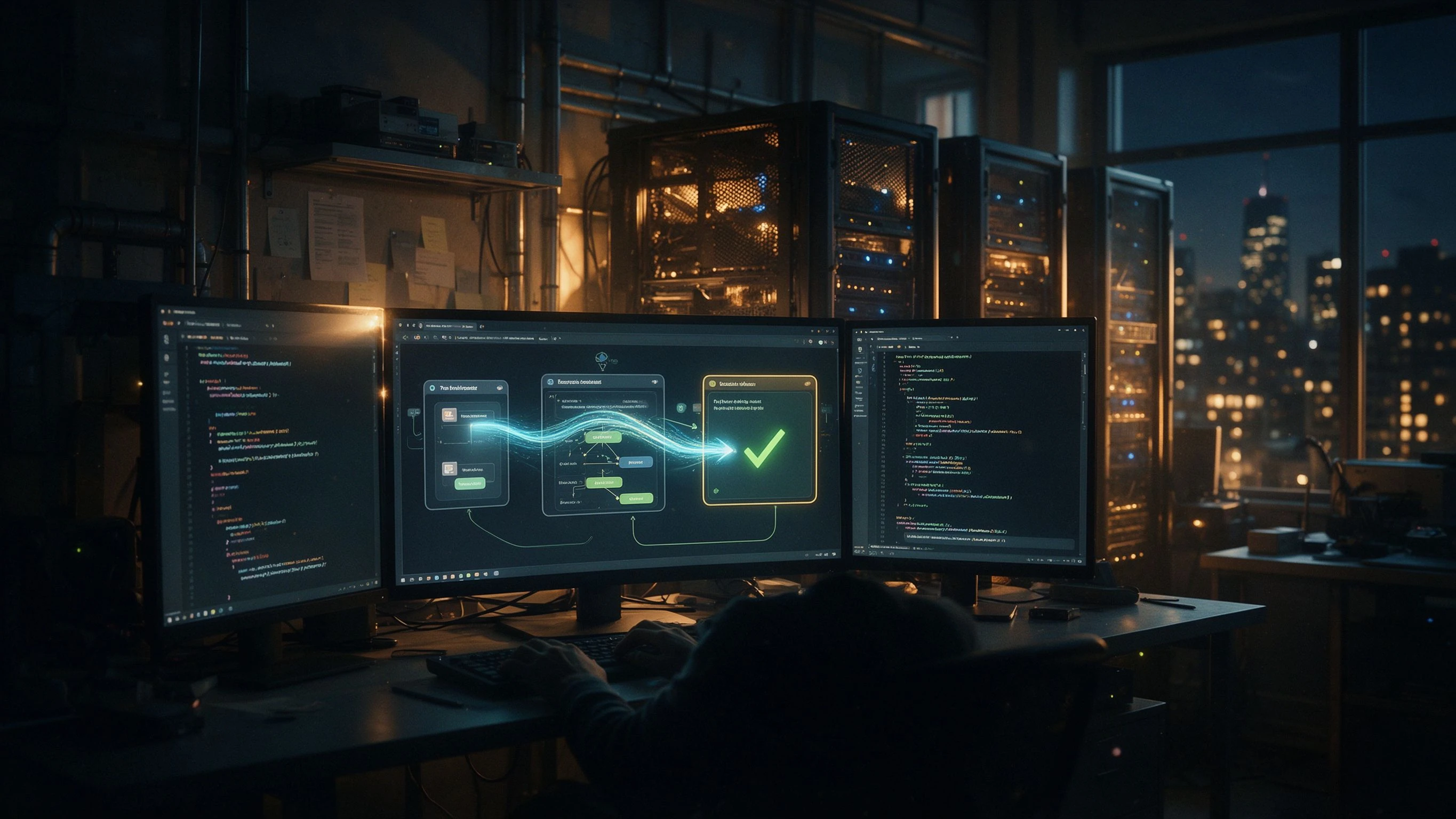
Self-evolving agents train on trajectories they generate themselves. The obvious question—who checks their own homework?—is the subject of “UnifiedPlayers,” a paper posted to arXiv on September 17. The authors propose a cooperative framework with three specialized players: a Planning Player that generates tasks, an Execution Player that produces multi-turn trajectories with Python tool calls, and an Evaluation Player that writes executable verifiers. On two model backbones and twelve reasoning benchmarks, the self-reported results beat the strongest prior baseline by at least 3.5 points on mathematical reasoning and 3.9 points on general reasoning.
[1]The paper starts from a bottleneck in agent training. Tool-using agents need realistic trajectories—tool calls, observations, error recovery, final decisions—and hand-annotating them at the scale reinforcement learning requires is expensive. Self-generated data is the standard answer, but existing methods usually split trajectory generation from evaluation. Static verifiers cannot adapt to failure modes that emerge mid-training; self-consistency signals can reinforce errors shared across trajectories, because several wrong answers agreeing with each other is not the same as being right.
UnifiedPlayers tries to improve planning, execution, and evaluation together, which runs into a problem the authors call cyclic interdependence: each component continuously changes the data or feedback used to train the other two. A planning policy shifts the task distribution; execution changes the resulting trajectories; evaluation alters the rewards that guide both. Left uncoordinated, this can degenerate—planning favors easy, repetitive tasks; execution learns confidently wrong trajectories that the evaluator accepts; evaluation collapses to trivial rules that accept or reject everything.
The paper's mechanism: optimize one player at a time with GRPO while keeping the other two fixed, and coordinate all three through a shared “verdict matrix.” For each task, a fixed perturbation engine generates adversarial trajectory variants, and a sandbox executes every verifier against both original and perturbed trajectories. The resulting matrix is executable evidence of whether a task is verifiable, whether a trajectory is correct, and whether a verifier can discriminate. Each player reads this matrix differently to build its role-specific reward, and the Evaluation Player gets an extra code-diversity term to avoid repeating similar verifier patterns.
Results are reported, not externally confirmed. The learned verifier reaches 84.2 percent adversarial detection accuracy, and its reward signal shows 2.03 times the per-question variance of a self-consistency baseline—more discriminative, in other words. Factorial comparisons attribute 2.5 and 2.3 points of Qwen3-4B-Base's gains to effective planning and 3.3 points on both tracks to evaluation; fresh feedback outperforms previous-iteration feedback by 1.5 and 1.7 points. The authors are transparent that these are pre-print numbers from two mid-size backbones, not peer-reviewed results on frontier-scale models.
The paper sits in a crowded line of work on self-evolving agents—AReaL-SEA generates interactions with per-instance executable verifiers; Agent0 trains a curriculum policy and an executor under GRPO but keeps its supervision self-referential, rewarding the executor with its own self-consistency and tool-call frequency. UnifiedPlayers's contribution is to make evaluation itself trainable and shared: instead of deriving feedback from the executor's outputs or an LLM judge, it grounds rewards in executable evidence. That is a modest but real step past the loop in which a model's own confidence is the only feedback.
[1]