

要点
- Google DeepMind announced AlphaGenome 2 on 11 November 2026 as a conditional DNA model that predicts variant effects for one tissue, cell type, or cell state at a time.
- On TenK10K, a map of 28 primary immune cell types, it identified 30% of causal variants against 16% for the previous AlphaGenome fine-tuned on single-cell data, and 43% of directional gene effects against 23%.
- The company says the model was trained on more than 107 million individual cell profiles from human and mouse samples, spanning 68 tissues, and now also predicts DNA methylation.
- DeepMind reports that the model reproduced a published finding that a distant regulatory variant drives IBD by overactivating ETS2 in gut macrophages, and that, given unseen COVID-19 vaccine single-cell data, it distinguished activated T cells from resting ones.
- AlphaGenome 2 is available today for non-commercial research via the AlphaGenome API, and in private preview for commercial research. It is intended for research use only and has not been validated or approved for clinical or diagnostic purposes.
Google DeepMind released AlphaGenome 2 on 11 November 2026. The model takes a million-letter stretch of DNA and a target biological condition, then predicts how that sequence, and variants in it, will be read in a given human cell type. The claim that matters is narrower than a general leap in genomics. Tissue-average models miss variants that act only in particular cells. DeepMind says a model that conditions on one cell state at a time nearly doubles the share of causal variants it can recover on a large immune-cell map.
[1][2]What shipped
Last year DeepMind launched AlphaGenome to predict how DNA variants affect molecular activity across broad tissues, and later published AlphaGenome Atlas with predictions for all 9 billion possible single-letter DNA changes. AlphaGenome 2 is the successor, moving from tissue averages to individual cell types and cell states, with a redesigned architecture.
The first model took a million-letter sequence and predicted properties from many tissues at once. DeepMind says that parallel setup spread the model's capacity thin and made it hard to tell closely related cell types apart. AlphaGenome 2 is a conditional model. Beside the DNA sequence, it takes the target condition, a tissue, cell type, or state, as an input at every stage, and predicts effects for that condition only.
The training mix includes bulk and single-cell data from human and mouse samples, including more than 107 million individual cell profiles across 68 tissues. The model still predicts gene expression, histone modifications, and chromatin accessibility. It also predicts DNA methylation, which the company says researchers had asked for. A conditional design also lets the model impute missing experimental measurements. Given one readout, such as single-cell gene activity, it can predict another, such as chromatin accessibility.
The model is available for non-commercial research through the AlphaGenome API, with interactive Colab tutorials for expression conditioning. Commercial research is in private preview. DeepMind says Skills for the model will later appear in Google Antigravity, its agent development platform. The same post states that AlphaGenome and AlphaGenome 2 are for research use only and have not been validated or approved for clinical or diagnostic purposes.
[1][2]The numbers, and what they are not
The headline comparison is on TenK10K, a large single-cell map of 28 primary immune cell types. DeepMind says AlphaGenome 2 identified nearly twice as many causal variants, 30% against 16%, and nearly twice as many directional gene effects, 43% against 23%, as the original AlphaGenome after that earlier model was itself fine-tuned on single-cell data, and as other specialized tools. "Nearly twice" is a relative gain from a low base. Even at 30%, most causal variants in that evaluation are still missed.
The company also says that, on genome regions held out from training, the new model explains more of how gene expression differs across cell types within a tissue, including continuous changes as human blood stem cells mature into red blood cells and immune lineages. A figure on the post compares observed expression of several genes across hematopoietic cell types with predictions from both model generations.
Two worked examples carry a lot of the persuasive weight. DeepMind says a recent study showed that a variant in a distant regulatory switch drives inflammatory bowel disease by overactivating the ETS2 gene in gut macrophages. AlphaGenome 2, asked to predict across immune cell types in the gut, singled out that variant and the cell type, and left other cells and genes largely unaffected. In a second example, researchers gave the model unseen single-cell data from a COVID-19 mRNA vaccine study. The model distinguished vaccine-activated T cells from resting ones, and indicated that a variant linked to severe COVID-19 disrupts gene activity more strongly in the activated state, an effect that would be missed in unactivated cells.
Those examples are illustrations, not a clinical validation set. The TenK10K comparison is the checkable number. It is also limited to immune cells, and the main baseline is DeepMind's own previous model.
[1][2]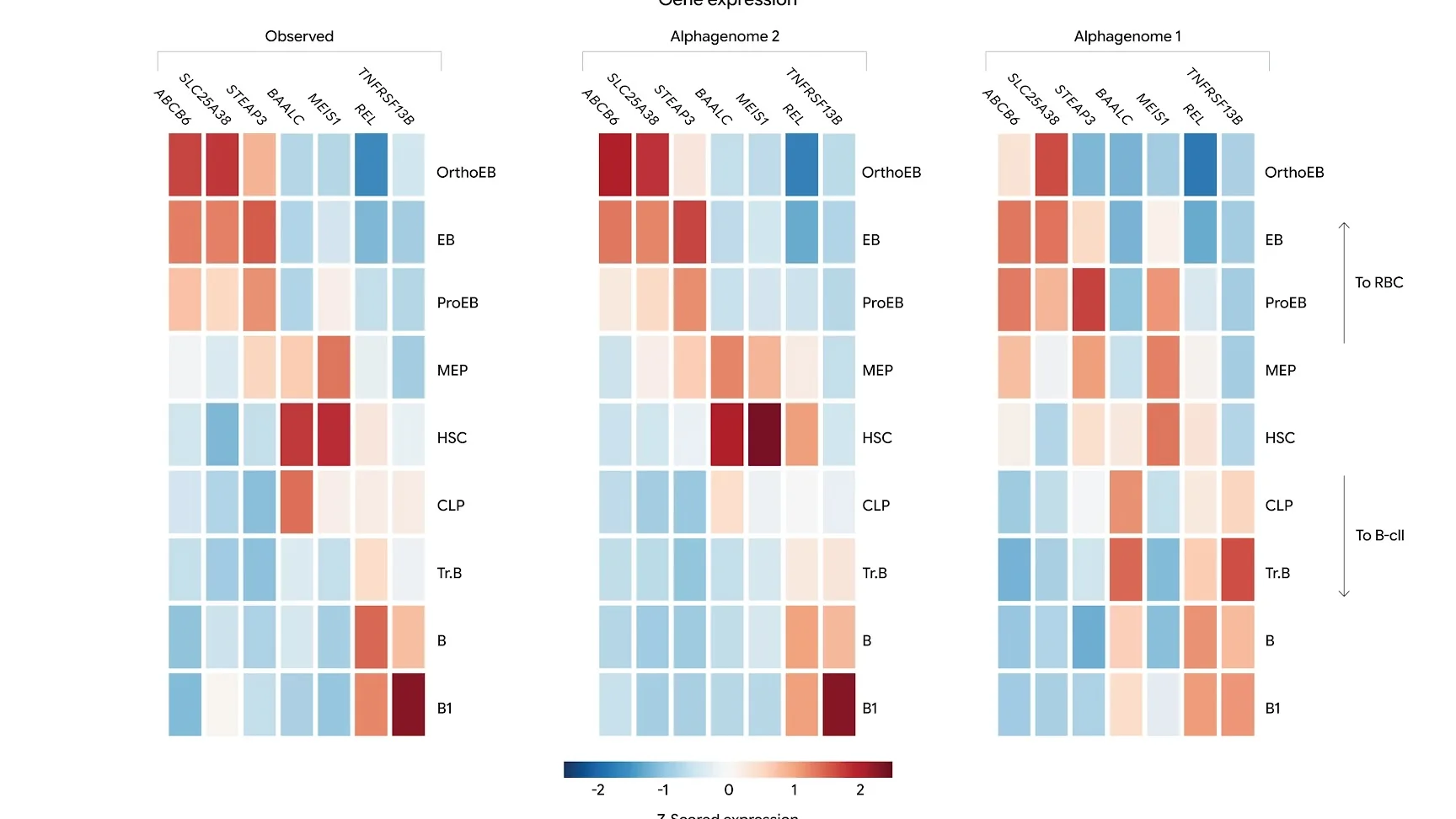
Why conditioning is the actual design bet
The mechanism is easy to oversell as "the model got bigger and saw more cells." The design bet is different. By forcing the network to predict one condition at a time, and by feeding that condition through every stage, the model is supposed to learn how the same stretch of DNA is read differently across cells, instead of averaging those differences away.
That same split, between a cell's state and the molecular outputs, is what lets the model generalize to new experiments without retraining, according to DeepMind. A scientist can upload a single-cell RNA-seq snapshot from a few dozen cells. Gene activity is compressed into a cell-state representation, which then conditions the model on a state it has not seen. The company says this can match or outperform models trained or fine-tuned directly on those datasets. If that holds outside DeepMind's examples, it would matter for disease or vaccination states that do not exist as labeled training slices.
The post also describes precomputed scores for trait-associated variants across hundreds of human cell and tissue conditions. The aim is to help with two bottlenecks. One is linking distant enhancers to target genes in primary human cells, such as brain astrocytes. The other is narrowing genome-wide association study hits, often called GWAS hits, to a likely causal variant, gene, and cell type, and, when the model is confident, whether the variant turns activity up or down. Those are research aids. They are not a substitute for experimental follow-up.
[1][2]What the post does not settle
The results are reported in a company blog, not in a paper with a full methods section, supplementary tables, and an independent review process that a reader can inspect today. The main quantitative gain is against DeepMind's previous model and unnamed "other specialized tools," on a single immune-cell resource. We are not shown a public, third-party leaderboard.
Absolute recall remains modest. Identifying 30% of causal variants is a real improvement over 16%. It is not a solution to the mapping problem. Predictions for unseen cell states are demonstrated with selected examples, including a COVID-19 vaccine study. That is not the same as a pre-registered test across many disease atlases.
The clinical line is correctly drawn and should stay drawn. The post says the tools have not been validated or approved for clinical or diagnostic use. A model that can propose which cell type a variant acts in is still a hypothesis generator.
[1][2]The fair objection
A reasonable reply is that tissue-level models are not a mistake. Many disease signals may act broadly enough that a tissue average is the right grain, and cell-type resolution can add noise when the underlying maps are sparse or batch-affected. On that view, doubling recall on one immune atlas does not prove that every genetics program should move off tissue models.
The objection has force, and DeepMind does not claim a clinical system. What it does claim is more limited and more interesting: some variants of real disease relevance are invisible in a tissue average because they act in a minority cell, or only after a state change such as immune activation. If later independent work on TenK10K and on other atlases keeps a gap of that size, the tissue-average default will look incomplete, even if it remains useful.
[1][2]Who can use it, and who still pays for experiments
The immediate users are researchers who already have single-cell atlases and GWAS catalogs and need a way to choose which variant, gene, and cell to test next. DeepMind says it has precomputed scores across hundreds of conditions, covering traits from height to type 2 diabetes, and that it is working with groups including researchers at the Wellcome Sanger Institute to profile more cell types and perturbed states. It is also inviting use-case submissions by 30 November, with possible extra API quota for selected projects.
The cost of being wrong is still an experiment, not a diagnosis. If laboratories start treating these scores as a shortcut past CRISPR screens or functional assays, they will over-trust a system that the publisher itself has not cleared for the clinic. The useful path is the narrower one: use the model to decide which expensive experiment to run first.
[1][2]What to watch in the next six months
The test is whether independent groups can recover a similar lift on TenK10K, and on atlases outside immune cells, once a full methods description is public. Watch for a paper, for third-party replication, and for whether the API's non-commercial access is actually enough to run those checks. The clinical door should stay closed until someone does the work the blog correctly says has not been done.
[1][2]