
SAN FRANCISCO — On September 9, Anthropic's economics team published something rare for an AI company: not a model, not a benchmark, but a macroeconomic calculator — the Economic Scenario Explorer v1.0. It decomposes the big question of how AI will reshape the US economy into five dials you can turn yourself — capabilities, adoption, autonomy, productivity, and re-employment speed — then shows you what GDP, unemployment, wages and the labor-capital split might look like in 2030.
The accompanying technical report, Economic Scenarios for Transformative AI (Korinek et al., 2026), carried a heavyweight review roster: Daron Acemoglu, David Autor, David Romer, Emi Nakamura and 13 other leading economists commented on the draft. This is not a blog post — it is a formal debut addressed to the policy community.
The conclusion first: the economy grows in all three scenarios, but the slicing of the pie differs wildly — in the modest scenario AI is merely "another internet"; in the extreme scenario GDP grows 15% a year and doubles every 4.5 years, while labor's share of each dollar falls from about 60 cents to 45 cents.
[1]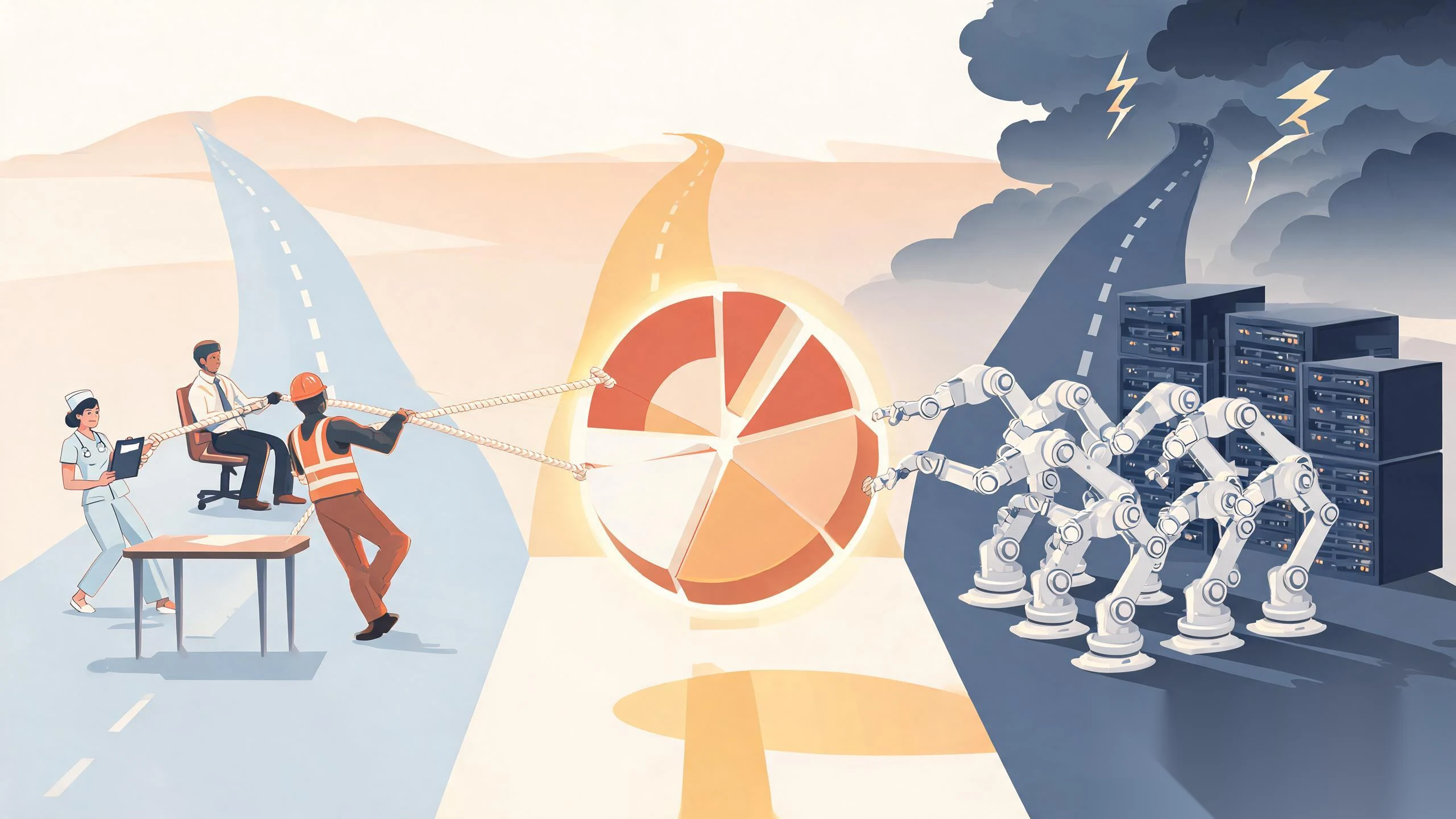
Methodology: the economy as bundles of tasks
The model's底层 idea is clean: the economy is not a monolith but a collection of countless "tasks." Every job is a bundle — take a nurse: rounds, blood draws, triage, charting vitals, ordering supplies, each item drawn from the US Department of Labor's O*NET occupational task taxonomy.
AI can do only four things to any task: leave it alone (AI cannot bathe a patient), augment it (help the nurse draft discharge instructions or monitor patients remotely), automate it (chart vitals automatically, reorder supplies), or create new tasks (checking how well an AI triages patients, reviewing AI-proposed care plans). As the bundle changes, the job changes — thirty years ago no nurse monitored patients remotely; today hardly anyone hand-writes paper charts.
Add up every instance of every task performed daily across the country and you get more than $30 trillion of annual value creation. AI's economic impact depends on whether it augments or automates each task, how much more productive it makes people, and how fast it is adopted. This task-level modeling is far more honest than back-of-envelope claims that "AI replaces X% of jobs" — it admits the impact is granular.
[1]Three futures: from "another internet" to "doubling every 4.5 years"
Anthropic highlights three scenarios; all differences come from the five dials:
- Modest: AI's impact is roughly that of the internet. 2030 GDP $34.1T (+1.6%) — real but gradual gains within historical norms;
- Substantial: by 2030 AI is capable of half of all knowledge work, most of it autonomously, though not all of that is adopted. GDP $36.3T (+8.3%), the economy growing at twice its normal rate; knowledge-worker wages flat, other workers see gains;
- Extreme: AI is more productive than humans at the vast majority of knowledge tasks, does nearly all of them autonomously, and creates essentially no new knowledge tasks for people — likely requiring recursive self-improvement (RSI) plus rapid adoption. GDP $44.4T (+32.4%), 15% annual growth, the economy doubling every 4.5 years; unemployment beyond typical recession levels; knowledge-worker wages down more than 10% by 2030.
The economy grows in all three scenarios — the model contains no option in which AI makes the economy worse. The real disagreement is distribution: the more aggressive the scenario, the more spectacular the growth and the worse knowledge workers fare. The report's own summary is blunt: in the extreme scenario the challenge is no longer achieving growth, but making sure the gains are broadly shared.
[1]Four findings worth copying down
Finding 1: growth holds in every scenario; only the magnitude differs. From +1.6% to +32.4%, what differs is speed, not direction. Anthropic is effectively telling AI pessimists: under our most conservative in-house assumptions, AI is at least another internet.
Finding 2: unemployment comes from the friction of switching occupations, not from a lack of jobs. Jobs shrink in occupations AI touches (knowledge work) and grow in those it does not — but a coder retraining as an electrician, or a call-center agent as a nurse, must learn skills, cross barriers, and wait. The more switching a scenario requires, the more people are stuck between jobs. In the extreme scenario, knowledge-work unemployment drags on far beyond normal job-search cycles.
Finding 3: average wages rise, but the rise is concentrated in what AI does not touch. The logic: AI makes knowledge work cheaper (pressuring its wages), while knowledge-work output (designs, permits, plans) boosts demand for physical labor (more construction projects → higher construction wages). The counterintuitive picture: coders' wages stall while electricians' wages climb. Yet the "average wage" still rises — a number politicians will happily misuse.
Finding 4: the pie grows, but the slicing tilts toward capital. Today workers get about 60 cents of every dollar of output and capital 40 cents. The scenarios drift to 59.4/40.6 (modest), 56.1/43.9 (substantial) and 45.2/54.8 (extreme) — even if everyone's absolute wages rise, as capital becomes more useful its price is bid up and more of the gains flow to capital owners. This is the most politically explosive table in the report.
[1]The 10,000-person survey: ordinary Americans picked the substantial scenario themselves
In August, Anthropic surveyed 10,980 Americans on their expectations for AI capabilities, adoption, autonomy, productivity and re-employment difficulty. The result is striking: the typical respondent's answers land close to the substantial scenario — GDP about 10% higher by 2030 than without AI, overall unemployment rising to around 5%. About 10% of respondents hold views consistent with the extreme scenario.
In other words, this is not the expert class's doomsday fantasy — the median expectation ordinary Americans voted with their feet is already at the level of "AI can do half of knowledge work." And one in ten believes the RSI-driven extreme transformation is the real one.
[1]Analysis: three judgments
First, this is a piece of Anthropic's policy strategy, not academic charity. Read the report on a timeline: the Economic Index measures the present, Economic Futures funds intervention research, the policy paper handles implementation — the scenario explorer completes the set with the future. Together they form a full policy-influence stack. When Washington debates AI and jobs, Anthropic wants its framework in lawmakers' hands. Whoever defines the problem first usually gets to define the boundaries of the solution.
Second, the labor-capital table is the epicenter of the report. Whether GDP grows is a technical question; 45/55 is a distributional one — and the latter is what actually detonates at congressional hearings and union tables. Note the model's own disclaimer: it deliberately excludes policy responses, business cycles, and aggregate-demand or financial-market disruptions. What the report shows is the direction of drift without intervention — itself a lobbying posture: look, this is how the share slides if you do nothing.
Third, the scenarization of recursive self-improvement is the economic translation of the safety narrative. The extreme scenario's precondition is spelled out: RSI plus rapid adoption. Anthropic does not say it will happen; it says this is what the economy looks like if it does. This is a clever descent of safety discourse — translating existential risk into unemployment rates and wage tables, so that even people who dismiss AI risk can see it in their own district's jobs data. On the same day, former Anthropic researcher Jacob Coxon's resignation thread went viral on X, accusing the company of racing toward self-improving superintelligence. One speaks of risk, the other counts the consequences — they are describing the same thing.
Honesty requires saying this is v1.0, a deliberate simplification — no robots, no policy responses, no financial crises. But it provides a coordinate system worth arguing over. Every serious debate about AI and employment in the next five years will likely cite "Anthropic's three scenarios" as a starting point. To be opposed, you first have to be worth opposing — this report earned that.
[1]Appendix: short-form post (Weibo / X ready)
Anthropic published an Economic Scenario Explorer: three futures for AI and the US economy. Modest = another internet (GDP +1.6%); substantial = 2x growth but flat knowledge-worker wages; extreme = 15% annual growth, economy doubling every 4.5 years, but labor's share falls from ~60% to 45.2% and knowledge-worker wages drop 10%+. A 10,980-person survey shows the median American's expectation already lands on the substantial scenario. The pie grows; the slicing tilts toward capital. #Anthropic #AIandEconomy #LaborShare
[1]