
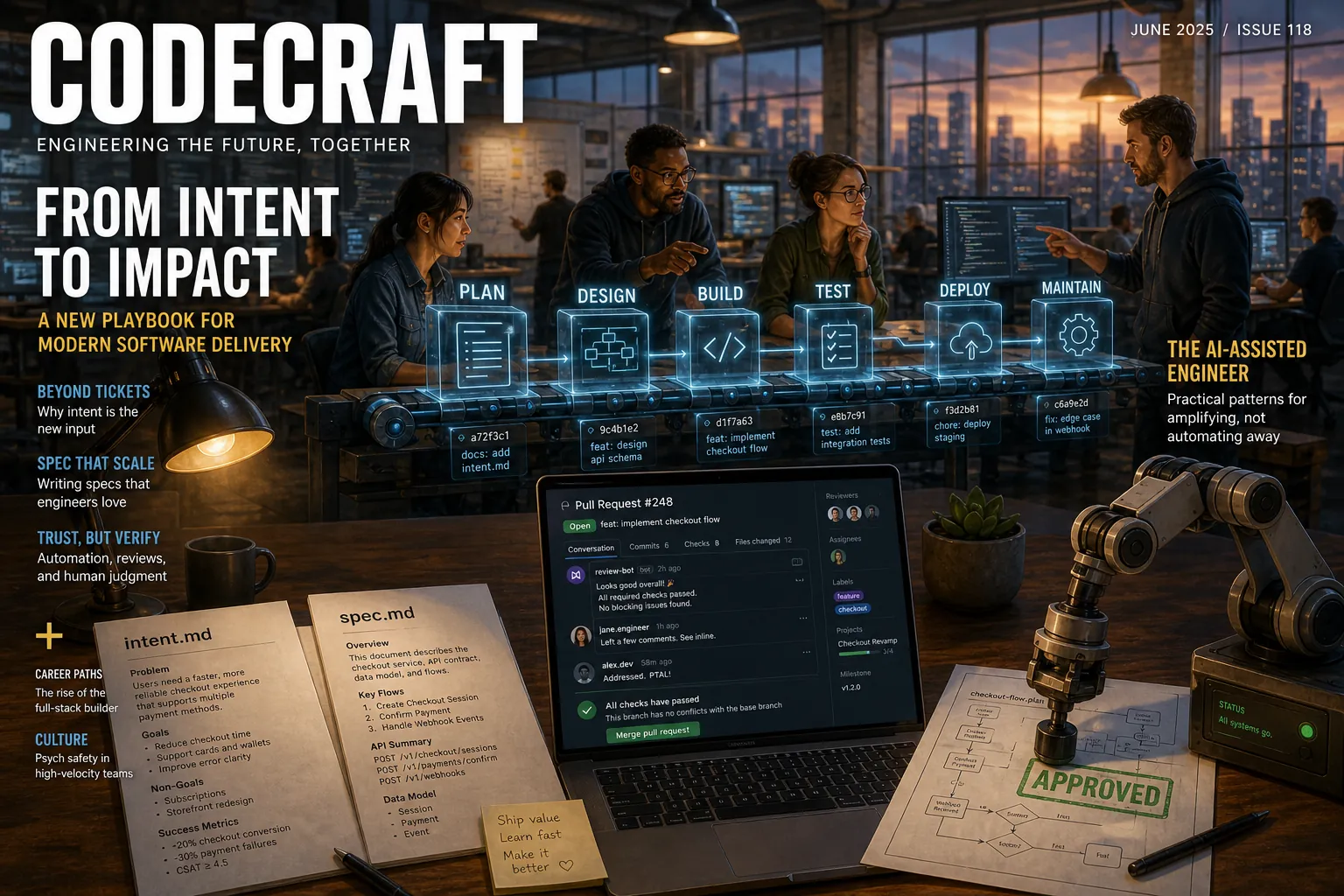
Engineering teams can now generate code with Claude Code far faster than their approval, review, and release rituals can absorb. In The AI-Native SDLC playbook (August 21, 2026), Anthropic Applied AI’s Louis Claxton states the awkward fact plainly: code is no longer the bottleneck—planning, review, and deploy still run at human speed.
Four days later, Bain & Company joined the Claude Partner Network as a Global Premier partner, packaging Claude rollout experience for enterprise clients. Read together, the playbook and the partnership show how Anthropic is trying to own not just model quality, but the operating system of the software factory.
What the originals say
Claxton’s guide does not ship a new model SKU. It redraws the six SDLC stages—Plan, Design, Build, Test, Deploy, Maintain. Classic process assumed implementation was the scarce step, so PRDs, estimation meetings, and security reviews forced alignment over weeks. Once agents compress build into hours, the human-speed sides remain, controls stop matching reality, and exceptions still queue for weekly committees.
The through-line is a committed artifact chain each stage can read: intent.md → spec.md → plan.md → diff and tests → PR with review findings → production anomalies written back as new intent.md. Early stages favor markdown both humans and agents can act on; from Build onward the artifacts are code and records; the commit history is the audit trail.
In Plan, originators brainstorm in their own words and commit a proto-spec after a product owner corrects it. Design collapses requirements and design into one session constrained by organizational skills (brand, security, compliance, UX). Build defaults to Claude Code plan mode—no file edits until a plan is accepted—plus CLAUDE.md, skills, hooks, parallel worktrees, and subagents. Test insists on a session-local feedback loop and continuous evals for agent configuration. Deploy puts Claude on both sides of PR review, uses hooks as approval gates, and keeps the production gate with a named releaser. Maintain keeps detection deterministic (control bands, Western Electric-style rules), then invokes Claude to diagnose or open PRs, with Claude Security scheduled scans and Claude Tag on-call called out explicitly.
Humans stay accountable for judgment calls; attention concentrates at the gates. Acknowledgments name Jim Blackhurst, Will Steuk, and Jamal Arif, with deep links into enterprise settings, hooks, sandboxing, and managed MCP docs.
Bain’s August 25 note is the channel story. The firm says Claude.ai, Cowork, Claude Code, Claude for Excel, and Claude for Microsoft 365 now reach about 19,000 employees; more than 7,000 were active within weeks of the pilot, and more than two-thirds of pilot participants adopted Claude for Excel. Bain cites 1,500-plus digital specialists and claims 30%–50% productivity gains on client work involving complex legacy codebases lacking architectural context—partner marketing, not an independent audit. Anthropic’s Steve Corfield frames rapid internal adoption as proof of the partner motion.
Product and technical value
The playbook’s bite is organizational, not algorithmic. Turning intent into versioned contracts (intent.md / spec.md / plan.md) makes previously oral alignment reviewable. Hooks and managed settings encode deny lists, sandboxes, and non-overridable gates—closer to something a regulated buyer can purchase than another safety slogan.
Developers get a default surface: plan mode, self-verification, two-way PR review, and writing repeated mistakes back into CLAUDE.md. Non-engineers can commit intent through connectors without waiting for a product translator. Buyers get Bain’s missing piece: enablement and industry transformation beside raw model access, with a 19,000-seat self-experiment cast as a reference case.
Novelty sits in wiring Claude Code, Tag, Security, and Design into one loop. Real value still hinges on whether firms will treat repo artifacts as system of record—or at least link them audibly to Jira/ServiceNow/Figma, which the guide itself admits will not vanish overnight.
Competition and strategy
Rivals also sell coding agents and enterprise suites. Anthropic’s bet here is more specific: rebuild the software factory as a Claude-readable state machine. While others chase benchmark headlines, the playbook plus partner network aim at CIOs and engineering-effectiveness leaders. Bain attaches consulting trust capital to the Claude Partner Network, distancing Anthropic from a pure API vendor story.
Competition therefore slides from model leaderboards toward who can offer an auditable agentic SDLC—skill marketplaces, managed hooks, per-environment autonomy tiers, and security scanning that keeps up with agent throughput. Whoever matches review capacity to code volume will be better positioned for regulated deals.
Risks, limits, and disputes
The practices are distilled from Anthropic’s Applied AI work and customer projects; cultural and change-control inertia elsewhere may reject “accept intent, fire the next gate.” Bain’s 30%–50% gains lack disclosed methodology (baseline, sample, rework), so treat them as marketing. Closing the Maintain loop increases unattended triggers—false positives, bad rollbacks, misconfigured permissions—despite branch protection and production gates on paper. Institutionalizing skills creates the risk of consistently applying a wrong policy at org scale. Switching costs rise as pipelines standardize on Claude’s artifact and control vocabulary.
Commentary
Read as a claim on engineering management in the agent era: whoever defines artifacts, gates, and feedback loops defines the organization’s OS. Claude products are cast as the default actuators; Bain is cast as the boardroom salesforce.
Credit where due: the text admits traditional controls fail under agent output and tries to patch with deterministic hooks plus human gates, instead of pretending the model will own accountability. Remain skeptical that consulting narratives turn pilot enthusiasm into a universal productivity law—double-digit gains often hold on carved-out subsystems, not entire value chains.
Outlook
Over the next 6–12 months, watch three diffusion signals more than another model name-drop: whether intent/spec/plan become default audit language in repos; whether security shifts from after-the-fact committees to in-action hooks; and whether the partner network turns internal playbooks into billable transformation programs. If all three move, Anthropic’s enterprise story upgrades from “a strong coding model” to “an operating system for the software factory.” If only the essay spreads, it stays a polished long read.
Anthropic’s newsroom is still topped by early-September Fable/Mythos headlines; with no fresher model launch in this hour’s check, this late-August governance playbook is a clearer slice of the company’s enterprise strategy.