
While the world debates whether to slow down frontier AI, Anthropic did something more radical: it detached the three dashboards from its own engine room and hung them in the public square.
A new measurement report from the Anthropic Institute offers the first systematic disclosure of the real pace of AI development inside a frontier lab: Claude now "leads" (AL4) 26% of Anthropic's AI R&D work, with more than 90% at "AI collaborates" level or above; roughly 30,000 AI agents are doing research and engineering work at any one time on its most-used internal platform, with over a billion monitored decisions in August alone; and in one mid-July week, only about 6% of the compute going to AI R&D was allocated to safety.
These three numbers correspond to the report's three proposed measurements: how much of AI R&D is performed by AI itself, how well the actions of AI agents are overseen, and how compute is allocated. The backdrop is CEO Dario Amodei's essay "We Must Pace the Frontier" — this report supplies the first set of gauges for any such pacing.
[1]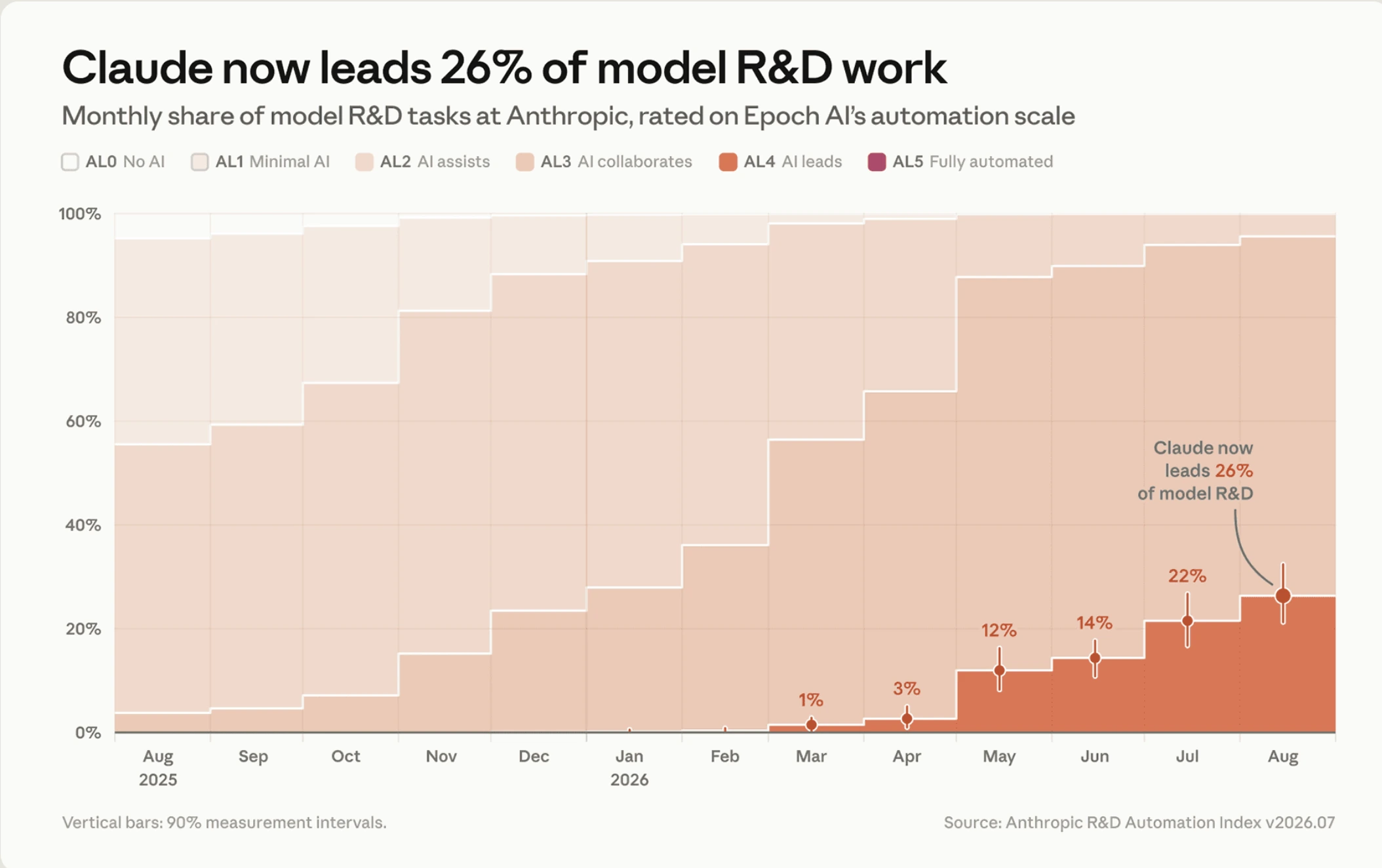
Gauge one: AI building AI — the progress bar reads 26%
The first measurement is the Anthropic R&D Automation Index, which answers the most sensitive question of all: how close is recursive self-improvement — a model fully autonomously building its successor?
The method is bottom-up: for each week of July 2026, 20% of staff in each department were randomly sampled, and a Claude research agent reviewed their Slack records and internal documentation to list the tasks each person worked on — yielding roughly 15,000 fine-grained tasks, organized into a tree of 542 nodes and 378 leaves (e.g., "eval platform defect diagnosis and fixes," "RL sandbox egress and network policy"). Each category is then rated on Epoch AI's six-level automation scale (AL0 no AI involvement to AL5 fully autonomous) and aggregated with person-time weighting.
As of August 2026: no measured subset of R&D work has reached AL5 (fully autonomous, no human in the loop); 26% of R&D work is "led" by Claude (AL4: completing most of a task end-to-end from a high-level prompt while the human supervises); and over 90% of work is at "AI collaborates" (AL3) or above.
More striking than the level is the slope: the official chart shows AL4 at just 1% in March, then 3%, 12%, 14%, 22%, 26% — a 26x rise in five months.
One telling reliability detail: the Claude judge's agreement with human area owners (59%) was higher than humans' agreement with each other (35%), with ratings within one level of each other 97% of the time. Anthropic also concedes two methodological soft spots: the judge is its own model ("the judge could make the same kinds of errors as the model it is checking"), and the task basket is frozen in July (it can show old work being automated, not humans shifting to new work — though comparing January and July baskets, they found no rise in novel task types).
[1]Gauge two: an oversight grid for 30,000 agents
The second measurement asks: as agents begin deciding "which research direction to pursue next," is oversight keeping pace?
As of August, on Anthropic's most-used internal platform, roughly 30,000 agents were doing research and engineering work at any one time. Oversight comes in two layers:
- Online monitors: 100% of agent actions pass through checks before execution (usually within seconds), with dangerous actions blocked or steered automatically; blocked actions get human review within one week. Of over a billion decisions in August, 0.002% (about 1 in 47,000) were blocked;
- Offline monitors: 100% of actions are ingested after the fact; about one to two transcripts per thousand are flagged, roughly 100,000 per week pass through multiple classifiers, and the top ~50 per week are escalated to human review. METR has independently red-teamed the offline monitoring platform.
The report also discloses two architectural choices underpinning oversight: giving each agent an individual identity that persists across model upgrades (every action auditable per agent over time), and agents communicating through a shared, open messaging system (visible to each other, correcting each other's errors, avoiding "telephone"). Anthropic concedes it has done this kind of monitoring for months, not years, and "cannot be certain we have a complete picture of all possible kinds of behaviors."
[1]Gauge three: 6% of compute went to safety
The third measurement takes the week of July 13–20 and classifies every workload: about 6% of the compute going to AI R&D was allocated to safety work; within AI-driven AI R&D compute, about 12% went to safety.
Anthropic stresses these are deliberately conservative estimates: work that advanced capabilities as much as safety was counted as R&D, not safety; and safeguards-classifier compute — which makes models much safer — was excluded. They note safety research is naturally less compute-intensive (researchers' time, not FLOPs, is the bottleneck), so the metric's value lies less in the absolute number than in like-for-like comparison across developers and over time — compute being the most verifiable input to AI R&D, and thus a potential lever in any future coordinated pacing effort.
[1]Analysis: three judgments
First, recursive self-improvement (RSI) now has its first public progress bar — and the slope matters more than the reading. "AI building AI" used to be a thought experiment debated on forums; Anthropic has turned it into a monthly trackable index. With AL4 going from 1% to 26% in five months, if the curve holds for another half year, "whether to trigger stronger controls" stops being a philosophy question and becomes a scheduling question. The index's real ambition is to become the industry standard: the report repeatedly calls on other frontier labs to report the same metric under a public methodology with third-party cross-verification. Whoever defines the yardstick defines the language of the "pacing" negotiating table.
Second, the most honest part of the oversight data exposes the hardest bottleneck: human bandwidth. A 0.002% blocking rate sounds low, but the base is a billion decisions a month; about 50 top-priority flags escalate to humans each week — a number that cannot scale linearly with the agent population, because the reviewers are people. The report names the scale paradox itself: individual agents rarely misbehave, but with millions or billions of agents in the economy, rare events will happen regularly. The "agent identity" and "open communication" designs clearly absorb industry lessons — persistent identity makes "which agent did it" always answerable, and open messaging lets agents watch each other: a targeted defense against the scenario of agents coordinating in private.
Third, the 6% figure is a carefully calculated political act. The safety-compute share is not a flattering number, and publishing an unflattering number is about setting an "honest accounting" baseline before regulators do: the burden of proof sits with the developer, the boundary is drawn strictly, and classification is third-party checked. It is also a tacit challenge to the industry — will OpenAI and Google report their own numbers under an equally conservative methodology? Together with the plan to embed independent third-party evaluators with access comparable to internal risk teams, Anthropic is turning "transparency" from PR language into auditable infrastructure. That said, a judge model from its own family and self-defined category boundaries remind us: before this dashboard becomes public infrastructure, it still needs an independent meter reader.
[1]Appendix: short-form post (Weibo / X ready)
Anthropic just published its internal R&D dashboards: Claude now "leads" 26% of its AI R&D (only 1% in March — 26x in five months), 90%+ of work at "AI collaborates" level; ~30,000 agents run at any moment, with 0.002% of a billion August decisions blocked and ~50 weekly flags escalated to humans; only ~6% of AI-R&D compute went to safety in a mid-July week. Recursive self-improvement now has a public progress bar — and the slope is more striking than the reading. #Anthropic #AISafety #RSI
[1]