
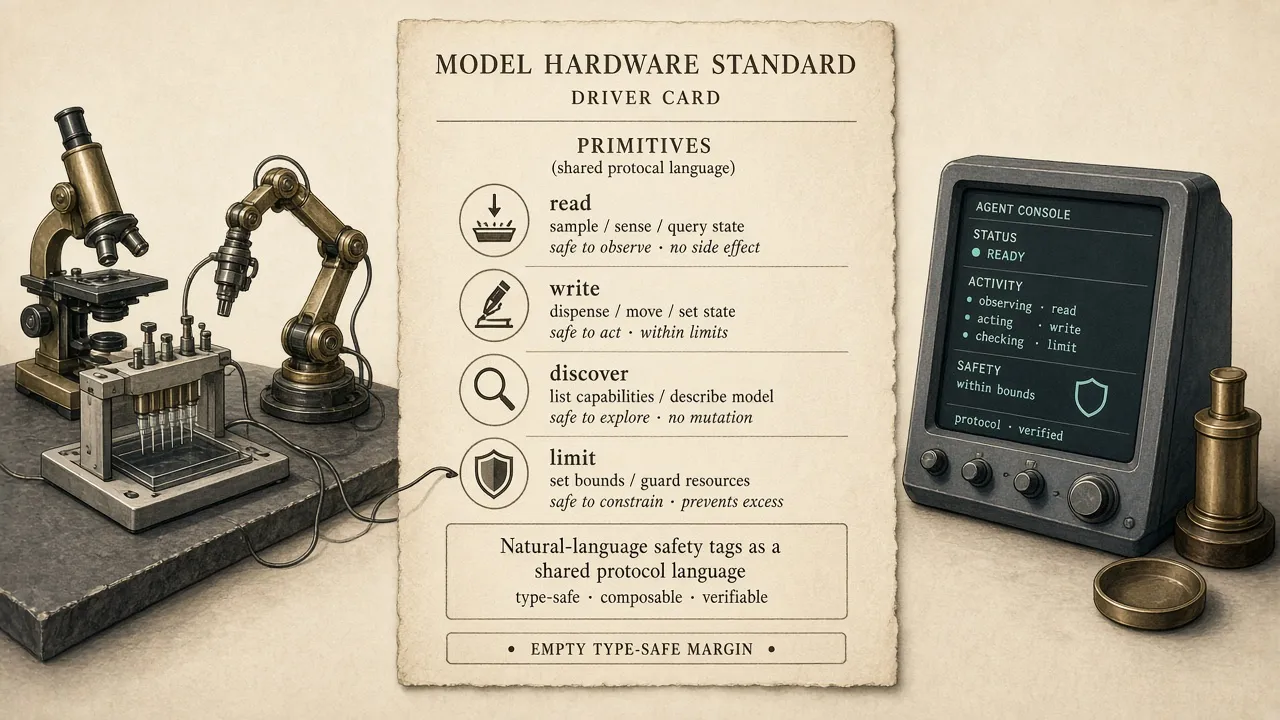
On 27 August 2026, Anthropic published Previewing the Model Hardware Standard. Fact (Anthropic): the company is opening a research preview of the Model Hardware Standard (MHS)—a shared specification for AI agents to safely operate physical devices—to a first group of scientific research labs and advanced manufacturers. MHS began as a collaboration between Anthropic and HHMI Janelia Research Campus. Claim (Anthropic): integration that typically takes weeks or months can shrink to hours or minutes; agents can orchestrate microscopes, liquid handlers, and robotic arms in parallel, including routines from drug-discovery assays to laser calibration on a quantum computer. Inference (labelled): if the load-bearing object is a standardized driver with discoverability, read/write primitives, natural-language device tags, and stated safety limits—reachable via MCP, CLI, or code—then the durable news is an interface bet, not a claim that Claude has suddenly mastered physics.
[1]What Anthropic says MHS is
Strip the launch tone and the post still describes a concrete stack.
Driver layer. MHS introduces a standardized driver that translates between an operating system and a hardware device using simple primitives—commands such as “read” (e.g., get temperature) and “write” (e.g., set temperature). Devices become discoverable in a standard format across networks, so agents and instruments need not each invent a bespoke translator.
Device knowledge. The driver can carry tags written in natural language—by a user or via an interviewing agent—about characteristics that code alone may not reveal (Anthropic’s example: the weight of a robot arm). From those tags the driver produces a reference file describing what the device can measure, what can be adjusted, and what safety limits will be enforced.
Control paths. Once connected, agents control hardware through three mechanisms that work together: the Model Context Protocol (MCP), a command-line interface, and code files (APIs). For long-running or latency-sensitive work, agents can chain driver commands into deterministic scripts so instruments run without step-by-step online reasoning.
Scope claims. MHS is said to work with any device that has a programmable interface; it is model-agnostic; any agent harness can reach it via standard protocols such as MCP. Access today is a research preview with a waitlist—not a general open-source release.
[1]Partner examples—and what they measure
Anthropic lists early projects across biotech, robotics, quantum computing, and manufacturing. Treat each as a company-reported partner vignette, not an independent league table.
Genentech implemented MHS as a proof-of-concept to automate a BCA protein assay across a liquid handler, robotic arm, and plate reader. University of Washington (Baker and Pinglay labs): a remote instrument dashboard, an agent-supervised qPCR that watches amplification curves and halts at the right moment, and collision-free plate handoffs between arm and liquid handler. Carnegie Mellon ran serial dilution dose-response experiments about three times faster than before, orchestrating incompatible interfaces across three computers. HHMI Janelia used MHS to unify a microscopy rig that previously required seven vendor programs without a shared interface. QuEra Computing gave an agent control over parts of a quantum laser system; Anthropic says the agent’s controller recovers laser “lock” 99.3% of the time without human intervention. Tetsuwan Scientific orchestrated a qPCR pollution-profiling workflow on its ResearchOS platform.
Hardware and software vendors named as building or exploring MHS support include AWS (Strands Robots, private pre-release for preview participants), Automata, Danaher, Doosan Robotics, MBF Bioscience (ScanImage), QIAGEN, Tecan, and Universal Robots. Hugging Face (LeRobot) and Raspberry Pi appear as early adopters for the next phase.
These examples support a narrower claim than “AI scientists”: when instruments already expose programmable interfaces, a shared driver can cut integration friction and let an agent sequence, monitor, and in some cases recover from errors. They do not, on this post alone, prove that agent physical reasoning is solved.
[1]Why the preview is gated: physical reasoning still fails in human ways
Anthropic’s own caveats are the editorial spine that marketing copy often skips.
As a large language model, Claude “learns about the physical world through text and images,” and Anthropic states that its spatial and physical reasoning still require expert oversight. In the Genentech protein work, researchers had to guide Claude to recognize that foaming errors were physical failures, not software bugs, and could only be mitigated with physical corrections.
MHS also does not yet work with hardware that lacks a programming interface; Anthropic says it is working with those manufacturers to build drivers. The research preview’s explicit purpose includes building safety evaluations and best practices for AI systems operating physical equipment ahead of open-sourcing the standard. Anthropic says it is developing a physical safety roadmap to bolster safeguards policy and enforcement against misuse, and that open-source release will include preview findings as deployment guidance.
Inference (labelled): the sequence matters. Interface standards that ship before misuse and failure-mode evals in the physical world are hard to walk back once vendor ecosystems lock in. Keeping MHS in a partner preview while naming a safety roadmap is, on Anthropic’s telling, an attempt to do the eval work before the protocol becomes infrastructure.
[1]Steelman, gaps, and falsifiers
Steelmanning Anthropic. Labs really do spend weeks gluing incompatible vendor APIs. A model-agnostic driver with discoverability, shared primitives, and a place to put safety envelopes below the agent’s free-form reasoning is a more honest product than another demo video of a robot arm waving. Partnering with Janelia’s messy multi-vendor microscopy world, then inviting Genentech, QuEra, CMU, and robot vendors into a preview, is a credible way to stress-test the spec. On that steelman, “research preview before open source” is governance, not theater.
Gaps that remain thin. The post gives no public specification document, threat model, or independent audit of driver-enforced limits. “Hours or minutes” versus “weeks or months” is a company comparison without a disclosed baseline sample. QuEra’s 99.3% lock-recovery figure is striking and attributed to partner use, but this page is not a methods paper. Competitive positioning versus existing lab-automation middleware (SiLA, vendor SDKs, ROS stacks) is largely unaddressed. Who sits on the waitlist, and how US-centric early access is, is unspecified.
Labels for editors. Facts: announcement date; MHS name and research-preview framing; Janelia origin (Alek Kemeny / Arco Bast collaboration acknowledged); primitives and three control paths; named partner vignettes and vendor list as stated; programmable-interface requirement; model-agnostic / MCP claim; open-source deferred pending safety work. Claims: large cuts in integration time; safe operation as a delivered property of the standard; broad usefulness across any programmable device domain. Inferences: the strategic object is the shared driver and gated safety process; autonomy theater is the wrong headline.
[1]What to watch in six months
By roughly early 2027, three checks matter more than another partner montage. First: does a public MHS specification ship with testable, driver-level safety limits—and do independent labs reproduce block/allow behavior under prompt injection and mistaken physical assumptions (foam, collisions, missing plates)? Second: do vendors ship durable drivers, or does “MHS support” remain marketing slides while bespoke glue persists for production assays? Third: when open-source arrives, are preview safety findings specific enough to be operational guidance, or only high-level principles?
If those tests hold, MHS’s lasting contribution will look less like a clever Claude demo and more like USB-for-agentic-labs: a boring shared language that makes reckless operation harder and careful orchestration cheaper. If they fail, the preview will have been an eloquent press cycle around wrappers that never became a standard.
[1]