
要点
- Tether AI Research released BotPsy-0.8B, a Qwen3.5-0.8B post-train for on-device tool use, with Apache 2.0 weights now on Hugging Face.
- Author-run tests dated 3 November 2026 show it roughly doubling the base model on key agent benchmarks and beating Qwen3.5-2B-Think on five of six, including BFCL v4 at 44.0 against 37.7.
- Knowledge still tracks size: GPQA Diamond is 38.1 against 59.9 for the 2B model. BrowseComp-Plus is 4.5, the best of the five tested and still very low.
- Training has four stages: supervised fine-tuning, on-policy distillation from three Qwen3.5-4B specialist teachers, then two reinforcement-learning rounds.
- The authors say the model is for low-to-medium difficulty tasks and is not intended for high-stakes decisions, money, health, or personal information.
On 11 November 2026, Tether AI Research published a Hugging Face blog introducing BotPsy-0.8B, a model with 0.8 billion parameters trained to act as a personal assistant that calls tools on the user's own device. The authors, writing as Tether Data, S.A. de C.V., say they built it on Qwen3.5-0.8B because frontier cloud models are costly, can be withdrawn, and keep user data off the device. The useful question is narrower than that pitch. Do the published scores show a small model that is generally stronger, or a small model specialized for tool use, while knowledge still tracks size?
[1][2]What shipped
BotPsy is aimed at everyday assistant work, including search, travel, shopping and finance, calendar and email, files, and device or vehicle controls. The authors say it is best suited to tasks of low to medium difficulty. Weights are already on Hugging Face under the Apache 2.0 license, in bf16, Q8, and Q4, as safetensors and as GGUF files for the QVAC SDK and llama.cpp. The blog still says the model "will be released." The repository at qvac/BotPsy-0.8B is live today.
The authors are explicit about limits. BotPsy still makes mistakes. It is not intended for safety-critical or high-stakes automated decisions, or for work that involves money, personal information, or health. English is the recommended language. On Multi-IF, which tests instruction following across eight languages over three turns, scores in Hindi and Russian lag far behind English, Chinese, and several European languages.
[1][2]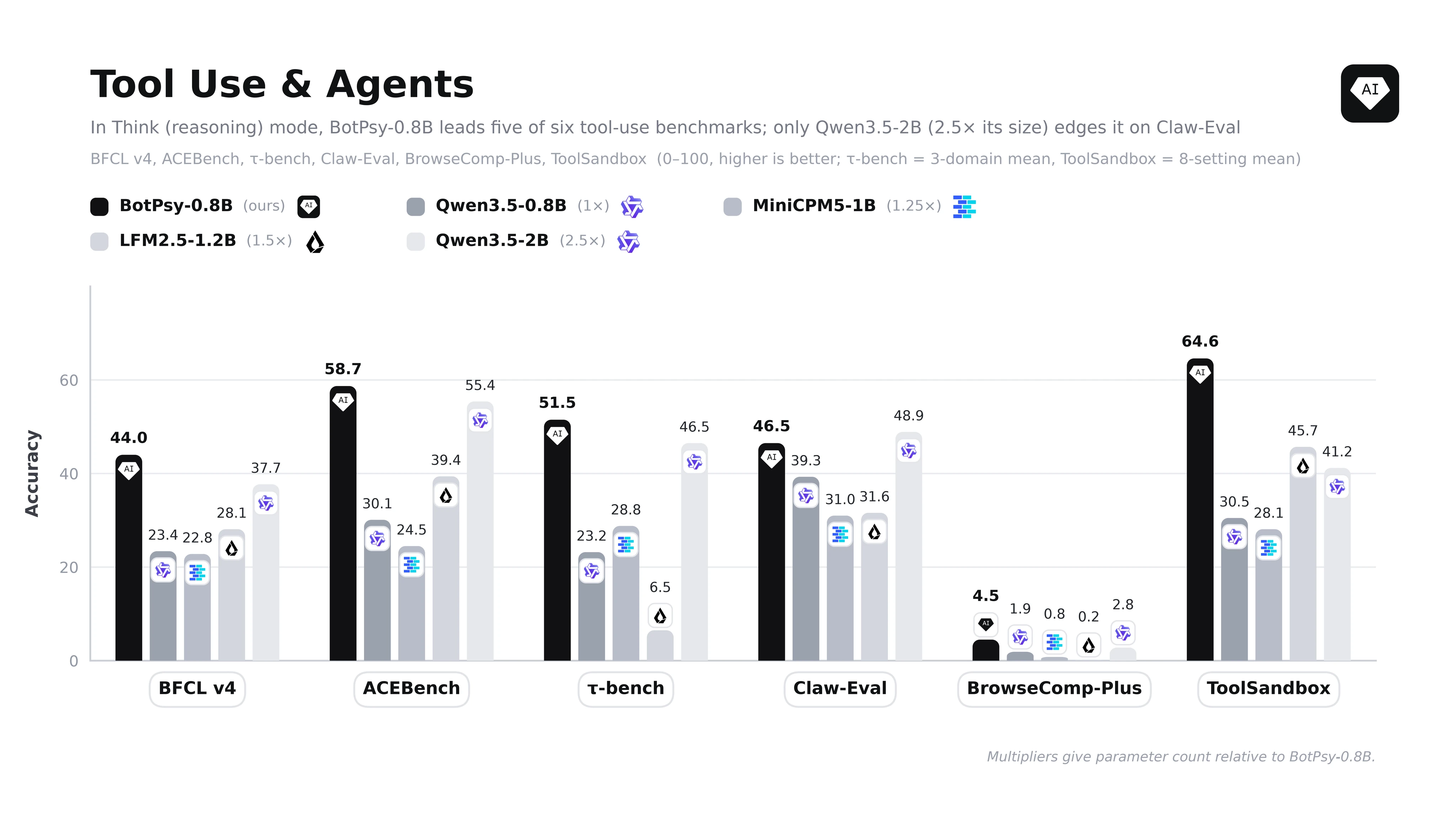
What the numbers actually show
All comparison scores in the post come from the authors. They evaluated five models in thinking mode, and dated the runs that used an external API to 3 November 2026. The post has no independent leaderboard check.
On six tool-use and agent benchmarks, BotPsy's unweighted average is 45.0, against 24.7 for the Qwen3.5-0.8B-Think base and 38.8 for Qwen3.5-2B-Think, which has 2.5 times as many parameters. Two other small models, LFM2.5-1.2B-Think and MiniCPM5-1B-Think, score 25.3 and 22.7.
The lead is largest where an assistant must call tools across several turns. On BFCL v4, a tool-calling benchmark whose official mix includes agent, multi-turn, live, non-live, and hallucination tests, BotPsy scores 44.0 against 23.4 for the base and 37.7 for the 2B model. The multi-turn slice rises from 7.5 for the base to 46.1, almost double the 2B model's 23.8. ACEBench is 58.7 against 55.4. τ-bench, reported as the mean of τ²-bench retail and telecom plus τ³-bench banking, is 51.5 against 46.5. ToolSandbox is 64.6 against 41.2.
The 2B model still leads on Claw-Eval, 48.9 against 46.5, and on ACEBench's special cases, where requests are incomplete, have wrong parameters, or cannot be served by the given tools, at 58.0 against BotPsy's 51.3. BotPsy is well above its own base there, which scored 13.7.
Knowledge did not collapse after tool-use training, and it also did not catch the larger model. GPQA Diamond rises from 33.2 for the base to 38.1, against 59.9 for Qwen3.5-2B-Think. MMLU-Pro rises from 41.6 to 48.9, against 65.5. The authors state this plainly. Knowledge still scales mainly with parameter count, and BotPsy is designed to call tools for facts it does not know.
Instruction following is the general skill where the smaller model is ahead. IFEval is 90.8 against 80.0 for the 2B model. IFBench is 55.9 against 40.9. On Multi-IF, BotPsy starts strongest at 84.3 in turn 1, then drops to 51.0 in turn 3, below the 2B model's 56.5.
[1]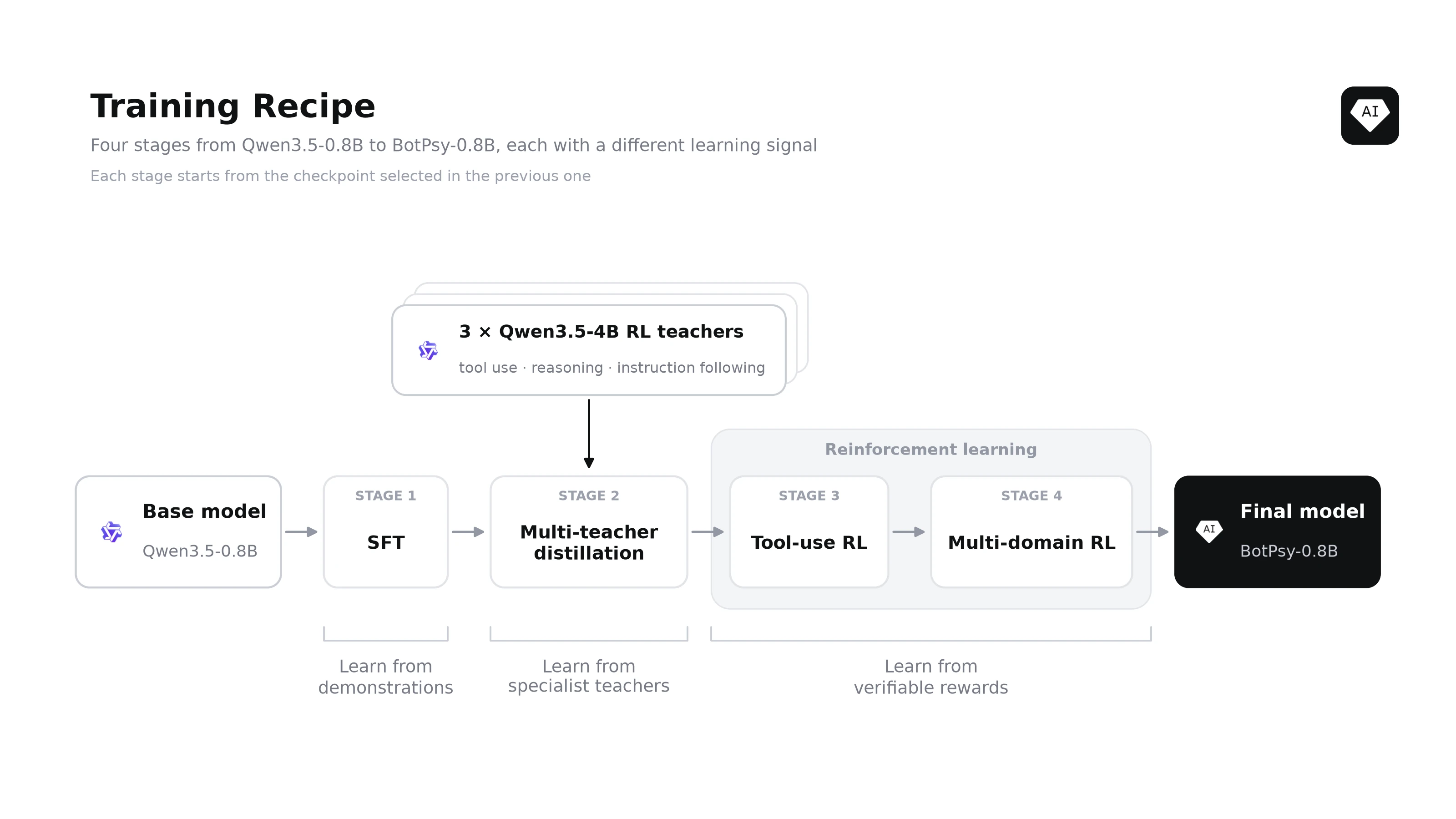
How it was trained
The training method is the part that still stands if a headline number later moves. The student model goes through four stages, each starting from the best saved version of the previous stage.
The first stage is supervised fine-tuning of all weights on tool-use conversations, including cases where no tool should be called. The authors' own training chart shows the cost. Tool use jumps, while knowledge and instruction following fall below the base model.
The second stage is multi-teacher on-policy distillation, which they abbreviate as MOPD. The student generates its own responses. One of three specialist Qwen3.5-4B teachers then gives feedback on every token, using reverse KL divergence as the training signal. Those teachers were first trained with reinforcement learning, one each for tool use, general reasoning, and instruction following. The post says this stage is mainly to recover the knowledge and instruction-following losses from supervised fine-tuning. Tool-use scores rise as well.
Two reinforcement-learning rounds follow, using the DAPO recipe. Rewards come from rules and checkers, not from a learned preference model. The first round focuses on tool calling and gives partial credit for tool names, argument names, and argument values, rather than a single correct-or-incorrect mark. The second round adds math, code, knowledge questions, instruction following, structured outputs, and multi-step tool use in a simulated workplace. The authors note that this second mix contains no multi-turn conversations, and that multi-turn function calling still improved.
That sequence is a claim about specialization, not about a new base model. If later independent runs keep the tool-use lead and keep the knowledge gap, the result that matters is this post-training recipe.
[1]Where the small model still fails
BrowseComp-Plus is the cleanest warning. It is an open-ended, multi-step search test with a 30-step cap. BotPsy scores 4.5, the best of the five models and still close to zero. The 2B model scores 2.8. The base scores 1.9. On BFCL web search and memory, the 2B model leads, 19.8 and 26.1 against BotPsy's 14.0 and 16.3. Complex search and retrieval cases score 15, against 79 for simple, single-call cases in the same group.
τ³-bench banking is a second stall. No model in the comparison breaks a score of 5. BotPsy is 4.1, unchanged from its base. The 2B model is 4.8. A gain that vanishes in a harder customer-service setting is not a general agent.
Safety numbers belong next to the product claim, because this on-device agent will read tool output. In the authors' automated red-teaming across six harm categories, BotPsy produces unsafe responses in 21 percent of cases, down from 36 percent for the base, and the lowest rate among the models up to 1.2 billion parameters. Under prompt-injection attacks, which hide instructions in the input the model is asked to read, the unsafe rate is 31 percent, down from 46 percent. That is an improvement. It is not a rate one would accept for an agent allowed to touch email, files, or payments, which is why the limitations section rules those uses out.
The efficiency figures are more useful for phones. On questions all five models answer correctly, BotPsy uses about 3 times fewer reasoning tokens than its base on GPQA Diamond, 3,690 against 11,563, and 2.7 times fewer on MMLU-Pro, 1,912 against 5,105. Across IFBench attempts, repetitive reasoning loops fall from 22.9 percent to 1.4 percent, and runs that hit the 32,000-token limit fall from 28.3 percent to 0.2 percent. On τ²-telecom tasks that all five models solve, it uses 13.1 assistant turns against 17.6 for the base.
[1]The fair case
The fair reading is that phone and PC assistants do not need to store every fact if they can call a tool, refuse a tool that does not exist, and finish a multi-turn task without looping. BotPsy's 86.1 score on BFCL v4's hallucination tests, which check that the model declines when no suitable tool exists, is the highest of the five. Combined with reasoning traces about 3 times shorter than the base, that is the practical case for putting a specialized 0.8B model on a device, rather than waiting for a 2B model that still knows more on GPQA. For a calendar change or a device setting, that case holds.
It does not hold for open-ended research, or for the high-stakes work the authors already exclude. A model that scores 4.5 on BrowseComp-Plus cannot be sold as a private search replacement. A prompt-injection unsafe rate of 31 percent cannot be ignored once tool output is untrusted, which it will be as soon as the assistant browses the web.
The post's closing broader vision should be read as a roadmap, not as a result. Tether describes future work on Hypersearch, a private peer-to-peer query path, QVAC Fabric local fine-tuning, and handing heavy jobs from a phone to a home PC. None of those systems are scored in the tables.
[1]Who should care, and what to watch
On-device and edge teams choosing between a 1B-class tool-calling model and a slightly larger general model should care, especially if they can run Q4 GGUF locally and can keep high-stakes actions behind a human or a hard rule. Labs comparing post-training recipes should care too. The staged recovery after supervised fine-tuning is the mechanism, and it is described clearly enough to try on another base model.
What to watch over the next six months is specific. First, whether independent BFCL v4 and ACEBench runs on the released weights keep the lead over Qwen3.5-2B-Think. Second, whether Q4 GGUF on actual phones preserves the multi-turn scores and the shorter traces, or only the bf16 figures do. Third, whether BrowseComp-Plus or a similar search test moves off the floor. If the tool-use lead holds and search stays near 4.5, the honest product is a local tool-calling specialist, not a general private assistant.
[1][2]Close
BotPsy is a carefully measured claim that post-training can buy tool-use skill at 0.8 billion parameters without wiping out the base model's knowledge. The same evidence shows that knowledge still follows size, and that open-ended search in this weight class remains close to a failing grade. That is a useful result for anyone trying to run an assistant on a device. It is a poor result to inflate into a story about small models replacing larger ones.
[1]