
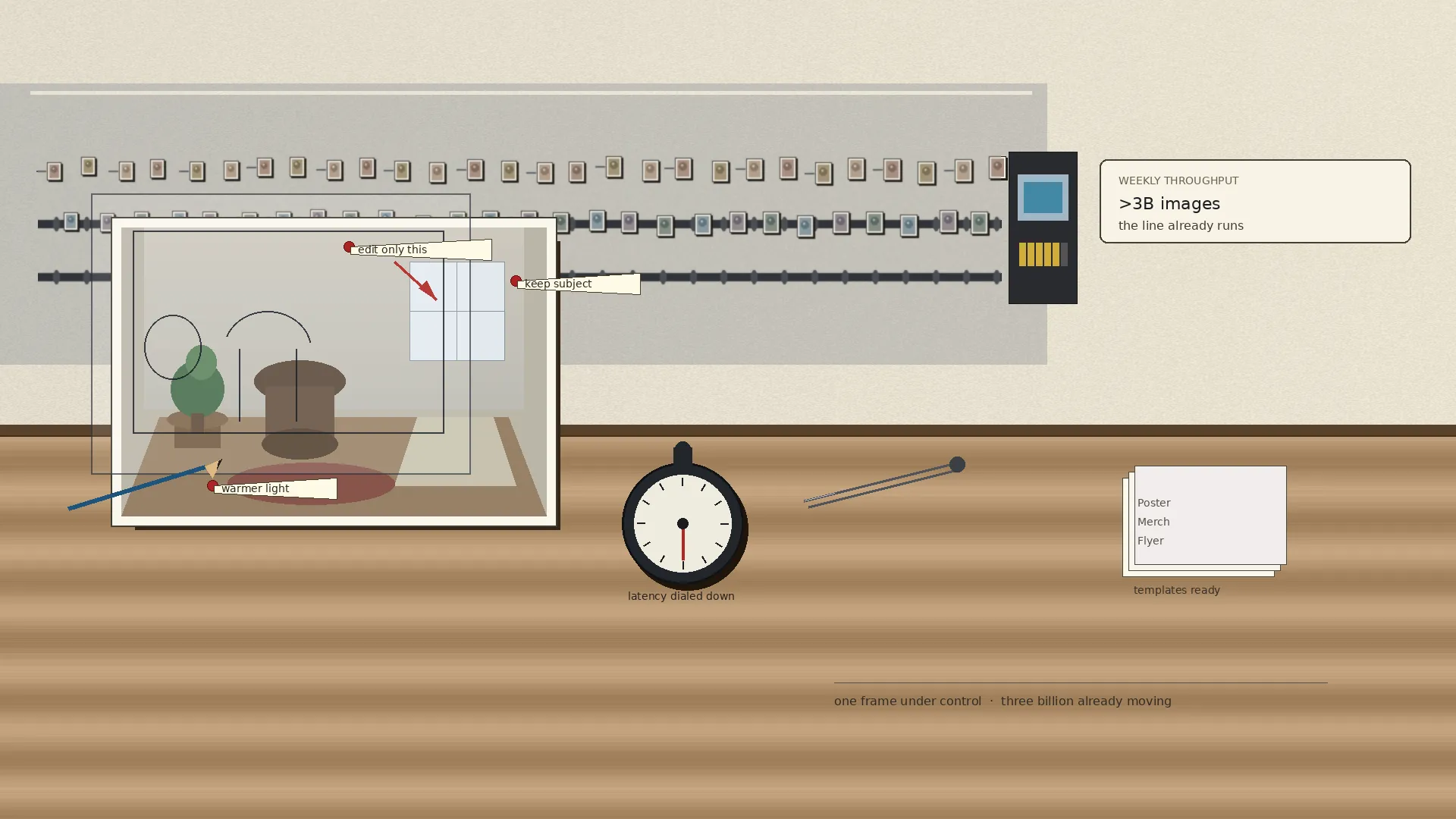
OpenAI published, on 8 September 2026, a Product post titled “Introducing ChatGPT Images 2.5.” Fact (OpenAI): the company says people already create more than 3 billion images every week across ChatGPT Images and the GPT‑Image models in the API. Claim (OpenAI): Images 2.5 brings sharper details, more precise editing, and faster generation, with image-generation latency reduced by up to 50% compared with Images 2.0. Also shipped in ChatGPT: Sketch (draw a reference in-chat via “@Sketch”), templates for common formats, comments placed directly on images, and the option to share the prompt with a shared image. The model is available to ChatGPT, ChatGPT Work, and Codex users on desktop, mobile, and web; the API adds GPT‑Image‑2.5 Flare and GPT‑Image‑2.5 Sunburst.
The news is therefore less a debut of a new medium than a refinement of an industrial habit. OpenAI’s own weekly volume figure places generative images in the realm of routine throughput. What 2.5 sells next is control and turnaround time—editing that stays on target across turns, and a stopwatch that, by company claim, can run up to half as long.
[1]What the post actually ships
Strip the adjectives and three layers remain.
Layer 1 — model claims. Images 2.5 is said to produce more natural lighting and richer textures, preserve subjects from reference photos more reliably, follow editing instructions more precisely (including complex subjects and backgrounds), and hold quality across multi-turn edits. It is also said to handle complex layouts better—including transparent backgrounds—and to reflect requested visual styles more faithfully. These are qualitative capability notes. The post does not publish a public architecture paper, training-data card for the image stack, or a third-party benchmark table in this Product note.
Layer 2 — ChatGPT surface. Sketch lets a user draw a layout or doodle as a visual guide. Templates (examples named in the post include formats such as Poster and Merch) lower the blank-canvas cost. In-image comments focus edits. Prompt sharing turns a finished image into a remixable recipe. None of these require a new scientific class of generative model; they are product affordances around an existing generation loop.
Layer 3 — API split. Developers get two named models: GPT‑Image‑2.5 Flare, described as the default choice with higher-quality images than GPT‑Image‑2 at 50% lower latency; and GPT‑Image‑2.5 Sunburst, aimed at premium workflows that need tighter control across edits, with longer generation times. The Flare/Sunburst naming is a pricing-and-latency menu, not evidence of a new research paradigm.
[1]The 3-billion habit is the real baseline
OpenAI’s lead statistic—“more than 3 billion” images per week across ChatGPT Images and GPT‑Image API models—does more narrative work than any single demo still. If accepted at face value, generative image creation is already a mass weekly behaviour at OpenAI’s perimeter, not a niche curiosity waiting for a breakthrough.
Inference (labelled): against that baseline, marketing language about “state-of-the-art” and “expanding what you can create” reads as iteration on a running factory line. Latency down “up to 50%” versus Images 2.0, better subject preservation, and stickier multi-turn edits are meaningful to people who already generate and revise at volume. They are not, on the evidence in this post, a claim that a new capability class has arrived.
That reading is falsifiable. If independent latency measurements fail to show a large gain versus 2.0 under comparable settings, the speed half of the pitch weakens. If third-party edit-consistency tests fail to separate 2.5 from 2.0 beyond noise, the “precision editing” half weakens. If OpenAI later discloses a distinct architecture or training method that explains a discontinuous jump, the “mostly product + iteration” thesis would need revision.
[1]Evidence quality, gaps, and a steelman
What is strong on OpenAI’s own terms: a dated Product post with named features (Sketch, templates, in-image comments, prompt sharing); a concrete relative latency claim versus Images 2.0 (“up to 50%”); a dual API SKU with an explicit speed/precision tradeoff; availability named across ChatGPT, ChatGPT Work, and Codex; and a safety paragraph that points to prompt/image checks, C2PA metadata, invisible watermarking, and a system card.
What is still thin: the “more than 3 billion” weekly figure is company-reported with no external audit in the post; “up to 50%” is a ceiling phrasing, not a median across workloads; customer quotes (Higgsfield AI, Adobe Firefly, Manus, Runway) are selected early-access testimonials, including qualitative speed claims such as Manus’s “two to four times the speed of GPT‑Image‑2” for Flare—compatible with, but not identical to, OpenAI’s own “50% lower latency” wording. No independent side-by-side gallery with fixed seeds and prompts is provided in the article body.
Steelman counter: grant that everyday creators and API teams care more about edit stickiness and wait time than about papers. Then shipping Sketch, comment pins, templates, prompt remix, and a faster default API model is exactly the right product move once weekly volume already exceeds three billion. On that steelman, demanding a scientific discontinuity is a category error—OpenAI labelled the post Product, not Research. The fair test is operational: do multi-turn edits hold, does latency fall for typical resolutions, and do safety markers remain intact at higher throughput?
[1]Safety as continuity, not the headline
The safety section is brief and continuous with prior practice: checks on prompts and images; C2PA metadata; invisible watermarking; a link to the system card. There is no claim here of a new safety method unique to 2.5. That is editorially important. A release whose scientific novelty is thin should not be over-read as a safety event either—unless evaluators later show that faster, stickier editing changes misuse patterns. The post does not provide that evidence; it asserts continuity.
[1]Six-month watchpoints
Watch four concrete signals. First: do independent latency and edit-consistency measurements versus Images 2.0 / GPT‑Image‑2 reproduce OpenAI’s “up to 50%” and multi-turn claims under controlled prompts? Second: does Sketch + in-image comments change session structure (fewer full regenerations, more local edits) in public usage reports? Third: how do Flare and Sunburst price and queue-share in the API—does the “precision” SKU stay niche? Fourth: does any system-card or research follow-up disclose method changes large enough to reclassify 2.5 as more than a fidelity/latency/product pass?
If those measurements look incremental, the durable story is that generative images at OpenAI’s scale are now an operations and interface problem: how to steer, annotate, remix, and watermark a line that already moves billions of frames a week. If they look discontinuous, the Product post under-sold the science. Either way, the baseline number OpenAI chose to lead with—more than three billion weekly—is the context that makes 2.5 readable as refinement of a habit, not invention of one.
[1]