
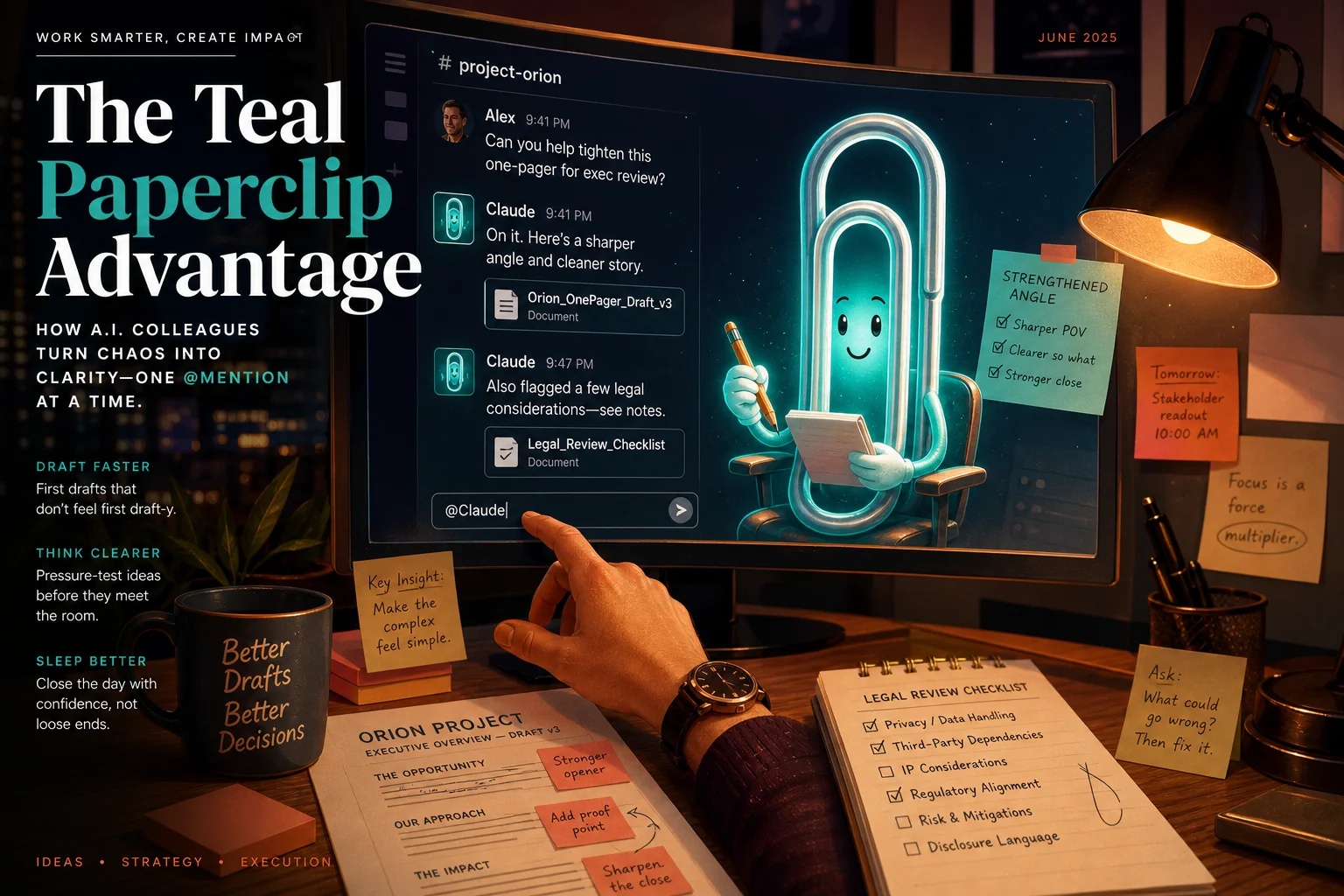
On August 28, 2026, Anthropic published what looks like an internal field guide on the Claude blog: How Anthropic employees use Claude Tag, by Aleksandra Todorova. There is no new model drop and no fresh leaderboard score. Instead, the piece turns @Claude-in-Slack into three reusable workflows: wringing a messy thread into customer-ready collateral, consolidating months of scattered asks into a notifiable list, and compressing marketing legal review from roughly a day to about thirty minutes per asset.
Claude Tag is in public beta on Team and Enterprise plans on Anthropic’s first-party service. You tag @Claude in a thread the way you would a colleague; it picks up conversation context, does the work, and posts back into the same thread. Officially, it can also follow conversations and, using available context, memory, and standing instructions, decide when to join. This commentary is less about another chatbot plugin and more about Anthropic’s bet that where work already happens should be the default agent runtime.
What the official posts say
According to the August 28 post, Anthropic teams have already used Claude Tag for self-serve data analysis in shared channels, support tickets, and tricky bug root-cause work. The article focuses on three named-role case studies (illustrations are generated examples and do not contain real customer data):
Product marketing: Slack thread to review-ready doc. During a feature launch, sales needed non-technical customer collateral. Product marketer Hema Thanki tagged Claude inside a 15-plus-message thread with competing asks: @Claude, go through this Slack thread and come up with a one pager that [the requester] is asking for. In about two minutes Claude returned a two-page draft covering plain-language explanation, business case, implementation, and an appendix. She then asked Claude to check factuality; it split claims into those verified against public docs versus its own framing that needed product-lead sign-off. She supplied two official sources and had Claude rewrite to match approved wording. Four versions later—about 45 minutes from the first ask—she sent the doc to the product lead. She also keeps a private Slack channel with Claude, issuing requests in separate threads while Claude posts a living progress checklist. Access is deliberately scoped to granted channels and documents; Claude says so when it lacks them.
Product strategy & ops: consolidating scattered asks. Ahead of GA, Steph Soderborg gave Claude search targets, a one-sentence match definition, and a seven-entry sample list. Claude ran roughly 20 search variants; when the product-feedback hub blocked direct access, it used Slack cross-references and deduped against another internal assistant’s first pass. In about 26 minutes it returned ~24 accounts with handle, team, account, and link. On a larger job—reading incident, escalation, support, and product-feedback channels—Claude posted a write-up in ~50 minutes with 23 still-open and 14 resolved issues condensed from ~120 raw findings; a self-check added 15 more. Steph estimates the manual version would take at least a full-time week, or never happen.
Legal: first-pass marketing review in a dedicated channel. Product counsel Molly Villagra set up a Slack channel where marketers drop document links; Claude applies her standing rules, works issues with requesters, and only tags counsel for remaining sign-off items. Officially, turnaround fell from a day or longer to about 30 minutes per asset. In one newsletter review, Claude flagged three items, then resolved one unprompted after finding internal docs; Molly asked it to verify in real time by default, and added a Friday routine to propose instruction updates from that week’s counsel feedback for her approval.
The post states turnaround times reflect individual experiences and vary with task, connected tools, and setup. Claude Tag public beta lives at claude.ai/admin-settings/claude-tag and claude.com/docs/claude-tag.
A related official piece—August 13, by Clement Peng and Lily Zhao, Self-service data analytics in Slack—pushes the same product into data work: Claude Tag mounts a governed semantic layer and skill files so non-analysts can ask ad-hoc questions. Key engineering notes: treat skills as continuously refreshed served content; mount runbooks beyond table knowledge (forecasting, cohorts, funnels, charting, analytical writing); connect an internal knowledge index for the “why”; lock service-account permissions first (governed marts only, deny PII columns, treat channel membership as an access grant, label every query for audit); instrument structured telemetry from day one. The authors also report that in one data channel over the prior month, Claude Tag answered more than 75% of questions, often within a minute or two, sometimes without being @-mentioned.
Why this is more than another Slack bot
For a year, enterprise agent demos have promised warehouse queries, drafts, and PRs. What these Claude Tag posts really sell is nailing the runtime to the collaboration stream itself—thread as ticket, channel as permission boundary, @ as invoke. People need not paste context into a second chat window; the model need not pretend to be an omniscient search box, only to work inside authorized surfaces.
For developers, the product signal is operational: skill files, progress checklists, and instruction updates after self-checks beat one-shot mega-prompts. For legal and marketing, the value is blunt—push mechanical pre-checks to the model so humans spend time on judgment and signature. For IT, the August 13 post is almost a negative checklist: the service account has no per-user row-level security; anyone who can @ Claude can ask about whatever that account can read; inviting Claude to a channel is an access grant. That is closer to production cost than a pretty demo.
Technically, little here is mysterious: context stitching, tools, memory, standing instructions. The novelty is mostly in distribution and governance—colleague-shaped UX paired with scoped access, human-approved instruction changes, and telemetry to blunt confidently wrong answers. Public materials do not provide cross-customer accuracy tables or misuse rates; the 45-minute, 26-minute, 30-minute, and 75% figures are Anthropic’s own scenes and should be read as cases, not industry benchmarks.
Who is fighting for “where work already happens”
Microsoft pins Copilot into Teams and M365; Slack already hosts assistants and workflows; OpenAI keeps pushing ChatGPT toward workspace connectors and enterprise controls. Anthropic’s move is to publish first-party Tag playbooks by role, then backfill the ugly essentials—permissions and skill freshness—via its own data team’s deployment notes.
Against “ship a stronger model” roadmaps, this is a different arms race: whoever becomes the default @-colleague owns the doorway to daily decisions. Against IDE agents like Cursor or Claude Code, Tag contests the cross-functional surface—sales, marketing, legal, data—not the repo diff. Author judgment: over the next six months, enterprise RFPs will ask less “where do you sit on the leaderboard” and more “can you enter our existing Slack/Teams, and is the permission model auditable.”
Risks, limits, and reasons to stay skeptical
Officially stated: results vary with task and setup; images are illustrative; Claude Tag remains in public beta; in the data deployment, service-account permissioning is “easy to get wrong and hard to undo.”
Not proven in public materials: long-horizon cross-team accuracy, customer-facing promise failures from hallucination, how fast poisoned instructions spread, and the noise tax when proactive joining fires in busy channels. Compressing legal review to thirty minutes does not automatically cut legal risk—it may only move the bottleneck from queueing to whether humans still carefully read paragraphs the model did not flag.
Author judgment: the commercial motive is clear—make Team/Enterprise seats habit-forming inside daily collaboration and harder to swap for “API experiments only.” The cultural risk is real: when @Claude is default, junior staff may stop asking why, while seniors drown in half-finished artifacts that still need review. If permissions loosen an inch, Tag stops being a colleague and becomes a side door onto a shared read replica.
Take
Rather than another model card, Anthropic is shipping a role-level operations manual. It admits gains come from putting the agent in the thread, not dragging people into another product—and that permissions, skill freshness, and telemetry decide whether you get self-serve answers or confidently wrong numbers.
I buy the part that moves human time toward verification, sourcing, and approval—Hema’s fact sorting and Molly’s feedback-into-instructions look like sustainable practice, not one-click magic. I discount the part where timings and the 75% answer rate come from Anthropic’s high-context, tool-rich Slack; the same @ in a poorly governed customer workspace can become a compliance incident first.
Next 6–12 months
If Claude Tag moves from public beta to default enterprise control, competition shifts from single-turn quality to channel-level permissions, instruction versioning, and whether audit logs survive a SOC review. OpenAI, Google, and Microsoft will answer with harder workspace-governance stories; open-source and third-party Slack agents will have to prove they can attach to a customer’s own semantic layer and approval flow, not just ship a mascot that replies.
For readers, the acceptance tests are concrete: do the next customer stories include vendor-independent correction rates? Must instruction updates be human-approved? When a bot joins a channel, does security get an alert at the same severity as other access changes? Whoever productizes those answers is selling a real enterprise agent—not another cheerful reply bot.