
要点
- The readable Bloomberg Law lede says the three co-founders of Toronto-based Cohere now have stakes worth an estimated $1 billion each after a $25.5 billion valuation in the latest funding round, per the Bloomberg Billionaires Index, and that this pales beside the more than $1 trillion OpenAI and Anthropic are said to be targeting.
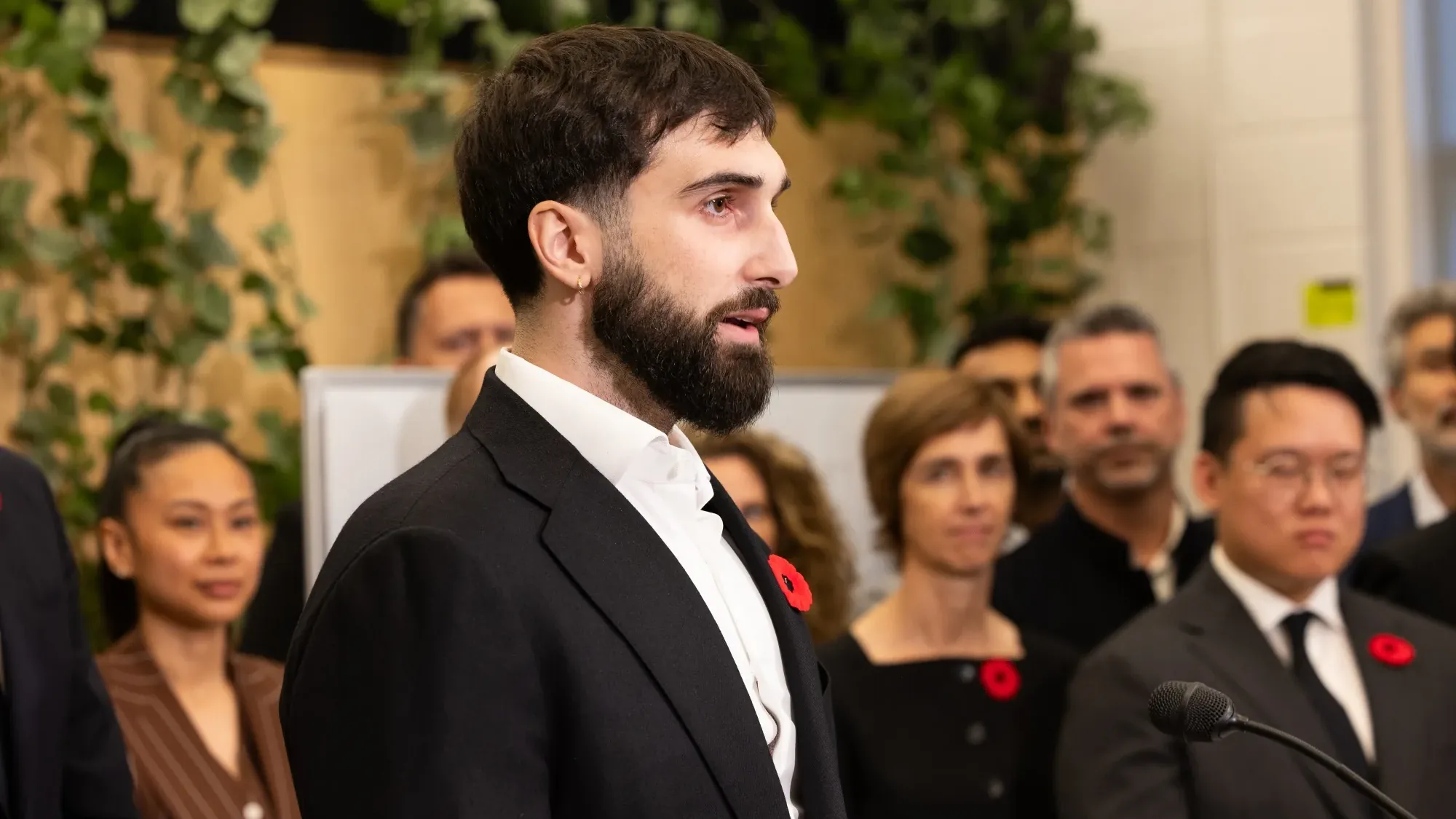
- The same-day Canada Daily newsletter is titled "It's Not a God." Its readable lede says Canada has its first AI billionaires, and that they owe that status in part to opting out of the race for superintelligence that spooked financial markets this week. The photograph is of chief executive Aidan Gomez, by Nasuna Stuart-Ulin.
- The original Bloomberg page returned 403 here, and Bloomberg Law cuts off after the lede. Interview quotes from Nick Frosst and Aidan Gomez appear in an AInvest write-up of the same story that I fetched and that links those lines back to Bloomberg. I do not use that page's extra revenue, Series E, or government-stake figures, which I did not see in the Bloomberg lede or newsletter.
On Nov. 6, 2026, Bloomberg News reporter Ari Altstedter wrote that the race to build ever more powerful artificial intelligence has created a new class of billionaires. Some of them, he added, are starting to question the race itself. The example he names is the three co-founders of Toronto AI lab Cohere. After the company's latest funding round reached a $25.5 billion valuation, the Bloomberg Billionaires Index estimates each founder's stake at about $1 billion.
The same lede says that valuation pales beside the more than $1 trillion Anthropic and OpenAI are said to be targeting. Hours later, Bloomberg's Canada Daily newsletter put the same story under the headline "It's Not a God." Canada has its first AI billionaires, the newsletter says, and they owe that status in part to opting out of the race for superintelligence that spooked financial markets this week. What a reader can check is the valuation gap, and their public choice to sit out that race. Not a proof that superintelligence has been debunked.
[1][2]Here is what I actually read.
Bloomberg Law syndicated the story at 14:00 UTC on Nov. 6, 2026, under the title "AI's Newest Billionaires Want No Part of Superintelligence Race." The three readable paragraphs say: the race to build ever more powerful AI has created a new class of billionaires, and some of them are starting to question the race itself; that group includes the three co-founders of Cohere, whose stakes are now worth an estimated $1 billion each after the Toronto-based company reached a $25.5 billion valuation in its latest funding round, according to the Bloomberg Billionaires Index; and that this valuation pales beside the more than $1 trillion Anthropic and OpenAI are said to be targeting. The text cuts off at "whether the vast sums being poured into increasingly …" and then asks readers to log in.
The Canada Daily newsletter, sent at 21:45 UTC the same day, is titled "It's Not a God: Canada's First AI Billionaires Dismiss Doomsday Scenarios." Its readable lede is: Canada has its first AI billionaires, and they owe their status in part to opting out of the race for superintelligence that spooked financial markets this week. The photograph caption is "Aidan Gomez, CEO of Cohere. Photographer: Nasuna Stuart-Ulin/Bloomberg." The newsletter links to the longer article.
The original bloomberg.com page returned 403 in this environment. The Internet Archive had no usable snapshot. Beyond the lede, the newsletter intro, and the photo caption, I do not have the full body.
[1][2]The valuation claim has a clear source. The $25.5 billion figure is tied to "its latest funding round." The $1 billion-each figure is tied to the Bloomberg Billionaires Index. Both can be checked against later filings or a later index update. If those numbers hold, the claim holds. If they do not, the numbers should change, not the mood of the headline.
The comparison with "more than $1 trillion" is a comparison with what others are said to be targeting, not with a completed listing price. The lede uses "are said to be targeting." That is a reported aim, not a realized market value.
The newsletter attributes part of their wealth to "opting out of the race for superintelligence." That is the writer's narrative judgment. The test is whether the founders keep spending as if they must match frontier labs on scale, not whether the headline stings.
I could not check the interview quotes against the Bloomberg body itself. An AInvest write-up of the same story, which I fetched, presents these lines as coming from that Bloomberg interview and links them back to the Bloomberg URLs. Co-founder Nick Frosst said, "We have a different understanding of this technology." "We don't think AI poses an existential threat." AI will do great things, he added, "but it's not a god." Co-founder Aidan Gomez, who helped write the paper that introduced the transformer, argues that labs have made each new generation smarter by pouring roughly 10 times more capital, energy and computing into it. "They're probably not going to be able to 10x again." The same secondary write-up describes Cohere as selling models just smart enough for the businesses that need them, banks, oil majors, a submarine maker, governments, that run on the customer's own servers.
If those sentences do not match the paywalled Bloomberg text, the Bloomberg text should win. I do not use the AInvest page's extra figures on about $240 million in annual recurring revenue, a Series E of up to $5 billion, or a Canadian government stake of up to C$1.6 billion, because I did not see those numbers in the Bloomberg lede or newsletter.
[1][2]The strongest steelman is this: if making models smarter really does hit a cost wall, then a business that sells models that are just good enough, and that run on the customer's own machines, can be worth a great deal of money without winning a race toward machines meant to far surpass human intelligence. Gomez's line that labs are "probably not going to be able to 10x again" is a test. If the next public generation again spends about 10 times more money, energy and computing and comes out clearly stronger, that judgment weakens. If spending keeps rising while the capability gain flattens, the gap between $25.5 billion and a more-than-$1-trillion target will look less like losing the race and more like a bet on the other side.
The risks are just as clear. I did not read the full article, so I cannot treat every line in a secondary write-up as a quote Bloomberg has already pinned down. A debate about threats to human survival is not settled by one funding round. Customers who want models on their own servers are telling you about deployment preferences. That fact alone does not prove the next generation will fail to turn "good enough" into a commodity.
[1][2]In the coming months, the checks are these: whether the Bloomberg Billionaires Index still lists each of the three founders near $1 billion; whether Cohere's next round or any public financial update still supports a valuation near $25.5 billion; whether OpenAI and Anthropic are still being reported as aiming above $1 trillion; and whether the next round of model training again shows a jump of about 10 times in spending.
Readers should test the index, the funding valuation, and the next checkable training bill. They should not test the usefulness of the phrase "it's not a god."
[1][2]What can be tested in the Cohere story is the estimate of about $1 billion for each founder's stake, the $25.5 billion funding-round valuation, and their public decision to stand outside the superintelligence race. Not a claim that three people have disproved doomsday arguments. If the numbers line up, this is an argument about which kind of model is worth funding. If they do not, it is another billionaire list.
【No.2】
[1][2]