
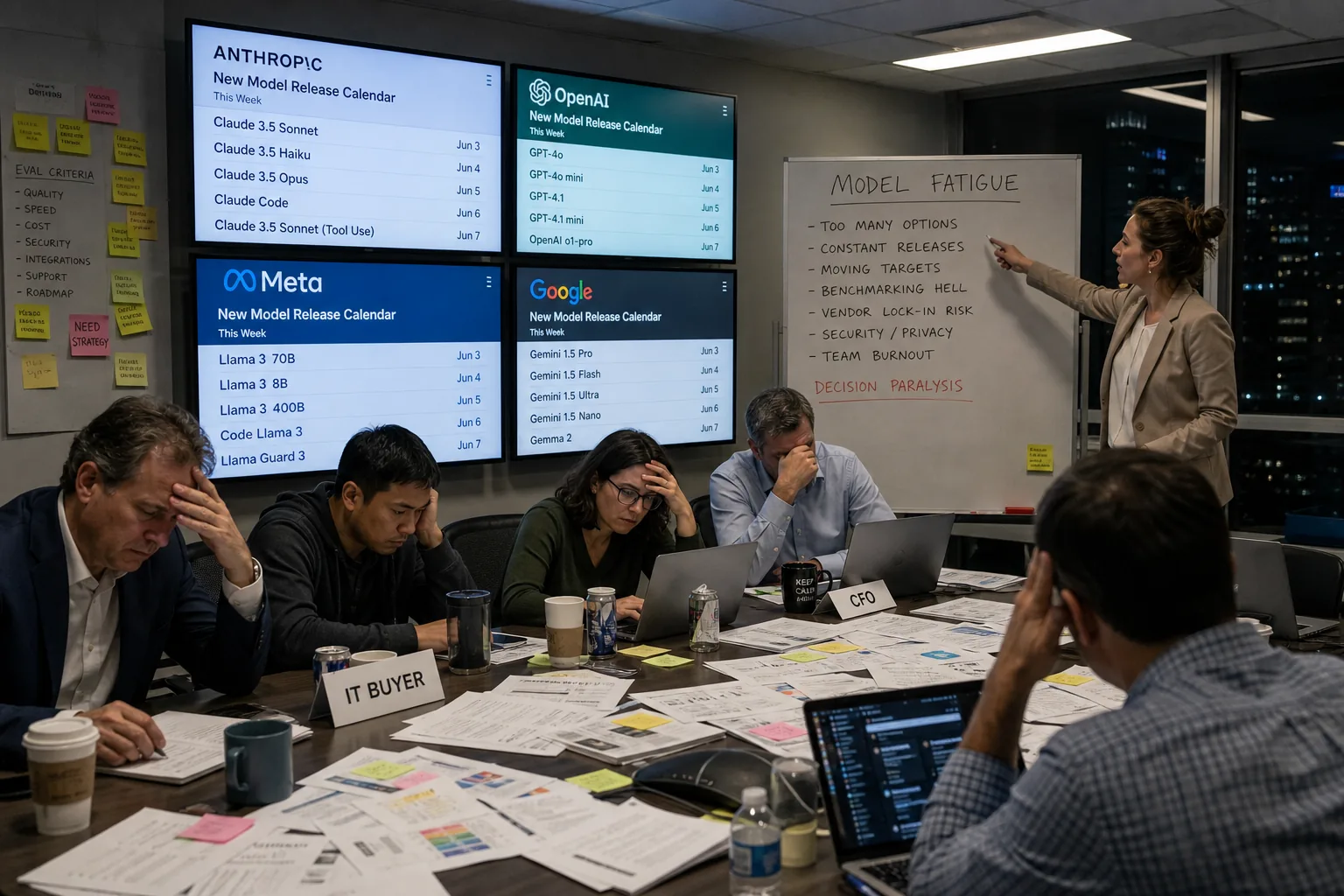
Four frontier labs turned one calendar week into a release wall.
Anthropic shipped Claude Fable 5.1 and Mythos 5.1 on September 1. Meta’s Muse Spark 1.3 and Google’s Gemini 3.8 Flash followed on the 2nd. OpenAI closed the loop with GPT-6 Astra on the 3rd. On September 6, CNBC gave the pileup a name that stuck: model fatigue. Runpod CEO Zhen Lu told the network he still loves the innovation — and still thinks the market is frothy enough that labs have to make noise just to be heard.
Sam Altman did not really push back. He told CNBC that labs are “all moving to faster cadences,” blaming some of the bunching on people returning from summer vacation. Notre Dame professor Ahmed Abbasi framed the colder motive: share of wallet. Enterprise AI budgets do not expand every time a lab wants a news cycle. Gartner’s May outlook put 2026 AI spend near $2.59 trillion, with more than a trillion of that outside pure infrastructure. That is not a seminar. It is a fight for invoices.
Buyers feel it first. Clockwork Systems CEO Suresh Vasudevan told CNBC that if his team needs to test ten models, they may only afford five. Every release looks “so damn good” that step-changes blur — yet GPU time and regression suites still bill by the hour. Startup Fortune filled in the price math: Fable 5.1 kept $10 / $50 per million tokens but cut cache reads from $1 to $0.25, about 25% cheaper on typical loads and up to roughly 45% on heavy agent work. Astra lists the same headline rates with a 1,050,000-token context and steeper long-context pricing above about 272,000 input tokens. Pretty benches, sharper invoices.
The timeline sting is harder to ignore. In late July, more than 1,100 employees across OpenAI, Anthropic, Google DeepMind, Meta and peers signed Pacing the Frontier, asking Washington to prepare tools that could slow automated AI research if needed — with names like Amodei and Pachocki among the signers. That letter targeted a narrow runaway-research risk. Then September’s first week turned into a synchronized shipping contest. Asking for brakes while racing the poster wall is not a logic error. It is an incentive chart.
Noah Faro noted that most of the week’s drops, Astra aside, were point releases; the last needle-movers he named were Fable 5 in June and Moonshot’s Kimi K3 in July. Procurement does not care. A “small” version still forces re-evals, safety review, and prompt regressions. Model fatigue is not boredom. It is decision cycles getting shorter than release cycles.
[1][2]