
The English press release from Preferred Networks carries the timestamp 2026-11-05T09:00:00+09:00, which is 08:00 in Beijing on Nov. 5, the inclusive start of this noon window. The dateline is TOKYO, November 5, 2026. The release announces open weights for PLaMo 3 Translate in four sizes, 0.8B, 2B, 8B, and 31B, covering 53 languages including English and Japanese. The models are described as able to run on a phone, a laptop, or a company's own servers, so the source text and the translation need not be sent to an outside cloud. The same page says the smallest 0.8B model outperforms Google's TranslateGemma and Tencent's Hy-MT2 in the company's own comparisons. Those comparisons include proprietary benchmarks. The prose prints no score, no sample size, and no error bar.
[1][2]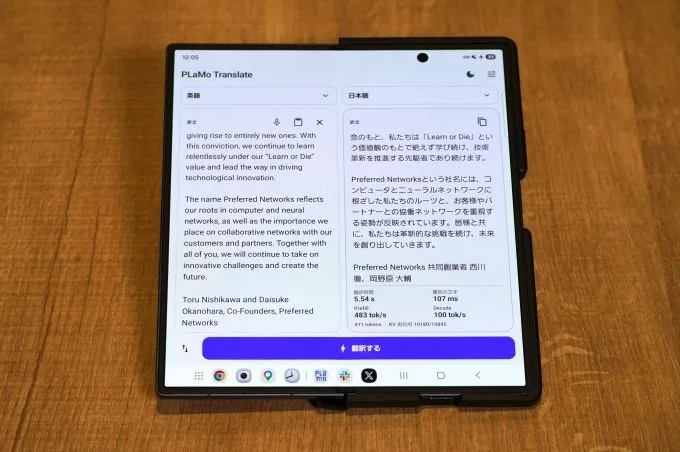
The announcement says the four models are on Hugging Face today. The hub record for the 31B repository uses a different clock. createdAt is 2026-10-26T08:41:09.000Z, which is 16:41 in Beijing on Oct. 26. lastModified is 2026-11-04T14:13:43.000Z, which is 22:13 in Beijing on Nov. 4. An announcement this morning and the first timestamp on the repository record are not the same event. This column dates the story from the 08:00 release and does not treat the October repository timestamp as this morning.
[1][2]The license is written three ways on the same page, and the three ways do not match. A correction is stamped 11:45 on 11/05/2026, and that line itself has no time zone. The page's article:modified_time is 2026-11-05T11:45:39+09:00. Read in that zone, it is 10:45 in Beijing, still inside the noon window. That sentence stacks "less than 1 billion yen" and "1 billion yen or less" in one line. The first license paragraph says individuals and enterprises with revenue of 1 billion yen or less in the most recent fiscal year may download the models free of charge, for commercial and non-commercial use, and it does not mention advance registration. A later paragraph switches the line to less than 1 billion yen, converts that to about $6.5 million, and says organizations above the line need a separate commercial agreement with PFN. The page never says which sentence governs.
[1][2]The four sizes are described as a way to trade off speed, quality, and hardware capacity. Smaller models are said to deliver translations completely offline, from personal mobile devices to on-premises servers and embedded services. The 0.8B demonstration is a phone in airplane mode. The parenthetical says it runs at normal speed in a demo environment. All four models are listed under the PLaMo Community License. The footnote prints the base as "baked on PLaMo 3 NICT," the pretrained model from the joint research with NICT. That spelling is on the page. It is not a second release.
[1][2]The page also lists several arrangements for use, none of them with a measurement attached. Smaller models are described as able to run offline on phones, laptops, and wearable devices. A person can supply surrounding context and a glossary, and, for Japanese, choose a formal or a plain register. Because the computation stays on a device or server under the user's control, contracts, research documents, and support logs are described as never sent to an outside cloud. The company expects uses in tourism, business, and disaster response. That is an expectation, not a counted customer list. An organization can try speed and quality on its own hardware before connecting the model to a workflow. Above the revenue line, the page offers an inquiry form and no price.
[1][2]The photograph is the phone demonstration in the release. The caption says it runs at normal speed in a demo environment. The page does not say a matching phone app has been shipped, and it does not attach a measured offline-speed table. The claim that 0.8B beats the other two translation models stays inside PFN's own evaluation. A chart cannot stand in for a public score table. A footnote says the translation model is built on PLaMo 3 NICT, a pretrained model from joint research by PFN and Japan's National Institute of Information and Communications Technology. This column does not relay the training procedure.
[1][2]