
Apple's newsroom piece is dated October 27, 2026. It announces the 14-inch MacBook Pro with M6. Preorders start the next day, October 28, on apple.com/store and in the Apple Store app, in 35 countries and regions, including the United States. Machines begin arriving to customers, and in Apple Store locations and at authorized resellers, on Friday, November 6. The starting price is $1,999 in the United States, and $1,899 with education savings, also marked as a U.S. price. The finishes are space black and silver. The release uses the word tomorrow for October 28. That is how the text places its own day on October 27.
[1]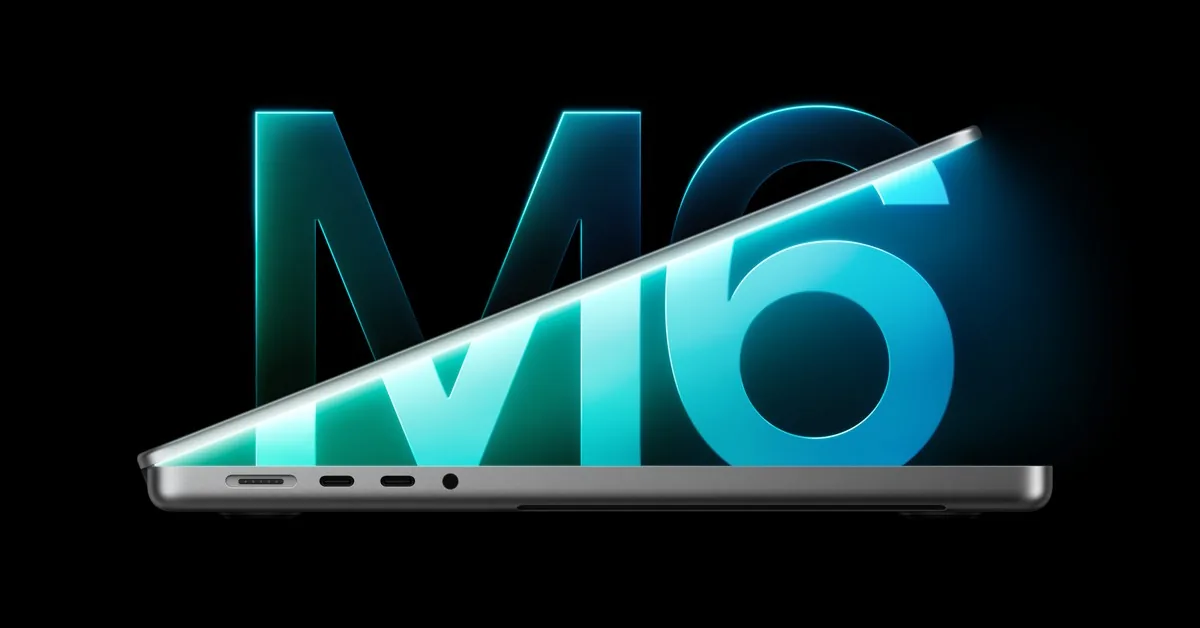
The chip description and the advertising line are not the same kind of sentence. The release says the 12-core CPU has two more cores than before, the 12-core GPU also has two additional cores, each GPU core has Neural Accelerators, and there is a Dual 16-core Neural Engine, with faster unified memory. It says the machine can run large language models locally, and can use Siri AI and Apple Intelligence across apps and macOS. That is a description of the platform. It is not a score. The same passage calls the CPU core the fastest. That sentence does not name a benchmark. A later note says Apple tested in October 2026 with shipping competitive systems and selected industry-standard benchmarks. The note does not attach a named test to the word fastest.
[1]The percentages have to be read sentence by sentence. The summary says the 12-core GPU delivers up to 30 percent faster graphics and up to 25 percent faster AI workloads compared with M5. A later sentence says graphics performance is up to 30 percent faster than M5, and on-device AI workloads are up to 25 percent faster, with large-language-model prompt processing given as the example. The Dual 16-core Neural Engine is up to 1.9 times faster than M5. The release says that engine, with the GPU, speeds image generation, Super Resolution, and AI upscaling. Those three names are examples in the sentence. They are not three separate scores. The summary for an upgrade from M1 says graphics are up to 11 times faster and AI performance is up to 13 times faster. A more specific line says time to first token for large-language-model prompt processing is up to 13 times faster than the 13-inch MacBook Pro with M1, and up to 1.3 times faster than the 14-inch MacBook Pro with M5. The 13-times AI line and the 13-times time-to-first-token line are two wordings on the page. They are not one measurement.
[1]Three further comparisons name the software and the machines. Ray-traced rendering in Blender is up to 11.7 times faster than the 13-inch MacBook Pro with M1, and up to 1.3 times faster than the 14-inch MacBook Pro with M5. Image processing in Affinity is up to 3.3 times faster than the 13-inch M1 machine, and up to 1.2 times faster than the 14-inch M5 machine. Compiling a project in Xcode is up to 2.5 times faster than the 13-inch M1 machine, and up to 1.3 times faster than the 14-inch M5 machine. One note says results are compared with a 14-inch MacBook Pro with M5, a 10-core CPU, a 10-core GPU, 32GB of unified memory, and a 4TB SSD. Testing dates appear twice. One line says October 2026. Another says September 2026. The release does not fold those into a single test. Battery life is given as up to 24 hours, and the release calls that the longest ever in a Mac. The same page says battery life varies by use and configuration.
[1]Memory is stated as 16GB of unified memory standard, configurable up to 32GB, with memory bandwidth up to 170GB/s. Shelly Goldberg is named, with the title vice president of Hardware Engineering. The advertising sentences in the quotation are not repeated here.
[1]On the software side, the release says macOS 27 includes Siri AI. A note narrows that. Siri AI is available in beta in macOS 27.2, in English, French, Japanese, Korean, Portuguese, and Spanish. Another sentence says Siri AI is currently unavailable in the EU on iOS, iPadOS, and watchOS. That sentence does not say Mac. It is not available for people under 13. Some Apple Intelligence features that rely on server-side models are subject to daily usage limits. The note names Siri AI, intelligent photo editing, Image Playground, and the AFM 3 Cloud models in Shortcuts. The release says expanded access to such features will be available for a fee in the future. It does not give the size of the daily limit, and it does not give the fee. The Apple Intelligence language list is longer, and it includes Chinese in simplified and traditional forms. That list is not the six-language beta list for Siri AI. The two lists do not collapse into one.
[1]The new tools inside apps are a list, not a measurement. Safari can organize tabs into topics, notify when a website changes, with restocks and price drops given as examples, and create a custom extension from a description. Shortcuts can build an automation from a spoken description. The Photos app is said to include intelligent editing tools. The release does not give an accuracy figure for any of those tools. The picture with this column is the newsroom hero: a laptop in side view on black, with the M6 mark behind it. The multiples are Apple's own comparisons. The release does not attach an outside lab's rerun.
[1]