
Figma dates the post October 29, 2026. The byline is Josh Clemm, vice president of software engineering. A structured timestamp on the page is exactly 21:00 UTC, with zero minutes and seconds, so it is a poor event clock. A topic card carries a separate time of 20:40:40 UTC, which is when the card appeared, not a clock printed in the article.
[1]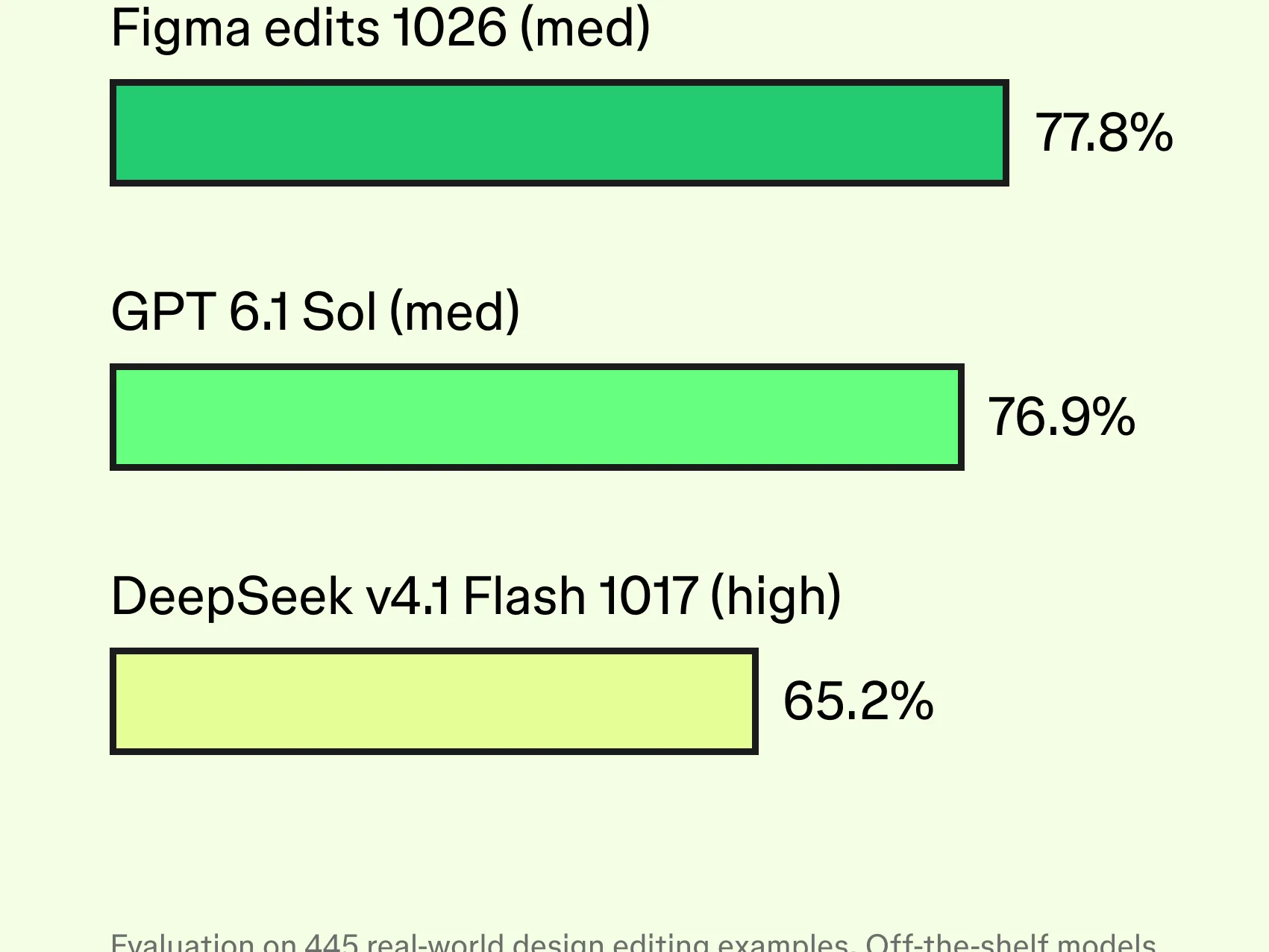
The post says specialized post-training can compete with frontier models on this kind of task. The work in view is edits to designs already on the canvas, not a new design from a blank file. Frontier models could not understand Figma syntax when the work started, and heavy system prompting would have consumed a large number of tokens, so the team used supervised fine-tuning instead. Each training example paired a starting design, a synthetic edit request, and a successful change. Designs were represented in Figma's own file format, so a change the model produced could be applied back to the canvas.
[1]Larger teacher models attempted the edits. Deterministic validators and visual model judges checked the candidates, including whether the output was valid and whether the request was fulfilled. The generation pipeline could revise an edit from evaluator feedback. The post says an earlier Llama 3.3 70B, trained on more than 250,000 examples, was competitive on editing tasks with the top models of that time. Later base models include newer Qwen models, Muse Spark Open, Inkling, and others. Supervised fine-tuning on its own ran into limits: imitation learning pulls outputs toward designs seen in training and weakens generalization, and it is less sample efficient. The latest recipe also invests in reinforcement learning.
[1]One sentence in the prose says the comparison uses an unreleased Figma edits model, post-trained on Qwen 3.8 27B. The chart on the same page prints a first row, “Figma edits 1026 (med),” at 77.8 percent; a second row, “GPT 6.1 Sol (med),” at 76.9 percent; and a third row, “DeepSeek v4.1 Flash 1017 (high),” at 65.2 percent. The chart note says the evaluation used 445 real-world design editing examples, that off-the-shelf models were run at default effort, and that an automated design judge graded them after a separate human check of the judge's reliability. The alt text instead says “Figma design edits v3” against “Sol 6.1,” and it does not name the third row. The three labels do not match. This column does not treat 77.8 percent as the score of a model that has already shipped.
[1]The product figures are a different set. The post says that earlier this month the Figma agent was rolled out to all users, and that the agent includes the first-party editing model. The agent runs that specialized model and leading third-party models, and uses them for different parts of the work. Image generation, vectors, and brand-new design explorations use the best third-party model available at the time. Precise edits and iterations the specialized model handles well use the in-house model. From beta to general availability, typical tasks are about 20 percent faster. In head-to-head tests with expert designers, the new agent beats or matches the previous production agent 62 percent of the time. User ratings are 33 percent higher, and users undo the agent's work 60 percent less often. The share of work powered by the in-house post-trained design model has more than doubled, and the average cost per message is down. The post says those gains come from the models, the tools, and the harness together. The editing model is one part of that.
[1]The 20 percent, the 62 percent, the 33 percent, and the 60 percent describe the whole agent moving from beta to general availability. They are not the score of the unreleased model on the chart. The 77.8 percent against 76.9 percent is one internal comparison, and the alt text and the printed labels still do not use the same name. The page does not say how many head-to-head trials sit behind the 62 percent, or how many ratings sit behind the 33 percent.
[1]