
IT Home reported at 21:08 on November 2, 2026 that Tencent Hunyuan had released the AI research system Hyra 2.0 the same day. The reported shift moves the work from using AI to crack scientific problems directly toward having general agents take part in building and upgrading scientific models, research workflows, and software tools, so that one round of work can be reused later.
[1]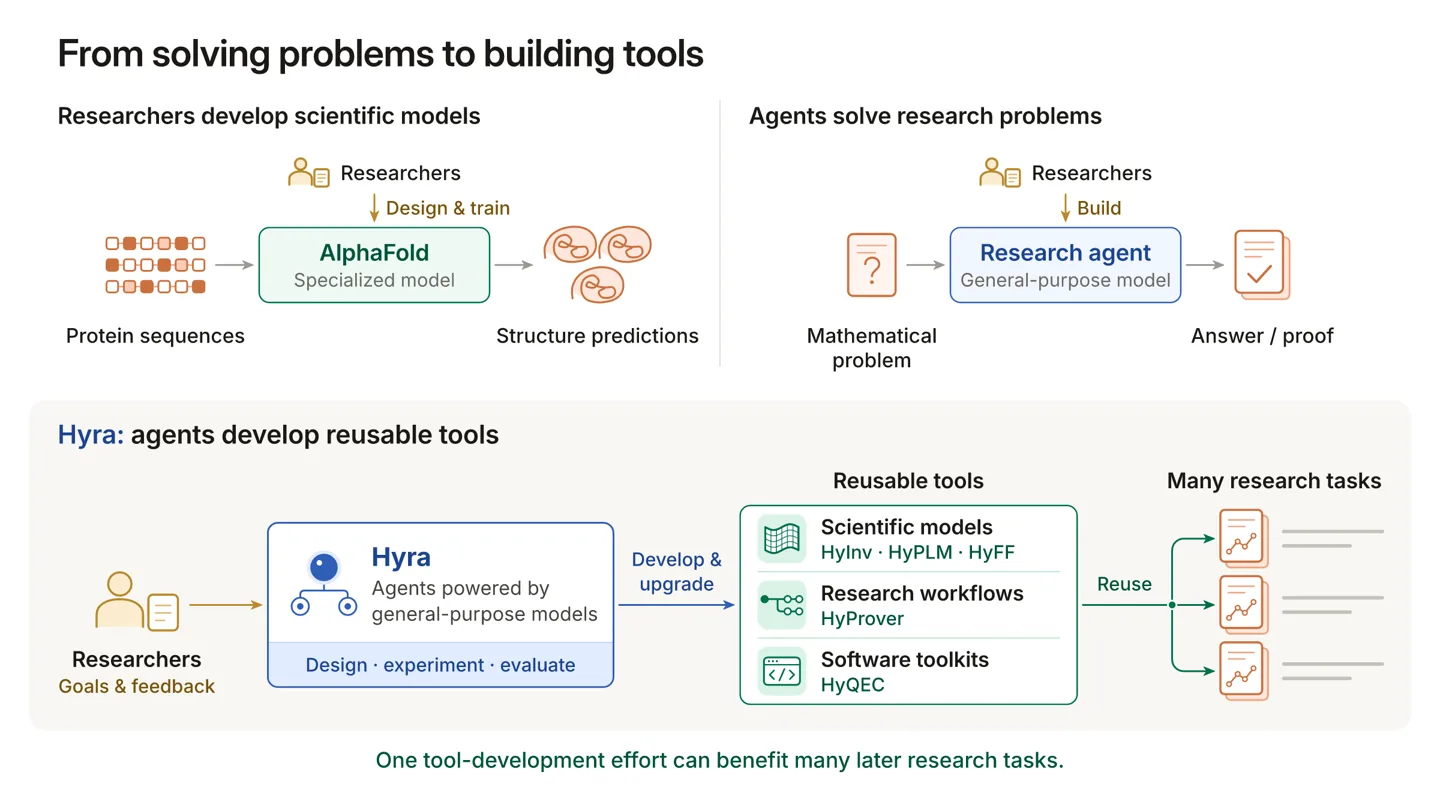
Hyra 1.0 had driven an open model to a problem in additive combinatorics that had stayed open for more than fifty years. Version 2.0 adds the claim that gains from upgrading a tool can be reused by later tasks.
[1]The architecture has three layers. Overall talks with human researchers and aligns goals. Mission stays with one research question and judges which path to take. Worker reads code, runs experiments, and analyzes failures on its own, and can question Mission's judgment. Storage is split among project state, layered agent memory, and a shared library called Books. During a review, a method that travels can be packed into a skill for a later task.
[1]The retelling does not name released models, parameter counts, or a repository address. A diagram on the page carries names that do not appear in the body.
[1]