
LangChain published a blog post dated October 27, 2026, by Amal Irgashev and Shreya Talegaonkar. The post describes Content Studio, a design agent used inside the company. A colleague describes the job in Slack, attaches material or a brief, and the agent returns files that follow the brand. The post says the open-source repository contains the full harness, and that Managed Deep Agents can deploy it to a team's Slack. The same passage announces GTM Engineering Live on October 28, and says that session will cover parts of the harness and the interaction that did not fit in the post. At the time the post was published, that session was an announcement, not a record of an event that had already taken place.
[1]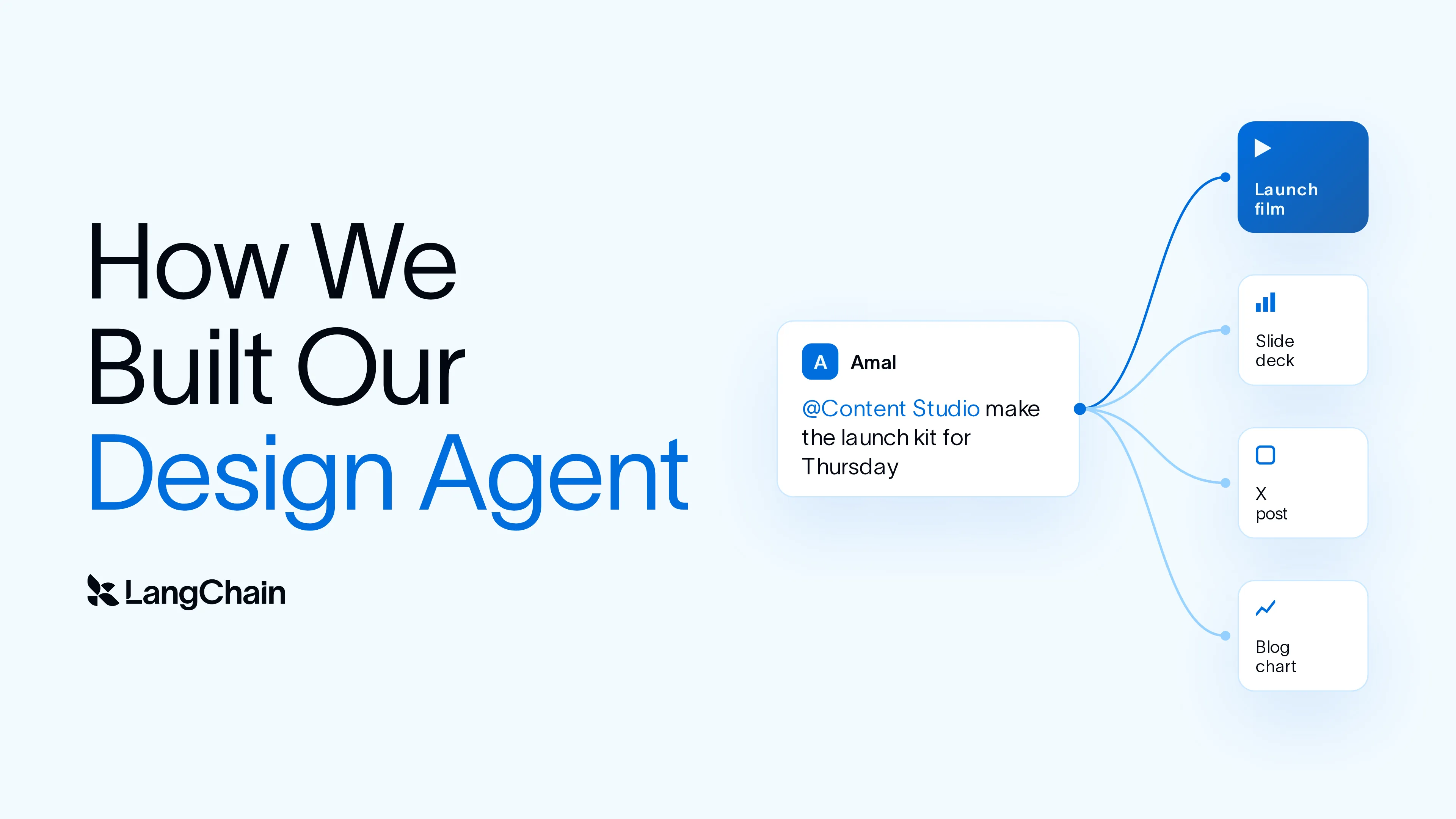
The results are written as the company's own books. Content Studio has delivered over 3,000 assets inside the company, including more than 80 slide decks. One of those decks was used in the company's most-watched organic video on YouTube. Posts that used the work drew about 4.5 million views on X. On the LangChain account, posts with those visuals earned about twice the likes and 3.7 times the bookmarks of other posts. Three in four requests now come from outside marketing, and 75 percent of the people using it come back every week. The median request costs about 50 cents in model spend, down from about $8 in mid-September. After the move to Managed Deep Agents, the company's own code shrank by about 80 percent. Every one of those sentences is LangChain's count. The post does not present them as a customer sample or as an outside audit.
[1]The post says the early feedback was not great, and that four months went into teaching the agent taste and design principles, mostly by watching it get things wrong in front of the company. The first harness included 115 reusable interface components for titles, layouts, and animation, to cover work the model could not yet do. The post says that after Opus 5.5 arrived, the quality jumped, and most of the hard-coded rules were removed, leaving the design principles and the high-level guidance. The cut in rules is the blog's account of an internal process, not an outside model evaluation.
[1]The post says every Slack thread gets its own sandbox. The agent keeps the project between turns, works across a video engine, image tools, and a shared canvas, and inspects the frames it renders. The motion layer names two engines. HyperFrames is described as HeyGen's open-source video framework, which turns a video into elements on a web page. The other engine draws each frame in code and blends up to 16 moments into one frame. The post does not explain how the sandbox is isolated, and it does not give deployment commands.
[1]The section on taste quotes a comparison from Katie Dill, head of design at Stripe. She describes modernist forms that were copied after the war until only the look remained, calls that zombie UI, and says software can end up in the same place. That is Dill's comparison, not a count of interfaces measured by LangChain. The post's own example is one prompt run twice: a local coding agent missed the right logo lockup, the text alignment, and which colors were primary or secondary, while Content Studio returned an image that followed the brand. The post treats the difference as a question of who fills in a decision the brief left open.
[1]The blog does not say how many teams outside the company have deployed the repository, does not say how many of the 3,000 assets were published externally, and does not give a sampling method or an interval for the 50-cent median or the twofold likes. The October 28 session is only an announcement in the text.
[1]