
The Hugging Face post carries datePublished 2026-10-30T09:58:28.399Z, and the page says Published October 30, 2026, which is 17:58 Beijing time on 30 October 2026. DiffuSpace announces Clover-35B-A3B-Preview and calls it the first version of DiffuSpace Clover. The lineage in the post runs through Dream 7B, released in April 2025 by the NLP group at the University of Hong Kong. The Dream family, the post says, has passed 2.7 million downloads on Hugging Face. Team members then started a new chapter at DiffuSpace. The license is Apache. Weights and code are listed on Hugging Face, GitHub, and ModelScope, with inference support named for SGLang and llama.cpp.
[1]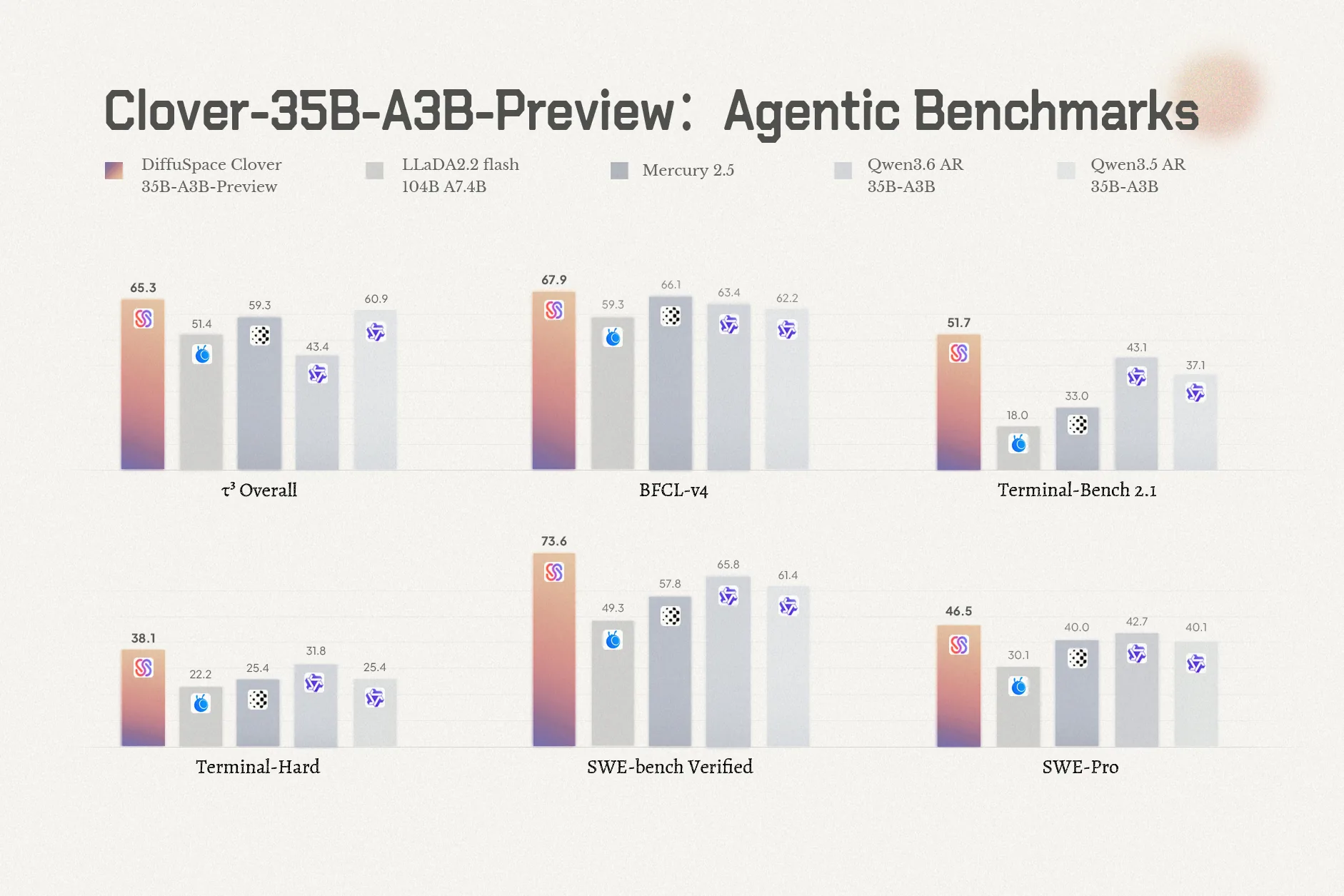
The specification is a mixture-of-experts diffusion language model: 35 billion parameters in total, 3 billion active, plus a thinking mode. The post sets the comparison against the similarly sized autoregressive model Qwen3.6-35B-A3B and says Clover scores higher on multiple benchmarks while generating faster. On agent and tool-use tasks it prints three of the six figures: 73.6 on SWE-bench Verified, 51.7 on Terminal-Bench 2.1, and 65.3 on the tau-cubed overall score. The post says those six agent benchmarks are the highest among the models it evaluated, and it names LLaDA2.2 flash, Mercury 2.5, Qwen3.6-35B-A3B, and Qwen3.5-35B-A3B as the models it claims to beat. That ranking is the post's own table, not an outside leaderboard.
[1]The general-capability figures are 83.8 on GPQA Diamond, 95.8 on ZebraLogic, and 72.0 on AA-LCR, under headings the post describes as instruction following, knowledge, logical reasoning, and long context. The wording is that Clover matches or exceeds similarly sized autoregressive models. The speed paragraph is an internal agent workload: 680 tokens per second overall on one NVIDIA GB300, in BF16, with a batch size of 1. On one H200 the same paragraph puts agent tasks at 515 tokens per second, against 365 tokens per second for a similarly sized Qwen setup accelerated with DFlash2. The 680 and 515 figures are tied to the test conditions the post names.
[1]The on-device paragraph says an INT4 build runs on an NVIDIA RTX 5070 Ti with 16GB of VRAM, at 101.8 tokens per second on MATH-500, against 48.5 tokens per second in the comparison tests with similarly sized MiniCPM and Qwen models. A second lightweight set names MiniCPM-V 4.7 in the same 35B-A3B shape, LFM2.5 at 24B-A2B, Nemotron 3.5 Lightning at 30B-A3B, and Gemma 4 at 26B-A4B. The post says Clover is highest on six of nine benchmarks. Against MiniCPM-V 4.7 the gaps it prints are 15.7 points on Terminal-Bench 2.1 and 28.0 points on SWE-bench Verified. Tool use is given as 67.9 on BFCL-v4 and 14.4 on the tau-cubed banking score. Knowledge reasoning includes 84.8 on MMLU-Pro. In the demos, a WebMCP evaluation of 49 tasks with three attempts each has a median agent time of 1.52 seconds for Clover and 8.86 seconds for the model the post writes as Gemini3.6 Flash. Creating a private project and inviting members takes Clover 13 steps and 169.9 seconds, against 21 steps and 392.3 seconds for Qwen3.6 Flash. On a compound drone-dispatch instruction, Clover returns five correct results together in 0.97 seconds. Qwen answers after 3.78 seconds and, the post says, reads one mapping mission as a medical mission. Those are the post's demo logs.
[1]A decision model built on the same preview weights is described as coming at a later date. It is not a downloadable model in this post. The internal validation set has 500 groups and 2,420 related questions. Joint mode is written as 95.0 percent of individual questions correct and 80.4 percent of groups fully correct. Independent mode is 89.8 percent and 62.4 percent. TypeSafe's Jev, on historical evaluations of the same questions, is written as 63.6 percent and 15.8 percent. That set is internal. The picture is the post's agentic bar chart. Terminal-Hard and SWE-Pro appear on the chart and are not copied into the figures above. The post also describes changes to a gated delta network. Those computation steps are left out of this column.
[1]