
要点
- HF blog with NVIDIA, 2026-11-05; four Cosmos3-Nano open-weight post-trains of Cosmos 3 Nano; OpenMDW1.1 for commercial and non-commercial use under its terms.
- Transfer-Auto: offline multi-view (up to 11 cameras) + optional RGB-LiDAR with World Scenario Map controls.
- Sim-Auto: causally distilled streaming camera+LiDAR chunks for interactive rollouts; adapt Transfer-Auto first, then distill.
- Sim-Transfer: physics-simulator spatial controls (depth/seg/edges/blur) + text → photoreal RGB; Sim-Bimanual: actions → video for YAM/AgiBot two-arm setups.
- Four-stage recipe: bidirectional adaptation → teacher forcing → consistency distillation → self-forcing; open skills/notebooks; technical report linked.
On 5 November 2026, Hugging Face published NVIDIA's note on four new Cosmos 3 Nano open checkpoints aimed at interactive world simulation. The package is not one "do everything" video model. It is a small family of post-trained 16B Nano variants that each own a control interface: offline multi-sensor driving transfer, streaming driving simulation, simulator-control-to-RGB, and action-conditioned bimanual robot video. The thesis is about infrastructure shape. Open interactive world modeling gets real when the shared substrate is a set of post-trainable jobs with explicit controls, not a single demo reel.
[1]What shipped
Cosmos3-Nano-Transfer-Auto generates synchronized multi-view driving video (up to 11 cameras, including fisheyes) with optional joint RGB-LiDAR, steered by per-camera World Scenario Map controls and text. It is the offline foundation for adapting to a new sensor rig before causal training and distillation produce a streaming sibling.
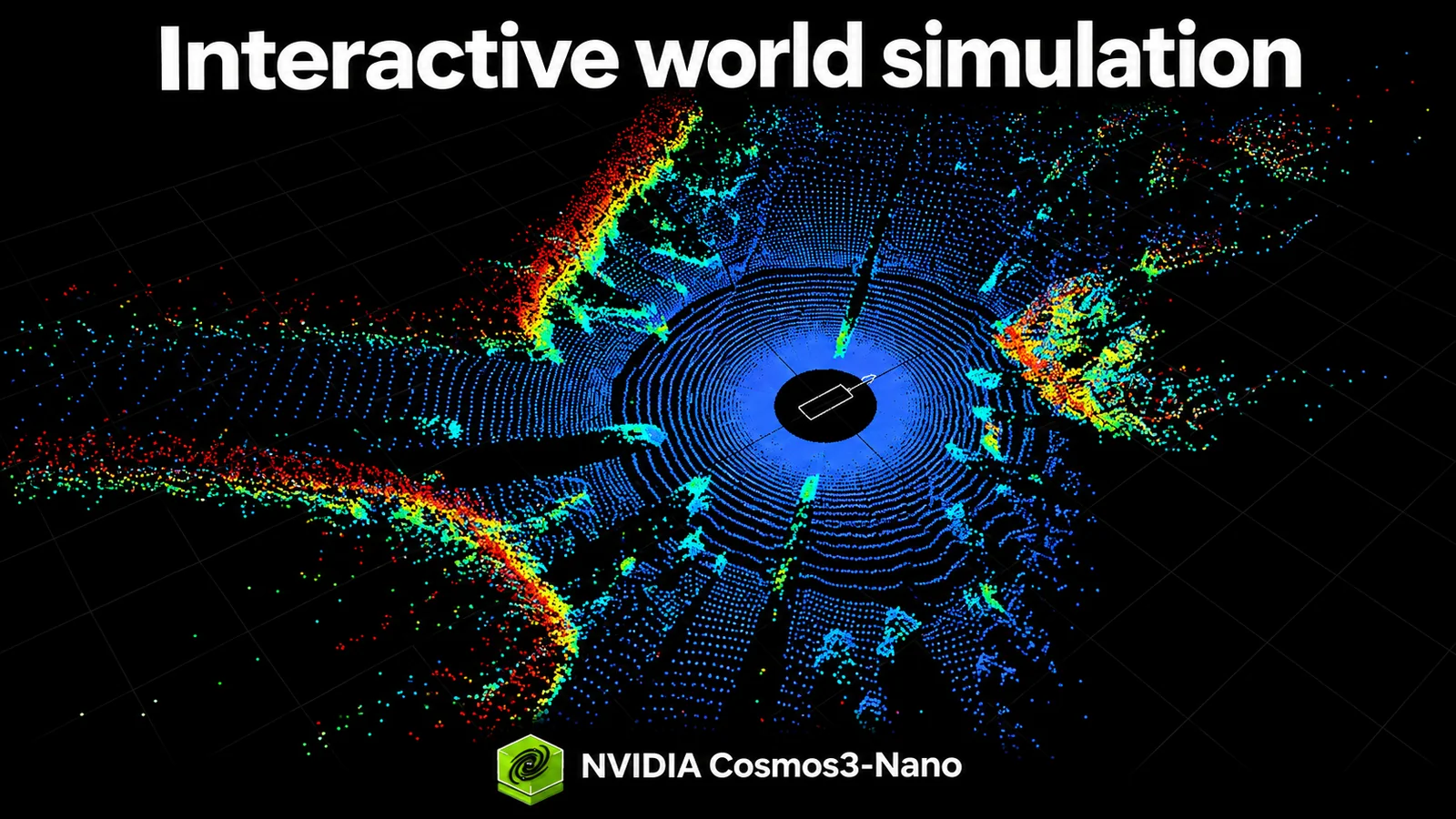
Cosmos3-Nano-Sim-Auto is that streaming sibling: few-step denoising of short synchronized camera and LiDAR chunks, conditioned on history and updated driving controls. Closed-loop use still needs a simulation runtime and WSM renderer. Cosmos3-Nano-Sim-Transfer leaves physics in the external simulator and renders RGB from depth, segmentation, edges, blur, plus text. Cosmos3-Nano-Sim-Bimanual predicts the next frames from robot or camera actions for YAM and AgiBot bimanual embodiments, with a documented action schema (mixed-action example uses 59 controls padded to 64).
All four are post-trained examples of Cosmos 3 Nano with 16B trainable parameters, released under OpenMDW1.1. The blog points to downloadable checkpoints, a technical report, open "skills" for agents, and notebooks. The Mixture-of-Transformers backbone and four-stage recipe (bidirectional adaptation, teacher forcing, consistency distillation to four denoising steps, then self-forcing on the student's own history) are the reusable method story.
[1]Evidence on the table
What is hard here is openness and interface clarity: named checkpoints, control contracts, distillation path from Transfer-Auto to Sim-Auto, and an explicit action schema for bimanual work. What is soft is policy-learning payoff. The post itself says the remaining work is to measure where models faithfully support policy learning and evaluation, and where they fail. Hardware notes mention a GB200-tested vLLM-Omni setup without calling it a minimum. There are no public closed-loop driving or manipulation benchmark tables in the blog body comparable to a leaderboard release.
That imbalance is normal for a platform drop. It still means the falsifier is external: someone must show that post-training these Nano checkpoints on private rigs yields better policy data or safer eval than today's closed world models or classic simulators alone.
[1]Steelman and gaps
Steelman. Open weights can still be compute-hungry, license-constrained in practice, or weak under distribution shift. Streaming distillation can compound errors; self-forcing exists because history contamination is real. Multi-view LiDAR claims need third-party sensor-rig replication. Robotics teams may prefer tighter coupling to their own physics engine than Sim-Bimanual's action-to-video path. "Interactive world simulation" branding can outrun measured closed-loop gains.
Those limits define a buyer's checklist. They do not cancel the useful split: offline transfer, streaming sim, sim-control rendering, and embodiment-conditioned prediction are different products that often get mashed into one trailer. Separating them as open post-trains is how other labs compare methods without reverse-engineering a monolith.
[1]Who should care, and what to watch
Autonomous-driving data teams gain an open path to weather, lighting, and layout expansion with multi-view and LiDAR controls. Robot learning groups get an action-conditioned video prior for two-arm setups they can post-train. Simulator vendors can treat Sim-Transfer as a photoreal layer on top of their state. Researchers comparing world-model recipes finally share checkpoints instead of only papers.
Next six months: third-party post-trains on non-NVIDIA rigs; closed-loop eval numbers for Sim-Auto and Sim-Bimanual; whether OpenMDW1.1 terms actually clear commercial fleets' counsel; and whether the four-stage recipe becomes a default citation beside the weights.
[1]Close
Cosmos 3 Nano's useful sentence is not that NVIDIA shipped prettier driving video. It is that interactive world models are being productized as open, job-split checkpoints you are expected to adapt, distill, and measure. Six months out, either independent closed-loop results justify that substrate, or the four names remain a well-packaged research shelf.
[1]