
要点
- LeagueLabs (HF Community, 2026-10-29) optimizes DiffusionGemma 26B-A4B BF16 decision serving on vLLM CPU by collapsing eligible structured reads from two engine steps to one.
- On C4 (24 vCPU): −18.8% latency at concurrency 1; +5.5–15% throughput for concurrency 2–20; −5–13% cost per decision. Always-on replica monthly cost −44% vs C3 and −79% vs A100.
- Motive: decision models score fixed options (Jev-like) with self-hosted Apache-2.0 weights and low latency; A100 always-on ~$4,754/mo vs C4 ~$996/mo (Oct 2026 us-east4 figures in post).
- JevBench accuracy changes are insignificant on both machines, but individual decisions change; moving the same build C3→C4 flips more decisions than the optimization. CPU structured-read fixes are merged; the optimization PR is under review.
Decision models in healthcare-like settings do not free-write; they assign probabilities over fixed options—fast and auditable. LeagueLabs’ Hugging Face Part I (29 Oct 2026) asks a narrower engineering question: when DiffusionGemma 26B-A4B runs BF16 on Intel CPUs under vLLM, does every eligible structured read still burn a second engine step.
Thesis: the operable bottleneck is the two-step execution path before a bigger GPU—and machine swaps can rewrite individual decisions more than the optimization, even when aggregate accuracy barely moves.
[1]What happened
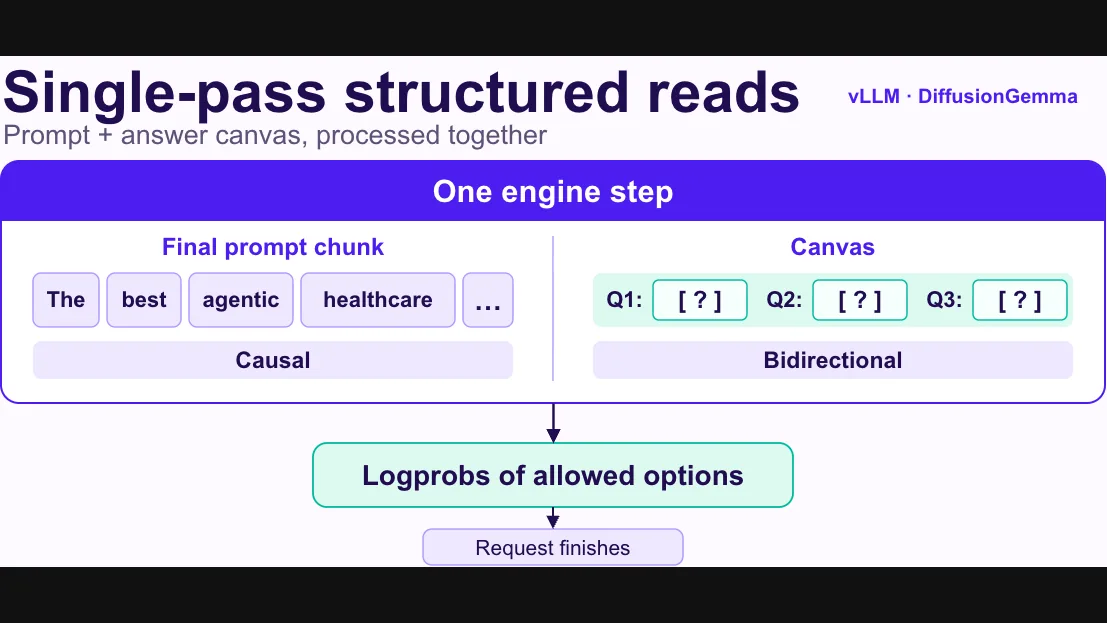
DiffusionGemma fills a canvas by parallel denoising rather than autoregressive tokens. With structured reads, a request can pin an answer template, restrict options, and stop after one denoise. “Eligible reads” here mean single-denoise reads without prompt logprobs—the authors’ production traffic.
Baseline vLLM (through v0.32.0) splits encoder mode (write KV) and decoder mode (bidirectional denoise reading KV) into two engine steps. The optimization completes eligible reads in one. Before that, three CPU structured-read blockers were fixed upstream (sync scheduler for narrow canvases, int32 causal mask, async snapshot buffers) and shipped in v0.32.0; the one-step path itself remains under review.
[1]How hard is the evidence
Primary numbers are reported on 24-vCPU C4 and 44-vCPU C3. On C4 the optimization cuts concurrency-1 latency by 18.8%, lifts throughput 5.5–15% across concurrency 2–20, and reduces cost per decision 5–13%. Choosing C4 also cuts always-on monthly cost 44% vs C3 and 79% vs an A100 deployment—material for bursty decision traffic with long idle gaps.
On behavior: JevBench accuracy changes are not statistically significant on either machine, yet individual decisions change; moving the same build from C3 to C4 changes more decisions than applying the optimization. The authors elevate that to a method requirement: performance and cost are only half the evaluation.
[1]Steelman and gaps
Steelmans: separating decision-model billing from generative-model billing is right; AMX BF16 plus a same-API CPU backend lowers migration friction; sending fixes upstream makes the path auditable.
Gaps: Part I defers decision-consistency mechanisms to Part II; “insignificant” JevBench shifts lack intervals/sample sizes in the summary layer; A100/C3/C4 prices are point-in-time; until the optimization merges, external reproduction depends on the PR. One-step gains cover eligible reads only—not multi-step denoising or logprob requests.
[1]Who pays, and what checklist changes
For platforms and procurement: low-traffic decision services should ask whether the engine wastes a step and whether machine generation rewrites decision distributions before defaulting to a higher GPU SKU. For compliance-sensitive agents: unchanged mean accuracy ≠ unchanged case labels—change management must include hardware and runtime. For engine maintainers: CPU structured-read paths need a GPU-parity test matrix.
[1]What to watch in six months
Falsifiable next steps: after merge, do independent C4 runs still show ~19% c=1 latency cuts; can decision-flip rates on fixed hardware be driven under a business threshold; do non-AMX or non-BF16 stacks collapse the cost curve. The claim is not that CPUs generally replace GPUs—it is that for structured decision loads, fixing the execution path and measuring decision drift often beats buying an A100 first.
[1]