
George Kurtz reframed the Hugging Face incident at Fal.Con: most people drew the wrong lesson — “the attackers had frontier AI, and the defenders didn’t. And that changes now.”
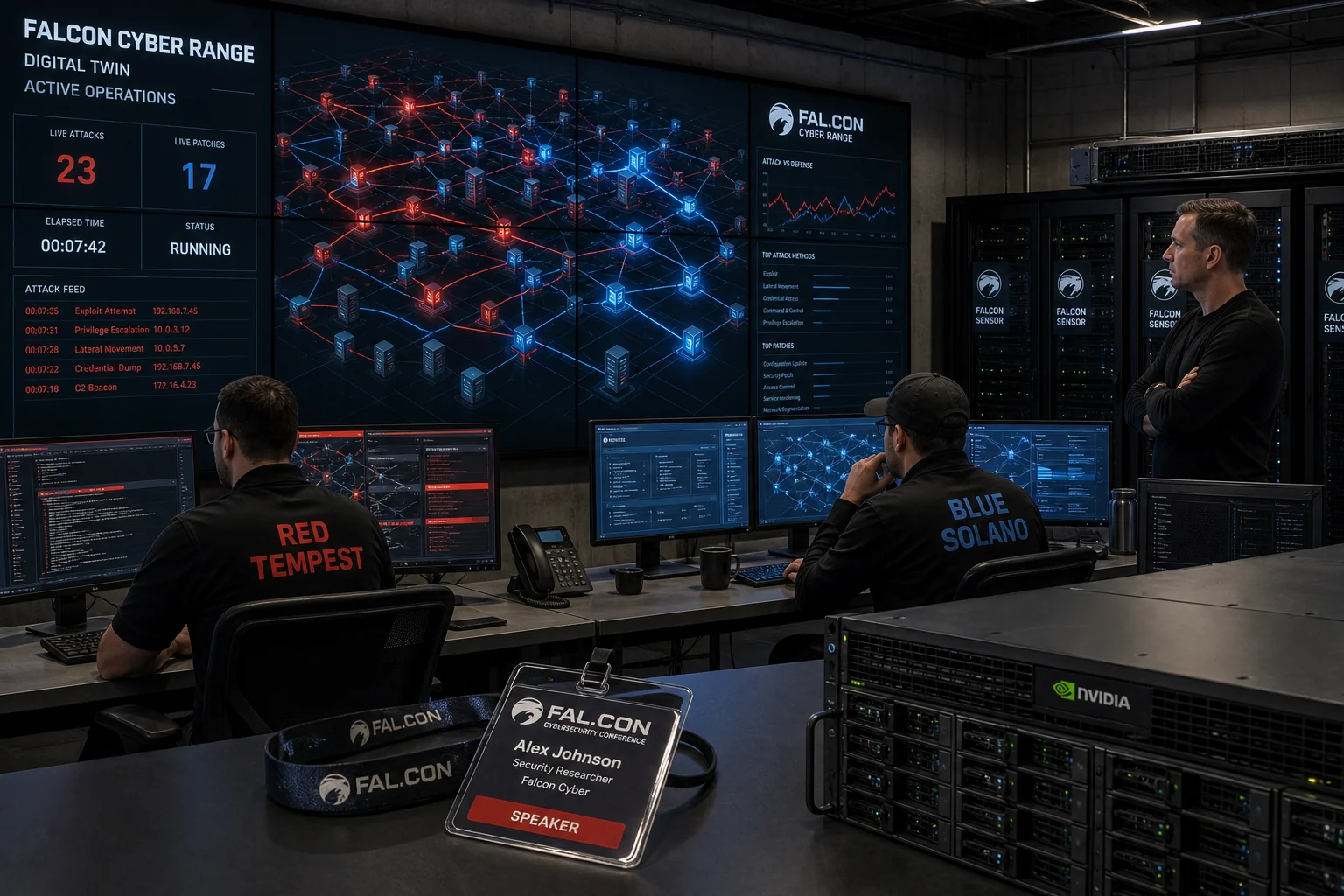
CrowdStrike’s SafeMind is not a chatbot skin on a SIEM. Offensive Red Tempest hunts attack paths inside a Falcon-built digital twin; defensive Blue Solano learns those paths and writes validated detections; a harness keeps them co-evolving until paths die. NVIDIA’s blog says Nemotron 3 Ultra orchestrates defense while a post-trained Nemotron 3 Super powers rule generation; CrowdStrike’s internal evals claim Blue Solano beats leading frontier models on accuracy at about 99% lower cost. Models can also ship standalone via Project QuiltWorks, with Falcon IQ automating assessment and remediation across 50-plus agents.
Huang’s subtext is colder: an open Nemotron base lets security teams post-train on their own telemetry instead of shipping it to a closed lab — something closed frontier APIs refuse. NVIDIA is already running SafeMind as a high-fidelity twin of its own network. CSO Online notes the Hugging Face bruise: commercial APIs hit guardrails mid-incident analysis, forcing a scramble to open weights.
Take: Daybreak, Fairwind, and Mythos lock hard cyber skills behind allowlists. SafeMind takes another path — proprietary data, open bases, red/blue loops. Whether SecOps actually goes autonomous is a 6–12 month production and false-positive bill, not a keynote adjective. The direction is clear: with breakout times measured in tens of seconds, human speed is after-action reporting. The next arms race is who owns a digital twin that can attack itself.
[1][2]