
要点
- Databricks field-engineer blog (4 Nov 2026): “The Enterprise Case for Open-Weight Models on Databricks”; authors Jay Palaniappan, Elise Gonzales, Tanner Waggoner, Toby Messinger, Will Middlebrook.
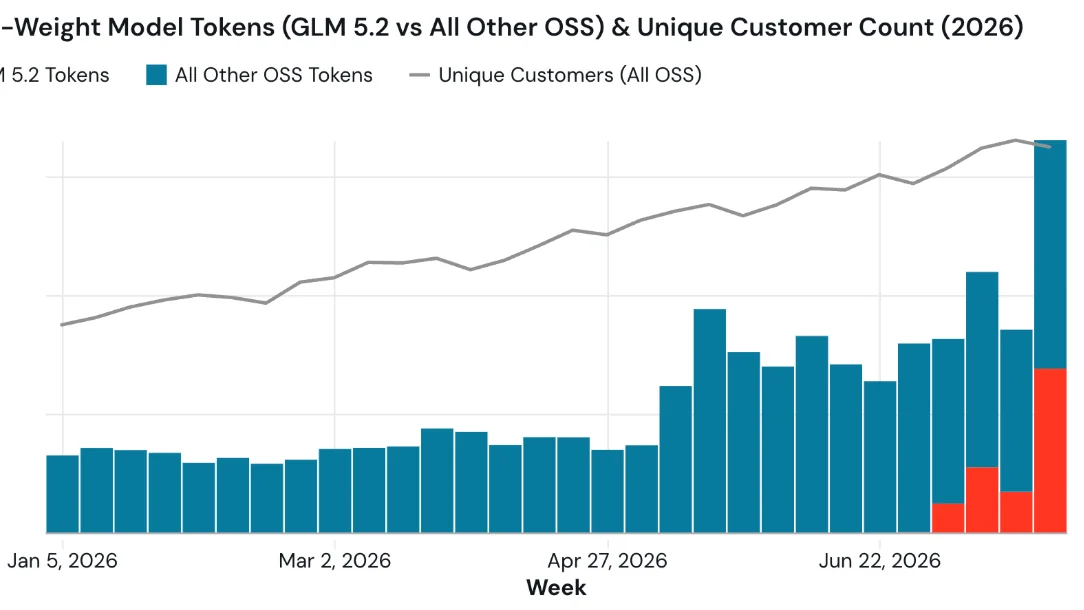
- Internal usage (week ending 5 Jan 2026 → 27 Jul 2026): average unique models per customer 4.2 → 7.1; ~40% of those models open-weight; after mid-July GLM 5.2 launch, that model reached ~40% of open-weight tokens on Unity Gateway.
- Same-model harness delta in Databricks’ own benchmark: 61.7% / 48.1% / 38.4% (harness A / harness B / bare).
- Artificial Analysis cited for GLM 5.3 (max) end-to-end response 9.1s on Databricks; HF July 2026 incident used as example where frontier guardrails refused malware analysis and responders used open-weight GLM 5.2 instead.
On 4 November 2026, Databricks published a field-engineer note arguing that enterprises should stop treating a single frontier API as the default architecture. The post’s durable claim is narrower than the headline’s cheer for open weights. Enterprise AI is consolidating on governed multi-model gateways because open-weight models now approach frontier benchmark scores at lower cost, while harness choice moves measured performance as much as the model name. Single-provider lock-in is therefore the wrong unit of strategy. If customers keep concentrating spend and traffic on one frontier provider while open-weight share on Unity Gateway stalls or reverses, that claim fails.
[1]What the usage numbers say
Databricks reports that from the week ending 5 January 2026 through the week ending 27 July 2026, the average number of unique models per Unity Gateway customer rose from 4.2 to 7.1, with roughly 40% of those models open-weight. After GLM 5.2 became available in mid-July, it climbed to about 40% of open-weight tokens on the gateway within a month, while overall gateway customer growth stayed relatively flat: a shift of existing traffic, not only new logos. CEO Ali Ghodsi told CNBC the company’s July fundraising was partly about securing GPUs to host open models, citing shortages across Japan, Korea, the U.S. and India.
These are vendor telemetry, not an industry census. They still contradict the “pick one lab and standardize” playbook many CIOs wrote in 2024.
[1]Seven pressures, one architecture bet
The authors list seven pressures: AI spend outrunning returns; leaderboard churn (20+ changes at the top since May 2023 on BenchLM’s tracking); frontier guardrails blocking legitimate security work; retention-policy drift away from zero-data-retention assumptions; demand for searchable input/output/agent audit trails; harness effects that dwarf model branding; and open-weight models reaching frontier-class benchmarks at lower cost.
The HF July 2026 incident is the concrete guardrail example: responders feeding real attack logs to hosted frontier models were refused, then ran analysis on open-weight GLM 5.2. The retention example points at Anthropic’s frontier-tier 30-day minimum retention as a compliance shock for teams whose policies assumed prompts were never stored.
Unity AI Gateway’s product answer is one governed API across open-weight, Databricks-hosted frontier, and external providers (Bedrock, Azure AI Foundry), with smart routing, fallbacks, budgets, and MCP/skill registration under Unity Catalog. Omnigent is pitched as the portable harness layer so coding agents (Codex, OpenCode) can point at gateway-hosted open weights via config rather than rewrites.
[1]Steelman and gaps
Steelman. Frontier APIs still win where they are clearly better on a task, and “open-weight on your VPC” still means buying GPUs, operators, and patch discipline. Databricks has every incentive to sell gateway seats and GPU capacity. Internal “~40% open-weight” mixes many small models with a few large ones; token share for GLM 5.2 does not prove quality parity on every regulated workload. Artificial Analysis latency and DeepSWE-by-cost charts are filtered comparisons, not randomized enterprise A/Bs.
That objection is fair. It does not erase the checkable core: multi-model counts rose, open-weight traffic shifted after a competitive open checkpoint landed, and Databricks’ own harness study shows a 23-point swing (61.7% vs 38.4%) for the same model. The strategic unit that survives those facts is a portfolio with routing and audit, not a single model SKU.
What the post does not close: independent replication of the 4.2→7.1 and GLM token-share series; cost-per-successful-task outside coding agents; how often smart routing actually picks open weights when quality SLAs are tight; and whether Omnigent reduces lock-in or merely relocates it to Databricks’ gateway.
[1]Who should care, and what to watch
Platform and FinOps teams still standardized on one frontier should measure unique models in production and the share of tokens that could move to open weights under the same eval harness. Security and compliance teams should treat guardrail refusals and retention-policy changes as first-class architecture risks, not prompt-engineering quirks. Agent builders should stop publishing model scores without naming the harness.
Watch next: whether open-weight token share on major gateways keeps rising after the next frontier price cut; whether third parties reproduce harness deltas of similar magnitude; and whether regulated buyers publish ZDR-compatible open-weight runbooks that survive an upstream retention change.
[1]Close
Databricks’s usable sentence is not that open weights always beat frontier APIs. It is that when the same model can move ~23 points across harnesses and customers already run seven models on average, the durable control plane is a governed portfolio, with open weights now cheap enough to sit inside it. Six months on, either gateway telemetry and independent harness studies will keep confirming that portfolio, or single-frontier standardization will quietly win on operational simplicity.
[1]