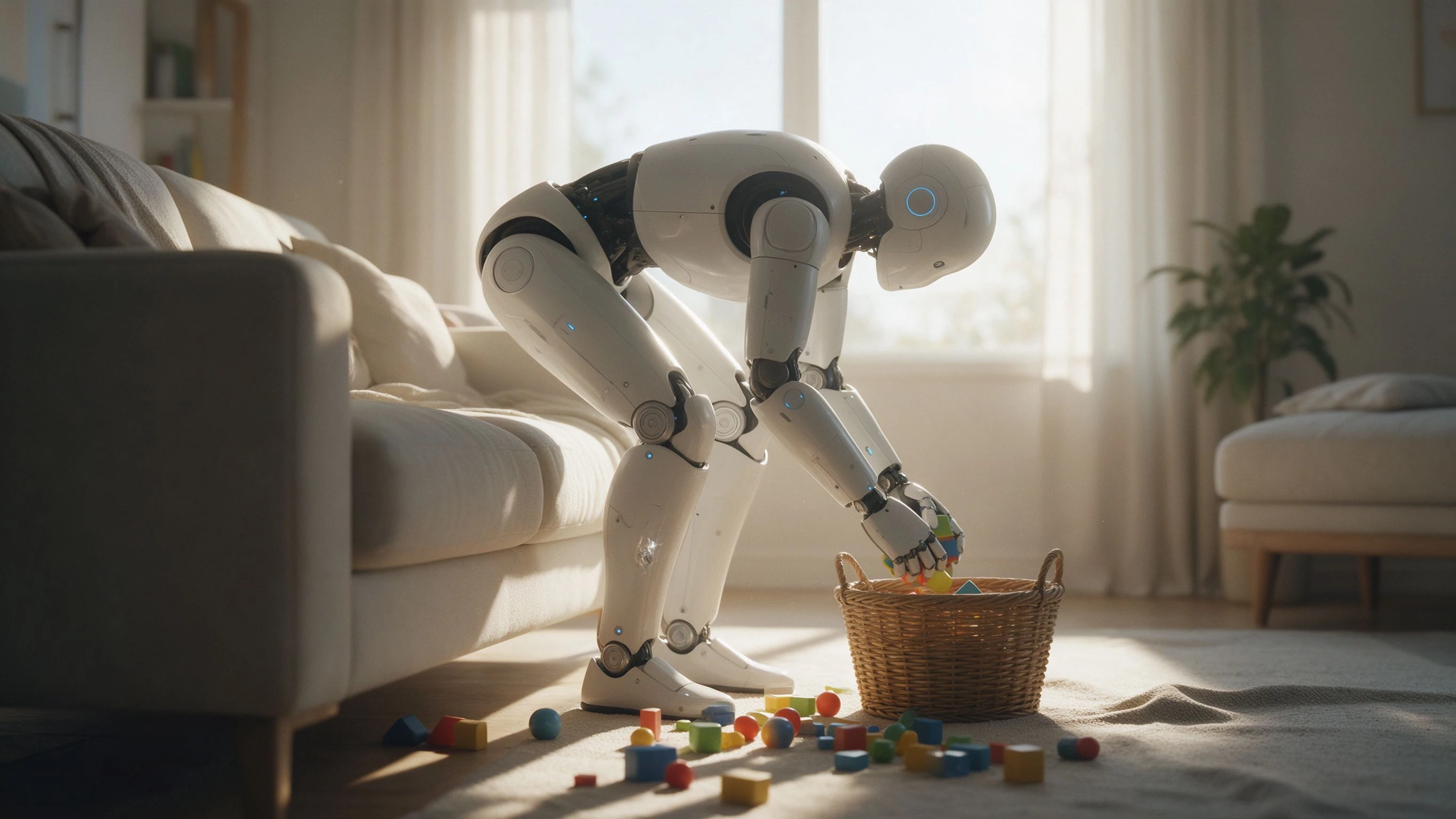
On September 17, Figure shipped its Figure 03 humanoid, running the new Helix 2.5 neural network, into 30 homes in the San Francisco Bay Area where the company had never collected a single byte of data. No mapping, no fine-tuning, no advance visit. The robot's job was three household chores: tidy the living room — all 13 to 15 scattered toys into a basket — fold towels, and make beds. Founder and CEO Brett Adcock called it the most important project the company has built.
[1][2]The numbers first. Across 420 trials, 237 completed fully: a 56% zero-shot success rate. Broken down: 67% for making beds, 62% for folding towels, 40% for tidying toys. Figure ran a clean controlled experiment — architecture, downstream data, training method and evaluation all fixed, with Index pretraining as the only variable — and success jumped from 9% to 56%. That design is the most defensible part of the release: the contribution of pretraining is isolated as a single variable.
The scaling story matters more. Figure pretrained four models on nested subsets of Index spanning an 8x increase in data, holding model size and downstream training fixed, and reports that action-prediction loss fell predictably with each doubling of pretraining data; the team says it forecast the largest run's test loss to four decimal places from the smaller runs alone. If that curve holds at larger scale, its implication is as blunt as the LLM scaling law: data and compute buy physical-world knowledge in a predictable way.
Then there is the data business underneath. Index went public on August 25. By launch it counted 264,000 downloads across 108 countries, more than 44,000 weekly active creators, over 16 million uploaded videos and $15 million paid out to contributors; it now ingests roughly 35 minutes of new human experience every second. Every 1,000 hours collected contains 373 unique tasks and 1,146 unique manipulated objects. The comparison writes itself: Index is beginning to look like robotics' version of internet text — human everyday behavior as the foundation corpus for machines.
The compute side is equally aggressive. Figure says it has committed $3.5 billion in computing resources to training the Helix series, and this month signed a multi-year agreement with cloud provider Nscale that locks in roughly 100,000 NVIDIA Vera Rubin GPUs, with a contract that could grow to $6 billion; Nscale also took an equity stake as priority compute supplier.
Not everyone is convinced. Tony Zhao, co-founder of Sunday Robotics, publicly questioned the 56% (237/420) figure — it means nearly half of complete tasks still fail. MIT Technology Review's Chinese-language coverage ran with the framing that peers are not buying it. Fairly stated: zero-shot, unseen homes, whole-body long-horizon tasks — 56% is real progress, but it is a long way from useful. The real signal of this release is not that a robot can make a bed. It is that Figure is wiring data collection, a creator economy and compute contracts into one pipeline. Data, not hardware, is becoming the battleground for humanoid robotics.
[1][2]