
要点
- Generally available on the Gemini API and Gemini for business / Google Cloud; outputs carry an imperceptible SynthID watermark; Provisioned Throughput is offered.
- Product increment: native 3 to 15 seconds in one-second steps; 720p at $0.07 per second (30% below Omni 1.1); draft at 360p or 720p, then upscale chosen clips to 1080p or 4K; edit background, lighting, product, or aspect ratio on the same clip across turns.
- Falsify the list price, the duration cap, and whether a local change can skip a full regeneration on API bills and outputs. Do not read this as cinematic video being solved. The company itself lists fast sports action, rapid script changes, and complex physics as still being improved.
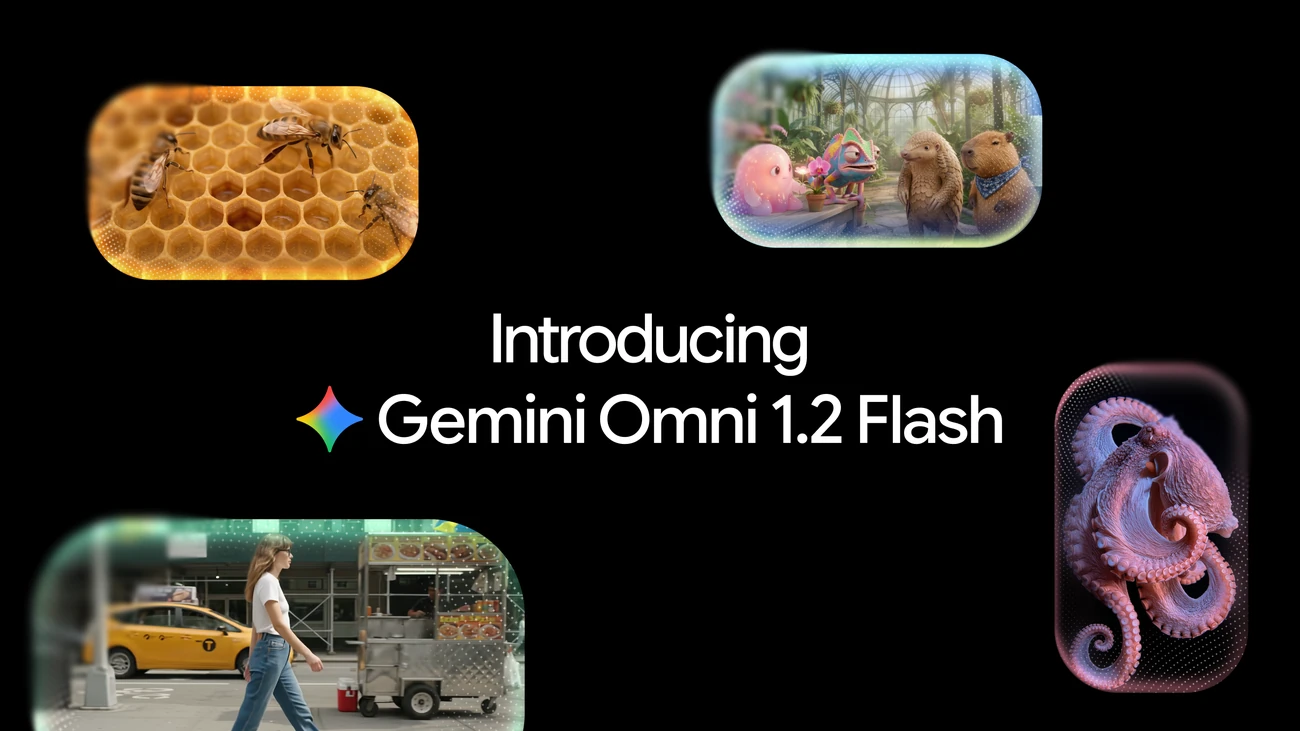
On 5 November 2026, Google DeepMind product manager Anish Nangia wrote that Gemini Omni 1.2 Flash is generally available on the Gemini API and on Gemini for business (Google Cloud). Compared with Omni 1.1, the checkable increments in the post are: native video rises from a 10-second cap to 15 seconds, with duration settable in one-second steps from 3 to 15 seconds; the 720p list price falls 30%, to $0.07 per second; and the same clip can be changed in a multi-turn conversation, for example by swapping a product, background, lighting, or aspect ratio, without generating the whole clip again from scratch.
The test should sit on whether those three items show up in the public price list and in real outputs. It should not sit on phrases such as a more cinematic look or more natural dialogue. The post itself says fast sports action, rapid script changes, and complex physics are still being improved. That list is the company's own signal that this version does not claim to have solved physical-world video.
[1]Hard facts (Google Blog, "Gemini Omni 1.2 Flash: Fast and cost-effective with longer clips", Anish Nangia, 2026-11-05, accessed 2026-11-06, Asia/Shanghai):
- Release and channels: Gemini Omni 1.2 Flash is generally available on the Gemini API and Gemini for business. The post says this is the first time Gemini Omni is generally available, backed by Google Cloud enterprise infrastructure and security.
- Duration: native generation and editing up to 15 seconds, up from 10 seconds on Omni 1.1; duration can be set in one-second increments from 3 to 15 seconds.
- Price: 30% below Omni 1.1, at $0.07 per second for 720p video.
- Workflow: draft quickly at 360p or 720p, fix a detail with a follow-up edit instead of regenerating the whole clip, then upscale chosen clips to 1080p or 4K.
- Reference control: character, product, or style images can be combined with short motion clips (up to three seconds) and audio cues. The post says faces, garments, packaging typography, and brand colors stay consistent across camera angles.
- Consistency and camera: it claims stronger character, object, and scene consistency from first frame to last, with less morphing; it also claims continuous FPV moves, zoom-outs, and orbits with fewer unwanted jump cuts.
- Speech: it claims more fluid dialogue, clearer lip-sync, and distinct multi-speaker conditioning, usable in Flow, Gemini for business, and Google Vids.
- Watermark and throughput: outputs carry an imperceptible SynthID watermark; Provisioned Throughput is available.
- Stated gaps: the company says work continues on fast sports action, rapid script changes, and complex physics.
- Where to use it: developers can prototype in Google AI Studio and read the developer docs and pricing; businesses can use the Google Cloud console; Flow supports scene direction and multi-turn edits; 15-second clips in Google Vids are described as carrying no additional cost with a Google account or Google Workspace subscription; 15-second videos in the Gemini app are rolling out to Google AI Ultra subscribers; it can also be used to scale video campaigns in Google Ads.
The post also describes selected demos: a 15-second virtual try-on from one model photo plus front-and-back shots of three outfits; multi-turn background swaps that keep the same performances; and a no-cut Pantheon FPV flight guided by two architectural reference photos. Those are company-chosen examples, not independent benchmark scores.
[1]Evidence strength: a primary product announcement with checkable price and duration figures. The $0.07-per-second 720p rate, the 15-second cap, the 30% cut, and the 3-to-15-second step size can be checked against the public price list and API parameters. Claims about reference following, lip-sync, jump cuts, and a cinematic look are qualitative descriptions of company demos. No reproducible third-party eval set or failure rate was published the same day.
The check is concrete: run several clips on 1.1 and 1.2 with the same prompt and the same reference set, then compare actual duration, whether the 720p bill is about $0.07 per second, and whether changing only the background or the product skips a full regeneration. If the bill or the duration disagrees with the post, the "cheaper, longer, editable in conversation" reading should be marked down. If the look improves while the bill and duration hold, that is still a product iteration. It is not evidence that video generation has crossed a physics or storytelling threshold.
Steelman: if 15 seconds, $0.07 per second, and multi-turn local edits hold in production calls, unit cost and turnaround for catalog clips, virtual try-ons, and ad variants fall, even when complex physics still fails. For teams that make short ads in volume, that change has commercial meaning on its own.
[1]Strongest steelman: replacing "regenerate the whole clip" with "edit one detail in conversation", then pairing that with a longer cap and a lower per-second price, is a change in the production path. It maps to price, duration, and an edit route, not only to a new model name. The try-on, multi-turn background swap, and continuous-camera examples in the post point at ecommerce and ad variants, not at theatrical shots.
Steelman risk: every comparison that says results are steadier, more natural, or less prone to jump cuts comes from the same company post and selected demos. There is no reported failure rate on random prompts, and no public side-by-side on sports, rapid dialogue switches, or fluid and collision scenes. The company itself lists those three areas as still being improved. Readers should not extend the Pantheon fly-through or the lip-sync sample to a football match or to complex body interaction.
The phrase "no additional cost" appears only in the Google Vids wording for a Google account or a Workspace subscription. It should not be read as the API being free. The API figure in the post is $0.07 per second at 720p. Limits on audio cues, multi-speaker conditioning, and reference combinations are described only in qualitative terms. Acceptance tests should check the developer documentation as it stands on the day of the call.
[1]For developers and ad teams, the next six months are about whether the public price list still says $0.07 per second at 720p, whether the 15-second cap can be obtained reliably from the API, and whether multi-turn edits are billed as local changes rather than as silent full regenerations. For brand-safety teams, whether detection tools can reliably see the imperceptible SynthID watermark, and whether the enterprise path offers Provisioned Throughput, are better acceptance tests than demo reels.
For other video models, the pressure is on per-second price and on an edit path that does not rerun the whole clip. It is not on another round of cinematic adjectives. For buyers, the checklist should be the bill, the duration parameters, and a consistency sample on the buyer's own reference images, not the selected clips in the blog post.
[1]Gemini Omni 1.2 Flash should be judged on native 15-second duration, $0.07 per second at 720p, and whether multi-turn edits of the same clip can skip a full regeneration. It should not be judged as cinematic video having arrived. If the figures and the edit path hold, this is a checkable cut in cost and a longer cap. If they do not, it remains a company product post. Fast sports action, rapid script changes, and complex physics are listed by the company as unfinished work, and they should stay inside the evaluation.
【No.2】
[1]