
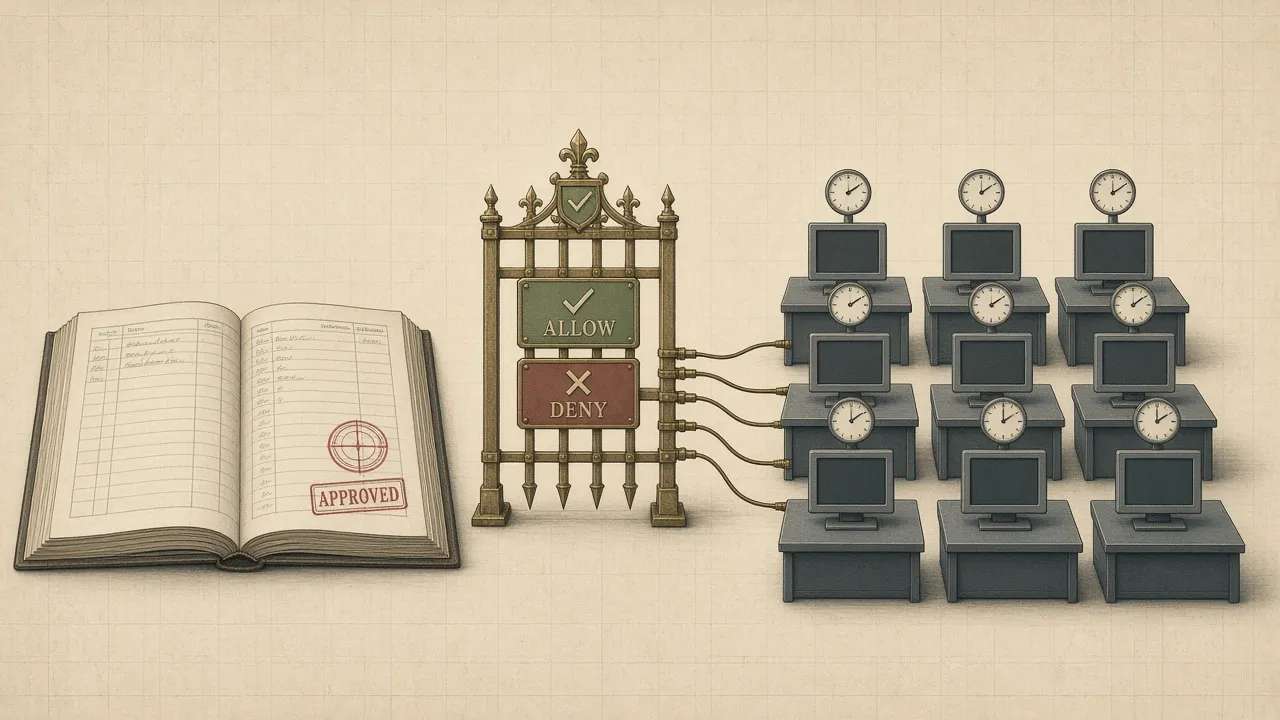
On 3 September 2026, x.ai published Grok Bot for Enterprise (page title and footer brand as SpaceXAI; JSON-LD author/publisher listed as xAI). Fact (company post): Grok Bot is now available for enterprises; Grok and Cursor Enterprise customers get free usage for the next two weeks and may invite their whole organization, including people without an existing seat. Bots are framed as always-on AI teammates that run each on its own cloud computer and use apps and websites the way a person would. Claim (same post): enterprises need to govern Bots at scale, and the release adds access, network, and audit controls. Inference (labelled): if those controls are real and enforceable, the strategically durable object is not the “teammate” metaphor but admin-scale governance of always-on agent computers—egress allowlists and attributable logs—because failure modes shift from bad text to irreversible actions in SaaS, email, and browsers.
[1][2]What the post says shipped
Strip the adjectives and the enterprise note still lists a concrete product shape.
Availability. Grok Bot is “now available for enterprises.” Existing Grok and Cursor Enterprise customers receive two weeks of free usage and can invite the whole organization, including people without a seat. Activation is pointed at an admin dashboard; macOS download and sales contact sit on the page (download host and sales links resolve under Cursor’s domains in the live HTML).
Bot model. A Bot is a worker created for a specific job. Each Bot “runs on its own computer in the cloud” and can use every app and website the same way a person does. Operators message a Bot like a coworker; it returns when work is done or a decision is needed. Workflows can be taught by following along once, saved as routines, corrected, then handed to a colleague as a template. Bots may message each other and share context.
Customer anecdotes (company-named). The post says thousands of organizations have adopted Grok Bot since launch, naming Legora, Supermicro, and ServiceTitan, and claims the heaviest use is outside engineering. It offers sales, recruiting, marketing, finance, and engineering vignettes (LinkedIn/email drafts, Gong scorecards, Zoom Q&A to Slack, procurement savings “tens of thousands of dollars,” PR monitoring). It also writes, literally, “the [millions] of bots created in the past few weeks”—brackets included in the published HTML, so treat the figure as a company placeholder, not a verified count.
Secure by default (as stated). Each user’s work runs in its own secure, isolated environment. A Bot has no access by default and reaches only accounts the user signs it into. A “Full security architecture” link points to Cursor’s Grok Bot security documentation.
[1]Governance of agent computers is the product
Chat assistants that draft email are familiar. Agents that hold browser sessions overnight, update decks mid-call, text candidates, and monitor vendor renewals change the blast radius. The enterprise objection is not “is the model clever?” but “who may it reach, what may it change, and can we prove what it did?”
The post’s own framing answers with three nouns: access, network, and audit. Companion Cursor documentation (linked from the post; read this run) details Enterprise-only Network Controls with destination allowlists (including “team allowlist only”), Audit Logs and Action Recording with optional OpenTelemetry export, MCP allowlists, SCIM, and computer management for org admins. It also states limits that matter for procurement: shared static egress IPs (not per-customer), Grok Bot computers in the United States today, no on-prem or BYO-image deployment, Auto Review without an org-level lock, and model-allowlist enforcement “not guaranteed.”
Inference (labelled): “AI teammates” does rhetorical work. The load-bearing object—if the architecture holds—is closer to a fleet of leased, permissioned remote desktops driven by models, with an admin policy plane for egress and logs. That claim is falsifiable: if network policy is soft, audit trails omit consequential actions, or Bots routinely act beyond the signed-in member’s identity, the governance thesis collapses.
[1][2]Attribution, Cursor rails, and SpaceXAI branding
The page is instructive about institutional packaging. The URL lives on x.ai; JSON-LD names xAI as author and publisher; the visible title suffix and footer read SpaceXAI / “© 2026 SpaceXAI LLC.” Download and dashboard links in the live markup point at Cursor infrastructure. Security depth lives on cursor.com docs, not in the news post body.
Fact vs claim: that Enterprise adds access/network/audit as product surfaces is the company’s stated reason for the release. That those controls match every regulated buyer’s bar (residency, dedicated egress, org-locked Auto Review, guaranteed model allowlists) is not proven by the news post—and the linked security pages themselves mark several of those as gaps or Enterprise-only caveats.
For editors: attribute the announcement to the x.ai news post under SpaceXAI site branding, and treat Cursor’s security docs as a linked primary for control details—not as independent third-party attestation.
[1][2]Steelman, gaps, and falsifiers
Steelmanning the launch. Suppose always-on agents that operate browsers and SaaS only become enterprise-ready when admins can constrain destinations, see control-plane events, and attribute actions to named members. Then shipping Network Controls, audit/action recording, isolation-by-default, and SSO/SCIM hooks—before another benchmark table—is the honest product order. On that steelman, criticizing the post for sparse control detail is fair as journalism, incomplete as product criticism: the linked architecture page is where the argument actually lives.
Gaps that remain thin. The news post does not publish independent red-team results, incident rates, or a customer-visible threat model. “[millions] of bots” is bracketed in source HTML. Named customer vignettes are marketing anecdotes. Several hard Enterprise needs are explicitly limited in the security docs (US hosting for Bot computers, shared egress, no org Auto Review lock, model allowlist not guaranteed). Related marketplace/guides pages were not required for this piece and were not used as evidence.
Labels for editors. Facts: date 2026-09-03; enterprise availability; two-week free for Grok/Cursor Enterprise with org-wide invite; Bot-per-cloud-computer model; access/network/audit as stated release theme; isolation and default-deny access claim; named customers; link to Cursor security docs; SpaceXAI branding on page vs xAI in schema. Claims: teammate framing; heavy non-engineering use; savings magnitudes; scale of bots. Inferences: governance of agent computers is the durable news; teammate copy is distribution.
[1][2]What to watch in six months
By roughly early 2027 from this 3 Sep 2026 post, three checks matter more than another usage montage. First: do Enterprise buyers actually enforce team-allowlist-only egress in production, or does “no policy / allow all” remain the quiet default? Second: do Audit Logs plus Action Recording (and OTel export) become the evidence path that security teams trust after a bad send—or do gaps in what Auto Review does not cover keep showing up in incident reviews? Third: does the xAI / SpaceXAI / Cursor packaging clarify for procurement (who is the contracting party, where Bot disks live, what residency letters say), or does brand multiplicity slow regulated rollout?
If allowlists and attributable audit hold under those tests, Grok Bot’s enterprise story will be remembered less as “AI teammates” and more as a template: always-on agents as leased computers that only become products when the gate and the ledger ship with them.
[1][2]