
The Tencent Hunyuan account timestamps Hy4 Is Released, Built for Real Work at 2026-11-04T04:43:55Z, which is 12:43 in Beijing on Nov. 4. The post announces the full Hy4 release. Against Hy4 preview, pre-training and post-training are larger, vision is a new capability, and instruction following, long context, long-horizon tasks, and deep research are described as stronger. Hy4 is already callable on Tencent Cloud and OpenRouter, and it is also in CodeBuddy, WorkBuddy, Yuanbao, and ima. The post says performance is clearly above preview while the API price stays the same as preview, and it does not print a unit price. Weights are still a plan to open-source. The account says it has already lined up support from the vLLM and SGLang communities and from Inferact Inc. A model system card, including a fuller safety evaluation, is planned for the same release. Weights, the unit price, and the system card are not files this post actually ships.
[1]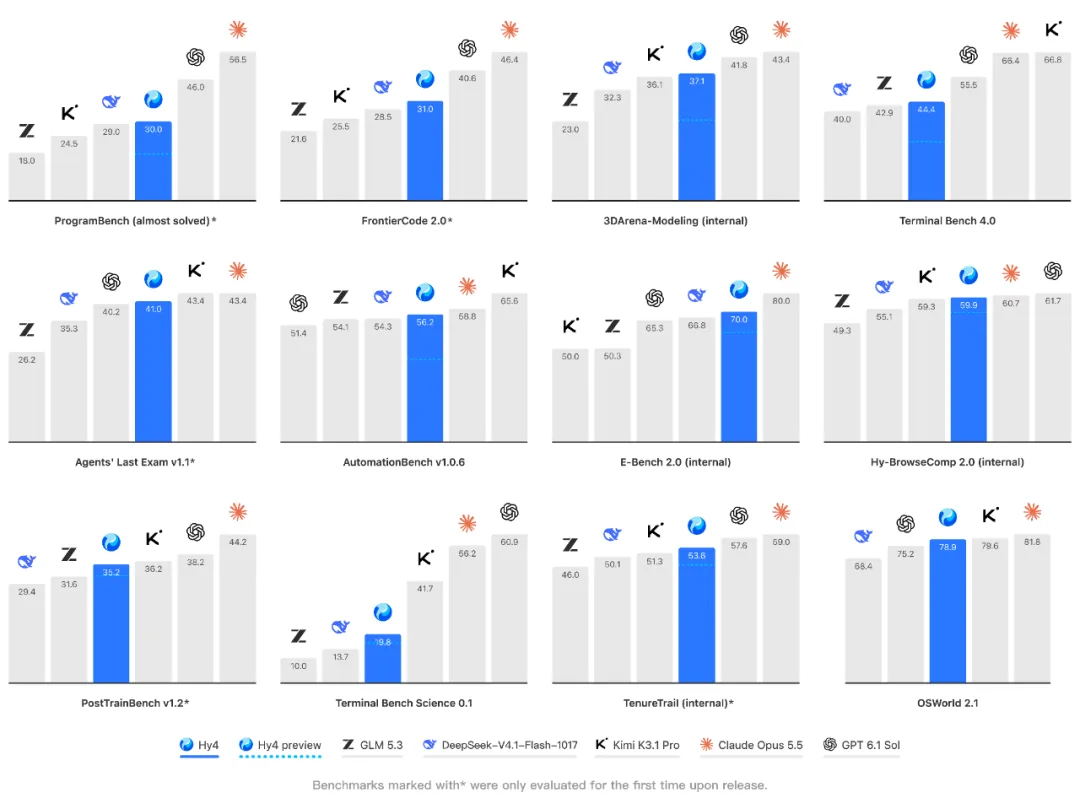
The vision section says the model can combine perception, reasoning, and tool use for fine-grained images, complex charts, and visual mathematical reasoning. Computer use is also supported for the first time, and the command line and the graphical interface can be used together. Blender, CAD, and long tasks that cross applications received specialized training, which the post presents as a way to improve planning and execution on professional work. Frontend and game development are described as gains that followed from vision. The company worked with game developers in Tencent's Interactive Entertainment Group, adapted Unreal Engine, Unity, and Godot, and started extending the work to multiplayer games. Against Hy4 preview, GameDev and GameLogic are up 19.1 percent and 9.8 percent. That paragraph does not name who wrote the tasks, how large the samples were, or any error bar. The post does not turn computer use into a procedure, and this column does not add one.
[1]The finance figures come from tests the company organized. The post says thousands of workspaces and tens of thousands of tasks were built from real finance work, covering fund research, securities analysis, quantitative strategy, asset allocation, corporate finance, and tax accounting. Tencent Financial Technology's FiT group ran a review with 213 experts, 153 of them from outside financial institutions, and seven in ten with more than five years of experience. On 579 real finance tasks, the post ranks Hy4 first among open models, with scores of 3.04 for Hy4, 2.68 for Kimi K3.1 Pro, 2.68 for GLM-5.3, and 2.97 for DeepSeek-V4.1-Flash-1017. On IRAB, an internal evaluation from the finance-agent company XunTu Technology, Hy4 is 12.03 percentage points above preview. On a separate self-built search test, the hallucination rate falls from 15.76 percent on preview to 5.45 percent, and the error rate from guessing falls from 23.1 percent to 5.6 percent. For office work, the post says a person and Hy4 can edit Word, Excel, and PowerPoint together. A blind review says documents are clearly better looking, more stable, and more usable, and it gives no score. The ranking, the drops, and the word first all stay inside these in-house or partner tests. No independent replication is attached.
[1]The research section is also the company's account. TenureTrail is described as an internal evaluation covering seven disciplines and 123 executable research tasks. The post says Hy4 shows research ability in mathematical construction, physical modeling, earth environment, systems engineering, and socioeconomic decisions, and ranks first among open models. Work with a mathematics team at Peking University found a counterexample to the Méndez–Pinto–Villarreal conjecture, added a new condition, and checked a proof in Lean. The mouse-embryo reconstruction is presented as one demonstration: 6.99 million cells and 84 unordered two-dimensional slices, including a mirror flip; the conditions are offline work, no dedicated registration tool, and no cell-type labels; alignment and a three-dimensional reconstruction finished within 1.5 hours with no person intervening, and the result is described as better than the default flow of common registration tools. On a scaled-down internal Hy4, end-to-end training throughput rose 20.1 percent. Hyra-Jev, trained automatically with Hyra 2.0, beats the official Jev model on six of eight benchmarks. HyCell, a single-cell representation model with 16 million parameters, is said to match Stack's overall performance on seven cell atlases held out of training, at about one fourteenth of the parameter count, and to post the highest average biological-fidelity score among the models compared. Against Walrus, HyPDE has lower prediction error on 9, 10, and 8 of 13 physics-simulation datasets for one step, steps 1 through 20, and steps 21 through 60. HyCell and HyPDE are described as already open-sourced. None of those ranks, hours, or error counts is followed by an independent replication.
[1]The safety section is a boundary the company draws, not a set of instructions. The post says training included defensive cybersecurity data tied to proof-of-concept generation and vulnerability repair, and that offensive training material was removed. An internal audit by Tencent's Xuanwu Lab and Keen Lab concluded that offensive capability did not show outstanding risk. On biology, open-ended experiment design remains clearly behind frontier models, and the score given in the post is 30.4 out of 100 on Hy-BioExperimentBench. After reviewing trajectories, internal experts write that basic biological knowledge is relatively strong, that turning that knowledge into an executable experimental plan is still limited, and that they have not found the model significantly lowering the threshold for carrying out biochemical harm. The post does not expand the audit or the plans into steps, and this column does not either. The limitation section grants that even if Hy4 is called one of the strongest open models now, a large gap remains versus the top closed models, especially on internal hard sets for frontier mathematics, long-horizon development, model iteration, and visual question answering. Hy4 flash is planned for the near term, aimed at price-performance and inference speed. Flash, the weights, and the system card are still plans.
[1]