
In an era when AI-generated slop floods every feed, Apple has offered its own answer: instead of straining to detect what is fake, prove directly what is real.
On September 9, at its Surprise and Shine fall event, Apple unveiled Apple Reference Image: the moment a photo is taken with an iPhone 18 Pro, the main camera sensor simultaneously captures cryptographically signed sensor data, which Apple's Private Cloud Compute service turns into an unalterable reference image stored in the Photos app. Any later version of that photo — cropped, retouched, AI-edited — can be compared against this "negative" to reveal whether anything was changed.
Apple calls it a "digital negative," stressing: "This is vital for photojournalists and photographers."
[1]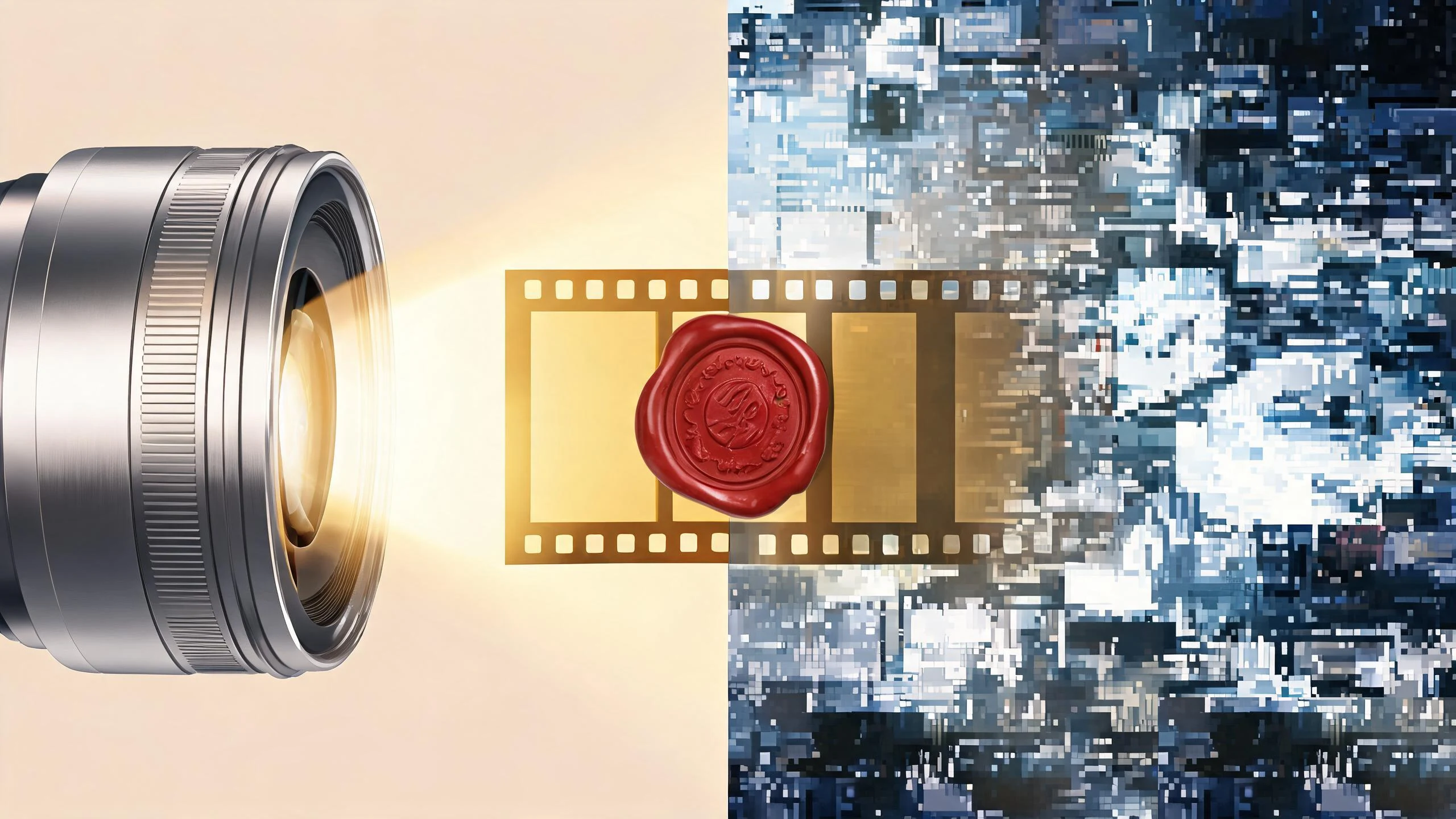
The technical path: trust begins in hardware, not algorithms
The key to this scheme is not detection but the moment of notarization.
Most "AI detectors" on the market do after-the-fact inference: examining pixel statistics and lighting physics to guess whether an image was generated — an accuracy race they can never stop running against generative models. Apple took a completely different route: pin the raw data down with a cryptographic signature in the very millisecond photons hit the sensor. The reference image is not an analysis of the photo; it is a digital witness to the act of photographing itself.
Three architectural details deserve attention:
- Signing happens at the sensor layer, not in software. Software can be tampered with; hardware signatures are far harder — the same root-of-trust logic as credit-card chips and passkeys;
- The "negative" is produced by Private Cloud Compute. Sensitive data never leaves Apple's verifiable cloud, extending its privacy narrative;
- Initially viewable only in the Photos app, but with APIs open to developers. Newsroom systems, insurance claims, and forensic tools can all embed "compare against the negative" into their workflows — Apple is building authenticity verification as a platform capability, not an app feature.
More interesting: Apple embraced Google's SynthID
An easily missed signal in the announcement: Apple will also support the SynthID standard to help users identify AI-created or AI-altered images. SynthID is Google DeepMind's watermarking scheme for AI content.
The combination is telling: Apple vouches for the "real" — endorsing what its cameras capture; Google marks the "fake" — watermarking what AI generates. One positive, one negative: the two mobile-platform giants have formed a de facto complementarity in content provenance. When the two companies with the largest device footprints both take photo credibility seriously, the resistance to industry-wide adoption of open standards like C2PA shrinks considerably.
[1]The other half of the event: variable aperture
The hardware beneath Reference Image is itself notable. Apple calls the iPhone 18 Pro its "biggest camera improvement in years": a new 48-megapixel fusion main camera featuring, for the first time, a variable aperture — six laser-cut blades, each thinner than a human hair, made of a specialized polymer composite, driven by a new rotor mechanism behind a custom lens. Variable aperture gives users direct control over light intake and depth of field, with night photography benefiting most.
Read together, Apple's strategy is clear: grant near-professional creative freedom in hardware while stamping every photo with a tamper-proof seal underneath. One hand attacks on imaging capability, the other defends the trust baseline.
[1]Analysis: three judgments
First, "provable reality" is becoming a selling point — a direct product of AI-slop economics. When generated content is infinitely supplied at zero marginal cost, the scarce good becomes verified reality. Apple is betting that this scarcity supports a hardware premium: users will pay for "I can prove I took this." In the AI arms race, Apple is selling not stronger generation, but the antonym of generation.
Second, a "digital negative" proves what the sensor saw — not what actually happened. The cold water must be poured: a reference image cannot tell whether the lens faced a real battlefield or a staged set, cannot stop someone from photographing a deepfake off a screen, and currently covers photos only, not video or audio. It solves the last link of the provenance chain — "this file matches that shutter press" — not the first link: "that shutter press faced the truth." Mistaking technical notarization for factual notarization is precisely how this system will be misused.
Third, the contest over trust infrastructure is more likely to produce monopoly-grade winners than the contest over model capability. Models get open-sourced and converge; but "who gets to stamp reality" is a different war, requiring hardware penetration, cloud trust, regulatory acceptance, and industry standards all at once. Apple's package — hardware signing + private-cloud notarization + open APIs + embracing SynthID — is the most complete move in this arena to date. When courts, insurers, and newsrooms begin writing "does it have a reference image" into their standards of evidence, today may be remembered longer than any model launch.
[1]Appendix: short-form post (Weibo / X ready)
Apple unveiled Apple Reference Image: at the instant an iPhone 18 Pro takes a photo, sensor data is cryptographically signed and turned via Private Cloud Compute into an unalterable "digital negative" — any later edit can be exposed by comparison. Same day: support for Google's SynthID watermarking. One vouches for the real, one marks the fake; the two mobile giants now complement each other in content provenance. When photos must prove their own innocence, trust itself becomes the product. #Apple #iPhone18Pro #Provenance
[1]