
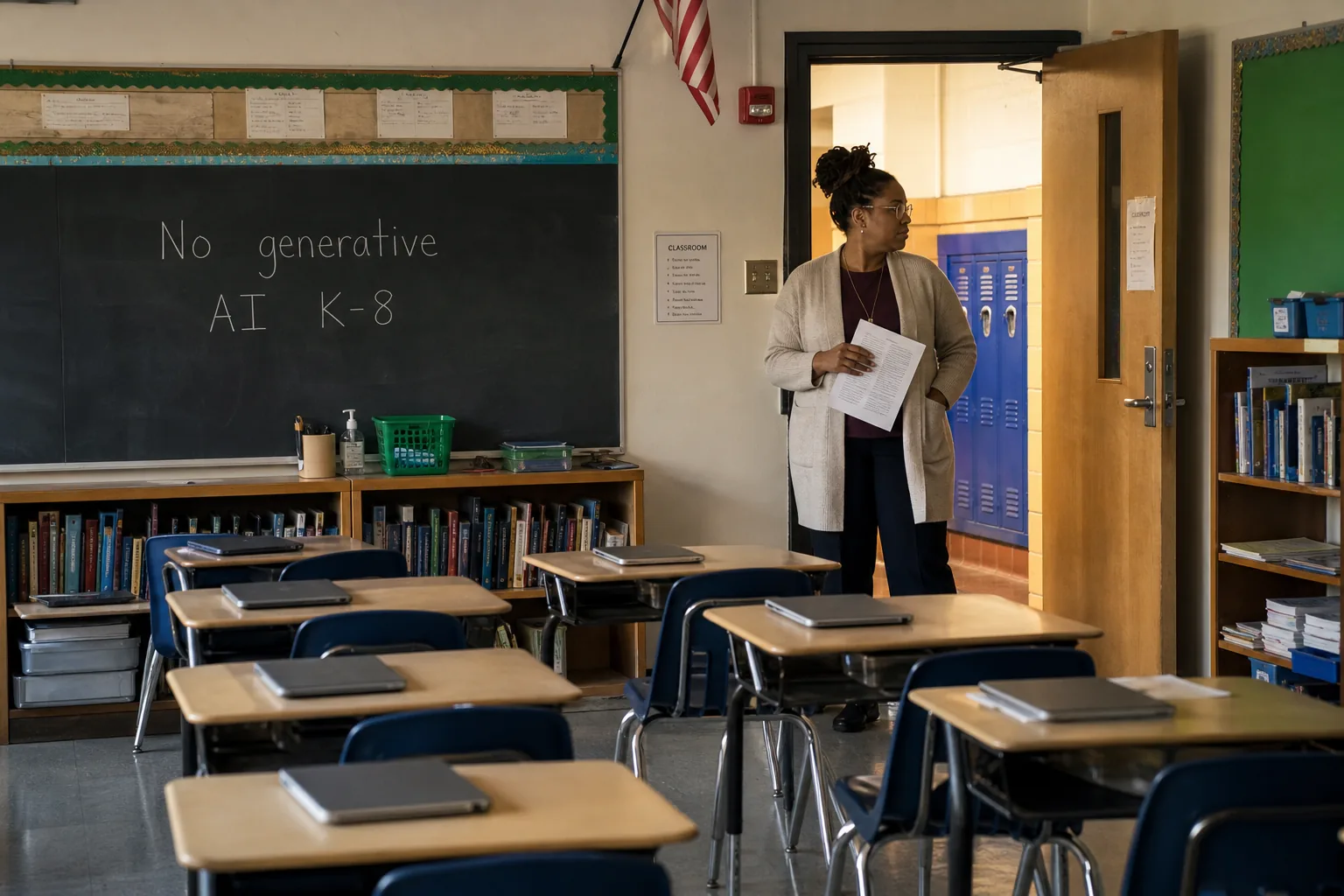
While vendors still pitch chatbots as classroom infrastructure, New York City just pulled the plug for younger students.
Mayor Zohran Mamdani and Chancellor Kamar Samuels announced a one-year moratorium on student-facing generative AI for grades 2-K through 8 in school year 2026–27—about 600,000 students, roughly two-thirds of the system. CNN reports the district will discontinue or disable AI features in more than 38 previously allowed programs. Companion chatbots are barred in every grade; mainstream tools such as ChatGPT and Claude are blocked on school networks.
High school is narrower, not absent. Up to about 50,000 general-education students (~5%) can enter five supervised pilots—Quill, Edia, Brisk Teaching, Playlab, Intel AI-Ready—capped at five classes per school with weekly time limits. Every high-schooler also gets two 45-minute AI literacy modules. Teachers may still use AI for planning and operations, but not for grading or assessment. Exceptions cover assistive tech, multilingual learners, and some career pathways.
Take: This is not Luddism. It is the country’s largest district writing “show evidence first” into policy. The hard edge is homework: Samuels admits schools cannot police dorm rooms. What the rule can protect is attention and human instruction inside the building. What it cannot—home substitution—will decide whether the pause is pedagogy or theater.
[1][2]