
要点
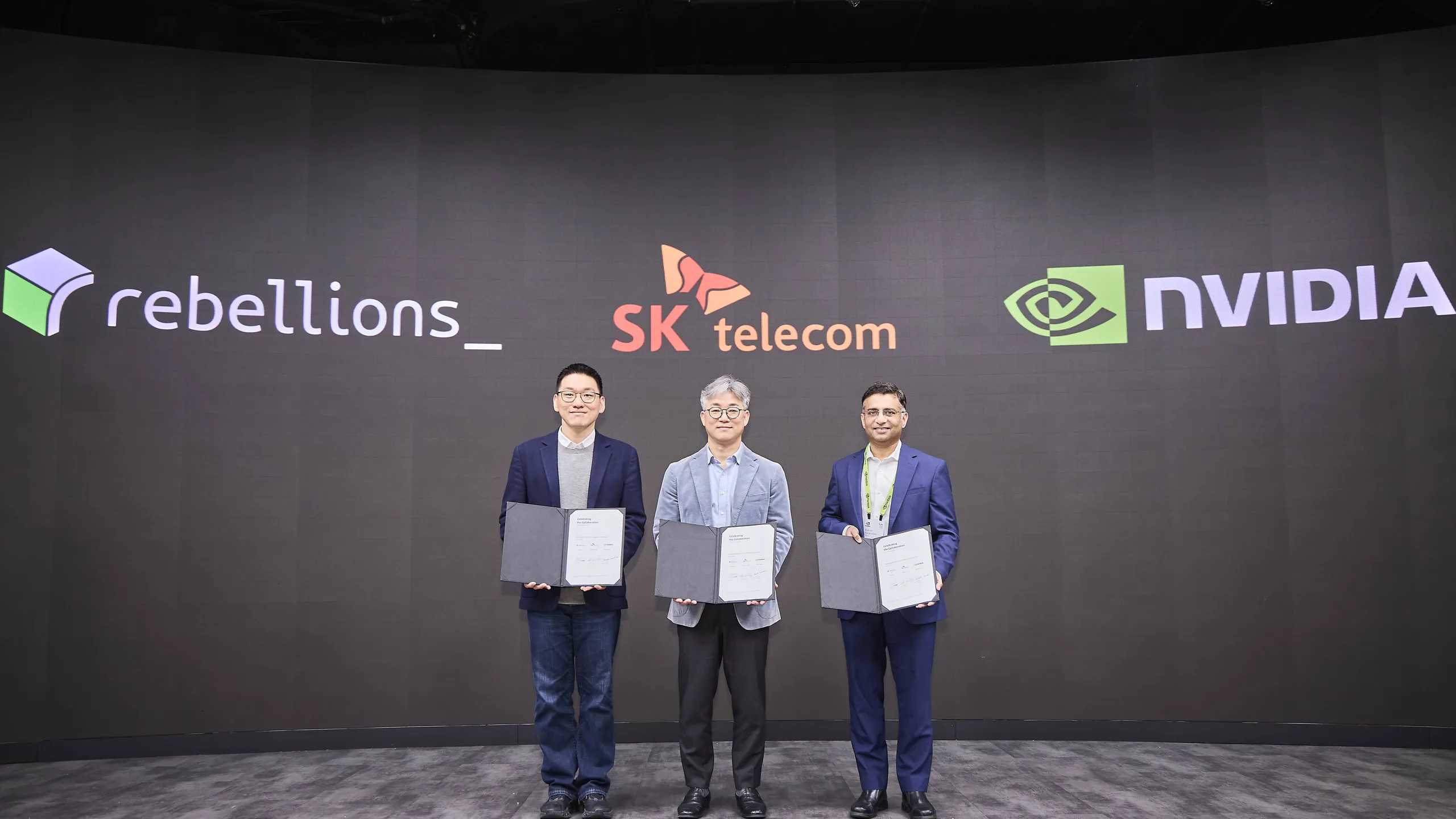
- SK Telecom says the three companies signed an MOU on November 9, 2026 at NVIDIA AI Day Seoul at COEX, to develop and validate an integrated GPU-NPU system.
- NVIDIA says Rebellions will use NVLink Fusion to connect its next-generation Rebel R200 neural processing units to NVIDIA's platform and will adopt the MGX rack design.
- The planned split assigns NVIDIA GPUs to prefill, the compute-heavy first stage of a response, and Rebellions NPUs to decode, the token-by-token second stage.
- NVIDIA's release says R200 systems are expected to be ready for deployment in 2028.
- Korea's Ministry of Science and ICT is supporting the work. The science minister described Korean NPUs entering the market alongside NVIDIA, and he also spoke of securing GPU supply.
SK Telecom said that on November 9, 2026 it signed a memorandum of understanding with NVIDIA and the Korean chip startup Rebellions at NVIDIA AI Day Seoul, held at COEX. The aim is to develop and test a server system that runs NVIDIA graphics processors and Rebellions neural processing units together. A neural processing unit, or NPU, is a chip built to run AI models. NVIDIA's English newsroom dated the same announcement November 8 and added the date that matters for anyone who has to buy or regulate these machines. Rebellions' R200 systems are expected to be ready for deployment in 2028. The language of the day was sovereign AI. The mechanism on the page is a hookup. Korean silicon is being invited onto NVIDIA's high-speed interconnect and rack design, not asked to replace them.
[1][2]What was announced
The three companies say Rebellions will use NVIDIA NVLink Fusion to attach its next-generation Rebel R200 chips to NVIDIA's platform. NVLink is NVIDIA's high-speed connection that lets many accelerators share data so they can act like one large system. NVLink Fusion is the version of that connection that chips from other companies can use. The servers are meant to follow NVIDIA MGX, a standard recipe for how a rack is laid out, powered, and cooled, so GPU machines and NPU machines can share the same data-center design.
NVIDIA introduced NVLink Fusion in May 2025 at Computex. The pitch then matches today's. Outside companies can design their own accelerators and still plug into NVIDIA's high-speed rack fabric and the MGX mechanical standard. The Korea announcement puts a national policy frame on that existing offer. It is a new named chip and a new operator, not a new kind of interconnect.
The work has government backing. NVIDIA's release says Korea's Ministry of Science and ICT is supporting the collaboration. Bae Kyung-hoon, the deputy prime minister and science minister, said the step lets Korean-developed NPUs enter the computing infrastructure market alongside NVIDIA through NVLink Fusion. He also said the government would push cooperation with NVIDIA on physical AI and on securing GPU supply.
NVIDIA's note on Rebellions lists SK Telecom among the startup's existing backers. The current flagship chip named in that note is Rebel100. R200 is the next chip, still in development. SK Telecom called the document an MOU, a signed agreement to work together rather than a completed purchase.
[1][2]How they want to split the work
Both statements describe a planned split of the work a model does when it answers a question. Prefill is the first stage. The model reads the user's prompt and builds an internal state. That stage is heavy on raw calculation, so a GPU is a natural fit. Decode is the second stage. The model emits the answer one token at a time. A token is a small piece of text, often part of a word. Each decode step has to pull stored weights and prior state from memory, so memory traffic often matters more than peak math.
The companies say they will assign NVIDIA GPUs to prefill and the Rebel R200 to decode, hoping for higher throughput and better power efficiency. NVIDIA says the R200 is being designed for low-latency, energy-efficient inference, including very large mixture-of-experts models. A mixture-of-experts model activates only some of its specialized sub-networks for each token. Those are design goals. The releases do not publish chip specifications, measured tokens per second, or a comparison against a GPU-only baseline.
SK Telecom says it will bring the combined system into its AI data centers to check performance and stability, then consider whether the setup can support real services. Those services include its own models, such as A.X K2, and public offerings under the government's AI for All program, known in Korean as 모두의 AI.
[1][2]Why this is a hookup, not an exit
Sovereign AI, as governments now use the phrase, often sounds like a wish to own the full stack: chips, models, data, and the buildings they run in. This deal owns only part of that stack. Rebellions would design the NPU. SK Telecom would operate the data center and connect some of its models and public services. The science ministry provides policy cover. The scale-up network, the rack blueprint, and the GPUs that would handle prefill remain NVIDIA's.
Jensen Huang, NVIDIA's founder and chief executive, stated the coupling in plain words. "With NVLink Fusion, Korea's chipmakers can connect their custom ASICs to NVIDIA's AI factory platform, tightly coupling their processors with NVIDIA compute to run AI workloads." An ASIC here means a chip designed for a specific job, the custom accelerator Rebellions is building. "AI factory" is NVIDIA's term for its end-to-end AI computing platform.
If the test of sovereignty is whether a Korean model can run on Korean silicon in a Korean data center without a foreign accelerator in the rack, this announcement does not meet it. If the test is whether a Korean chipmaker can sell into the racks that operators already know how to power and cool, the offer is clearer.
[1][2]The fair case, and what is missing
The fair reading in favor of the deal is that self-sufficiency is the wrong test. A domestic NPU that cannot talk to the dominant rack fabric may never see production volume. MGX exists so that data centers can reuse floor space, power delivery, and cooling across GPU and NPU systems. Prefill and decode have different hardware needs, so splitting them can save money and electricity if the link between the chips is fast enough and the software can keep both sides busy.
The releases leave the hard parts unmeasured. Moving intermediate state between a GPU and an NPU can add delay that cancels the specialized chip's advantage. The companies do not say which serving software will orchestrate that split, or how it will treat SK Telecom's models. They do not say how many R200 chips will share an NVLink domain, what memory the R200 will use, or what "energy-efficient" means in watts per token. SK Telecom's own wording is cautious. It describes an MOU to develop, validate, and review commercial use. NVIDIA dated readiness to 2028, so this is not a machine you can order from today's photographs.
[1][2]Who should care, and what to watch
Builders of Korean models and buyers of AI for All capacity should watch whether SK Telecom actually racks a GPU plus R200 system and publishes a comparison against a GPU-only serving stack on the same models. Chip investors should watch whether R200 appears with NVLink Fusion as a required companion, which would make NVIDIA both a partner and a required supplier of the link. Policymakers who use "sovereign" as a label for supply-chain control should notice that this path still depends on NVIDIA's interconnect, rack partners, and GPUs for the first stage of every response.
[1][2]Close
Over the next six months, the checkable items are documents and prototypes, not national independence. Look for a detailed R200 specification, a named software stack for the prefill-decode split, and any SK Telecom test that reports tokens per second and energy per token against a GPU-only baseline. Until those appear, the accurate description of this announcement is an MOU to put a Korean inference chip on NVIDIA's fabric, aimed at 2028.
[1][2]