
要点
- LFM3 puts text, vision, audio, omni and decision models on a shared ~2B backbone aimed at single-GPU fine-tunes and on-device deploy.
- A tri-hybrid stack (short conv + SWA + global attention); LFM3-1.7B beats larger LFM2.5-2.6B on agent tasks (WebArena-Verified 38.42 vs 3.02).
- In-house vision encoder claims ~3× less compute than prior SigLIP2 path; VL average on 62 benches rises 57.6→71.4, with robotics timing claims on Orin.
On-device multimodal products usually pick a bad dichotomy: one giant generalist, or a zoo of separate ASR, VLM, LLM and TTS services. Liquid AI’s LFM3 argues for a third path—six specialized variants from a shared ~1.7B–2B backbone, each fine-tunable on a single GPU.
The falsifiable claim: under agent and edge constraints, capability-per-parameter plus fine-tuneability matter more than another jump in generalist size.
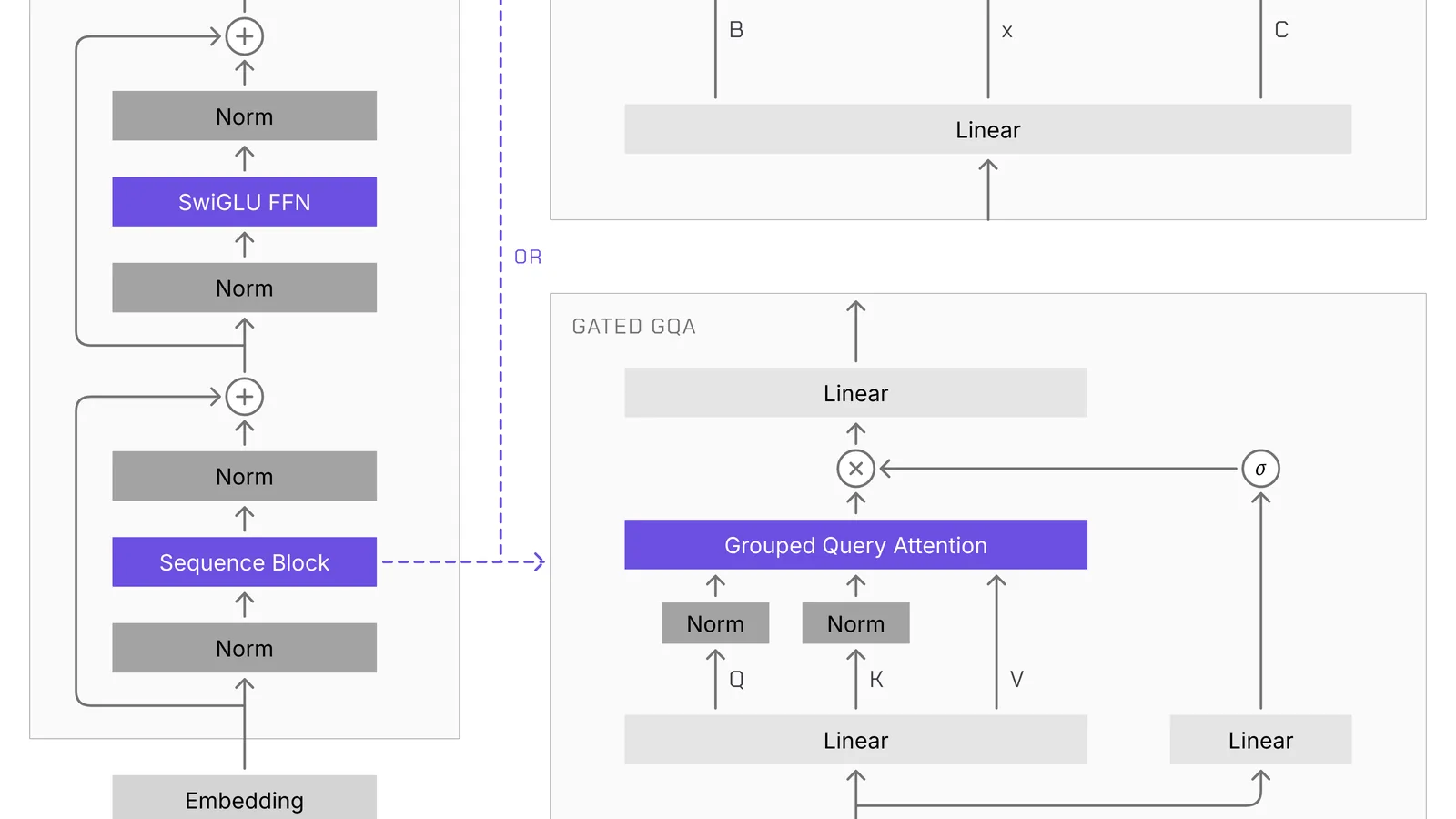
[1]LFM3-1.7B-Base uses 24 layers: 13 gated short convolutions (kernel 7), 5 sliding-window attention layers (256-token window), and 6 global attention layers, plus head-wise gated attention, partial RoPE on global layers, and sandwich norm. Pre-training covers ~22T tokens; a final 3.5T mid-training stage densifies agentic traces and tool calls and extends context to 256K.
Branches: text, VL (with video), audio, first omni model, and d1 decision models that answer multiple calibrated questions in one forward pass. Weights are open on Hugging Face.
[1]Vendor numbers: LFM3-1.7B uses ~35% fewer parameters than LFM2.5-2.6B yet scores 38.42 vs 3.02 on WebArena-Verified and is claimed to beat Qwen3.5-9B on long browser/business tasks. VL average across 62 benches rises 57.6→71.4, said to match Gemma 4 12B-class results at far smaller size. Robotics vignette: a manipulation VLA jointly trained across 15 embodiments hits 96.2% average success on four LIBERO suites, with action chunks under 50 ms on Jetson AGX Orin (TensorRT FP16).
Audio path cites LiquidCodec ~87× real time on one M4 Max CPU thread and time-to-first-token as low as 50 ms.
[1]Steelman: agent benchmarks are harness-sensitive; Qwen/Gemma comparisons may not match decoding and tool protocols; robotics suites are vendor-chosen.
Missing: independent replications, full training cost, and omni leaderboard protocols behind “beats models up to 10.7B.” Confidence high on architectural disclosure; medium on cross-model SOTA transfer.
[1]If small shared backbones plus specialty heads become default, private and edge deploy shifts from “distill the giant” to “pick a modality branch, then SFT/GRPO.” Product teams should ask whether a four-stage ASR→VLM→LLM→TTS pipe is still the rational default.
[1]Watch third-party harness-matched replications and whether d1 calibration survives real ticket/QA shift. If the numbers hold, LFM3 is a template for specialized small multimodals; if not, it remains a thorough open-weight productization exercise.
[1]