
要点
- MIT CSAIL blog (2 Nov 2026): frontier models can read, edit, and write small-to-mid weight tensors under constrained harnesses; logs and a Hugging Face artifact are public.
- Qwen3.5-0.8B: editing ~0.016% of weights lifts MATH-500 from 7.9% to 48.1% and roughly triples IFEval; authors attribute the gain mainly to cutting reasoning loops, not new math skill.
- Control: on rarely looping Gemma 3 270M, similar edits do not stably raise MATH-500. The falsifiable claim is constrained read/write skill, not “LLMs replace training.”
On 2 Nov 2026, MIT CSAIL authors Takehi, Teoh, Zhang, and Khattab framed “Weight-Space Programming”: treat a frontier model not only as a writer of training scripts, but as something that can read weights, edit weights, and sometimes write a small runnable network from scratch.
The falsifiable reading is narrow. If, in the public logs and artifacts, frontier models cannot stably read and write small-to-mid tensors under the stated harness (weights-as-text, Python sandbox, capped forward passes), or if “removing an obstacle” is sold as “adding ability”, discount the post’s extrapolation. The authors’ own Gemma math-edit failure makes that distinction explicit.
[1]Hard facts (authors’ blog and public logs, 2 Nov 2026):
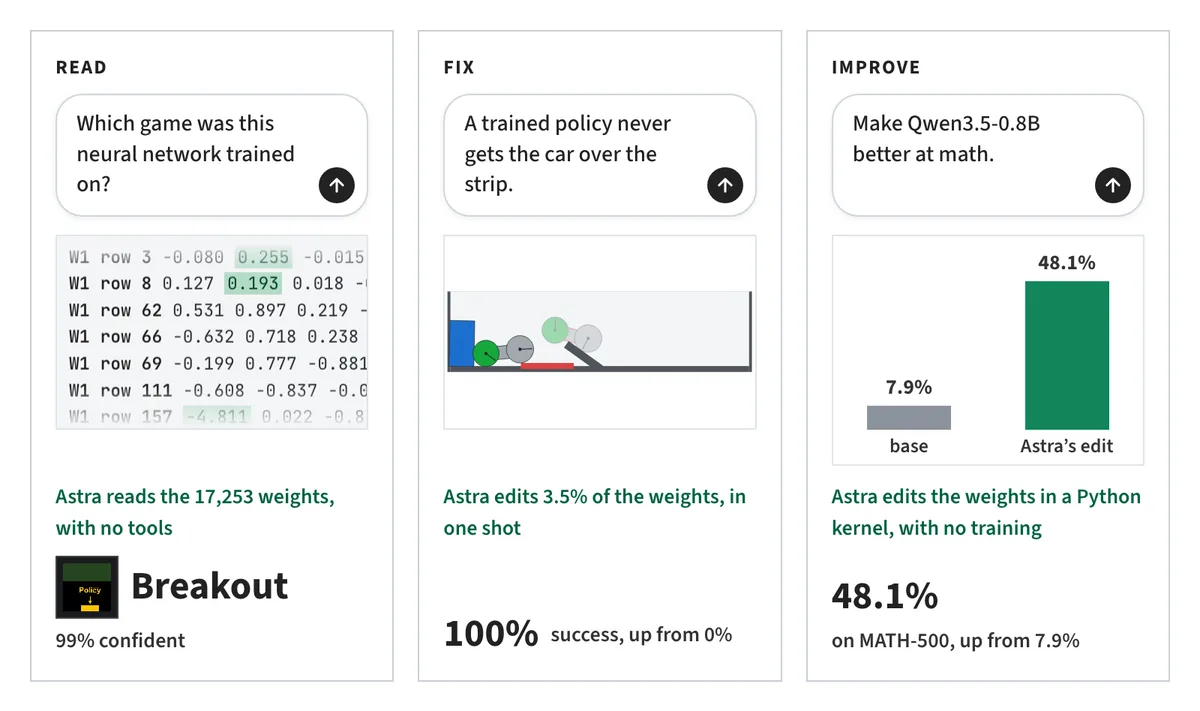
- Read: same-shape PPO policies (~17k weights) are named to the right game (Breakout and peers) from weights alone; diffusion nets yield shape outlines from weights; mid-blocks of ~7.2M character Transformers, without I/O layers, still support language ID (Python / romaji / English) and copying-head labels that match measurement.
- Edit: a Kinetix car-on-ramp policy stuck in a local minimum succeeds in all 1,024 episodes after a one-shot edit of ~3.5% of weights.
- Write from scratch: for three MinAtar games, zero-training, zero-rollout nets beat PPO trained for 100M steps; versus 500M-step PPO, Breakout scores ~20×, Asterix is close, Seaquest reaches ~60%.
- Larger scale: a ~1.48M-parameter 9×9 Go net can be written in a Python sandbox with a forward-pass budget; at 50 forward passes it beats an equal-sized PPO trained on ~20M games.
- Language models: on Qwen3.5-0.8B with a 50-forward budget, the authors trace looping to a direction in MLPs of layers 15 and 19 and subtract it from 64 output columns each: 131,072 weights (~0.016%). MATH-500 7.9%→48.1%, GSM8K 13.8%→67.1%, IFEval 21.0%→62.3%; answers hitting the token limit fall from 93% to ~33%. Gemma 3 270M rarely loops; similar small edits do not move MATH-500 beyond ~1-point noise.
Evidence strength: first-party research post + full interaction logs + the edited Qwen weights on Hugging Face. Numbers come from the authors’ sampling settings, not a third-party blind eval.
Mechanically, successes read as “implement a program inside the weights from a natural-language spec”: Breakout predicts bounce then moves the paddle; Go encodes liberties and threatened groups by layer. Failures are equally concrete: sycophancy detection fails from weights alone and works once attention patterns are allowed; Gemma’s errors are ordinary reasoning mistakes with no single switch to flip.
Steelman: if frontier models can do targeted surgery on small and mid nets without writing a training loop, interpretability and optimization gain another path: audit without first running a benchmark suite, repair without full retrain. Public logs lower the bar for “irreproducible demo” critiques.
[1][2]Strongest steelman: the Qwen result shows obstacle-type failures (loops) can be lifted by editing a tiny weight fraction, with spillover to instruction following, a different intervention class from math fine-tuning alone.
Steelman risks: many highlights need weights in context or a sandbox with capped forwards; the post itself calls out context and harness efficiency as limits. Reading “loops removed” as “model learned math” is refuted by the Gemma control. Astra is the frontier model name in their setup; do not extrapolate to arbitrary open checkpoints. Independent labs have not yet published a full table under the same protocol.
[1]For interpretability researchers, watch whether weight-only audits (no forward pass) reproduce hits like copying-head localization on larger open models. For training and safety teams, watch whether targeted edits can plant backdoors or erase alignment, and how harness rights (may it write training loops; may it take unbounded forwards) are fenced. For product readers, the six-month check is log reproducibility and whether third parties rerun the Qwen edit table, not the “sparks” rhetoric in the title.
[1]Do not read this post as “training is obsolete.” The falsifiable focus is whether models stably read and write small-to-mid weights under the public harness and logs, and whether “obstacle removed” stays separate from “ability added.” If replication holds the Qwen table and the Gemma miss, weight-space programming looks like a constrained but real new operator surface; if only demo fragments remain, it stays a research spark.
【No.2】
[1]