
Why this matters now
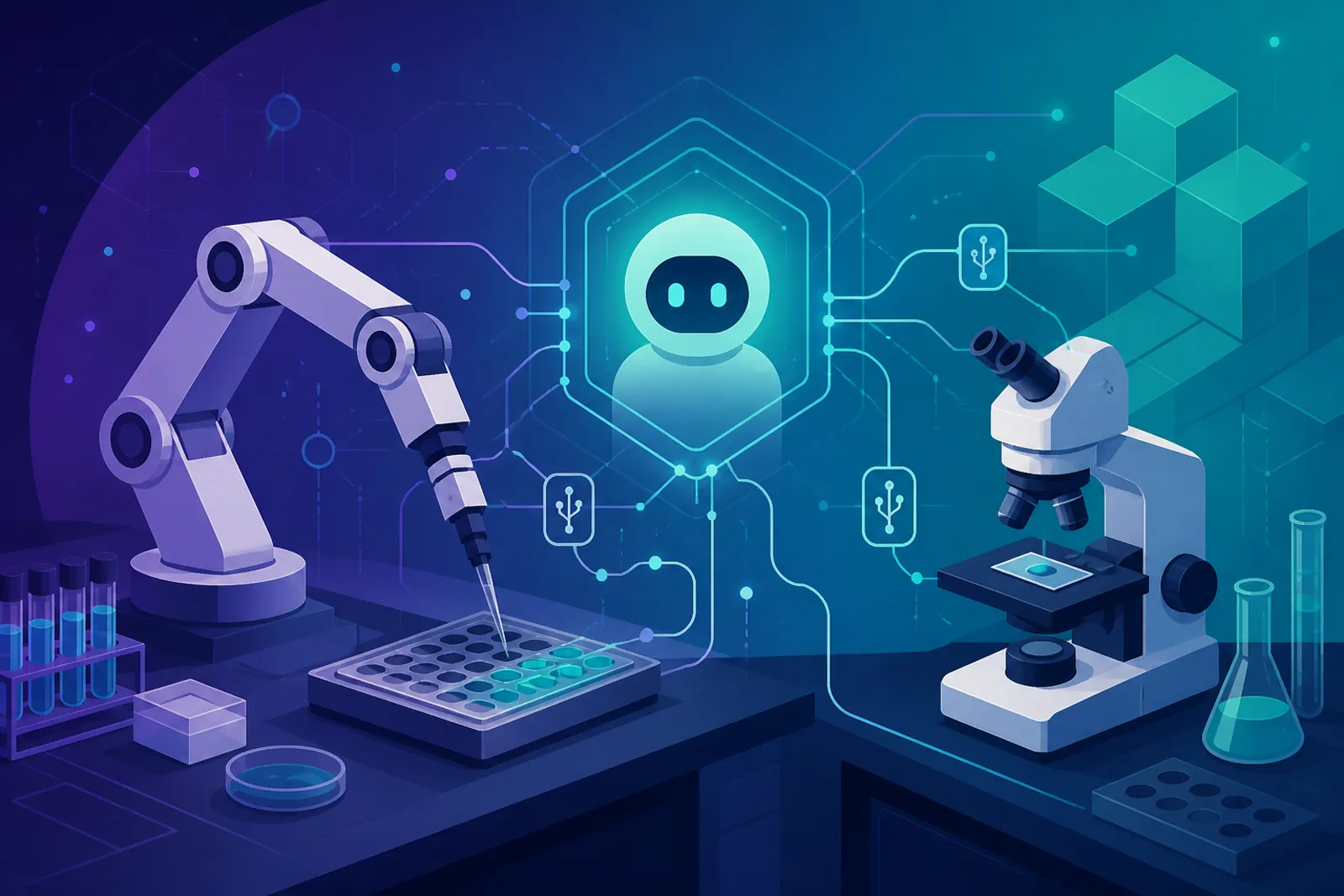
For two years, agent talk mostly lived in browsers, repos, and APIs. Working scientists kept hitting the same wall: instruments do not speak a common language, and wiring even a few devices can take weeks. On August 27, 2026, Anthropic’s post Previewing the Model Hardware Standard opened a research preview of MHS for an initial set of labs and advanced manufacturers. The stated goal is blunt—cut typical hardware integration from weeks or months to hours or minutes, and let agents operate microscopes, liquid handlers, robot arms, and similar programmable gear in parallel.
Around the same period Anthropic also expanded scientist seating and AI for Science credits, and the later Fable 5.1 / Mythos 5.1 launch note treated MHS as part of the science stack. Treat it only as a partner PR blurb and you miss the point: this is Anthropic extending the MCP-style universal connector story from software into the physical world.
What the official release actually says
Per Anthropic, MHS is a shared specification for AI agents to operate physical devices more safely. It began as a collaboration between Alek Kemeny on Anthropic’s Beneficial Deployments team and Arco Bast, a postdoctoral scientist at HHMI Janelia, whose brain-imaging rig mixed lasers, motorized focusers, and cameras from different vendors with no common interface. Bast built a shared-memory dictionary; together they wired models into that interface.
Mechanically, MHS adds a standardized driver with simple read/write primitives, makes devices discoverable in a common format, and lets operators attach natural-language tags so agents get machine characteristics and enforced safety limits that code alone may not reveal. Control then flows through MCP, a CLI, and code files/APIs. For long-running or latency-sensitive work, agents can compile driver commands into deterministic scripts instead of reasoning at every step. Anthropic’s laser-alignment vignette shows exploratory tuning followed by packaging the learned sequence into a single command.
Early partner cases (company-disclosed; not independently reproduced here) include Genentech’s BCA assay across a liquid handler, arm, and plate reader; University of Washington dashboards and agent-supervised qPCR with collision-free plate handoffs; Carnegie Mellon serial-dilution dose-response runs reported about 3× faster across three incompatible computers; Janelia unifying a rig that previously needed seven vendor programs; QuEra recovering laser lock without human intervention 99.3% of the time; and Tetsuwan Scientific qPCR workflows for local pollution profiling. Vendor names on the list include AWS Strands Robots, Automata, Danaher, Doosan, MBF Bioscience, QIAGEN, Tecan, Universal Robots, plus early adopters such as Hugging Face LeRobot and Raspberry Pi. Anthropic says MHS is model-agnostic, works with any programmable interface, and will be open-sourced after preview partners help build safety evaluations and a physical-safety roadmap.
Cross-check: R&D World restates the same arc and quotes Kemeny on the missing common way to connect a model to physical equipment, and Bast on replacing bespoke integrations with one-time MHS connections. It also sharpens the Genentech foam episode—Claude initially treated bubbling as a software bug and made it worse until experts intervened—consistent with Anthropic’s own caveat that spatial and physical reasoning still need expert oversight. R&D World’s notes on scientist seats and AI for Science credits are adjacent science go-to-market moves, not part of the MHS technical claim.
Product value: the scarce piece is a closable physical loop
MHS’s pitch is a reusable contract for discovery, capability description, safety limits, and orchestration—not another robot demo. Developers get less vendor-SDK glue and a MCP-like ecosystem bet. Enterprises get a path to treat the bench as a science problem again instead of an IT integration project. The disclosed cases look like real increments: cross-vendor orchestration, turning exploration into scripts, QuEra-style closed loops. Limits remain clear: programmable interfaces only; weak physical failure diagnosis; research-preview access, not a consumer toggle. MHS taxes integration, not robotics itself.
Competition and strategy
Strategically this rhymes with MCP: publish a connector narrative, recruit clouds, instrument makers, and open robotics libraries, then compete on science workflows and evaluation depth. Model-agnostic is a deliberate stance—if the spec truly opens, other models and harnesses can ride it, and Anthropic’s edge shifts to partners, evals, and scientific agent quality. OpenAI’s public story more often centers general computer use and cloud agents than a lab-instrument standard. Industrial stacks already have ROS, OPC-UA, and SCADA; MHS sits above them as a model-readable device sheet plus limits, not a replacement for hard real-time control. Commercial motive is straightforward: wire Claude into daily lab and factory loops, while preview-plus-open-source language blunts lock-in criticism and a physical-safety roadmap manages reputation risk.
Risks, limits, and disputes
The danger is success. Parallel write access to machines expands misuse, accident, and supply-chain surfaces into the physical world. Anthropic states plainly that Claude learns the physical world through text and images and still needs expert oversight; the foam misdiagnosis is the canonical counterexample. The preview also means no frozen spec, no public independent certification package, and no broad production evidence. Model-agnostic is an interface claim, not a proof that every model–harness–device combo is safe. Open-source timing and the physical-safety roadmap remain commitments. Visionary lines about compressing a century of progress should be read as aspiration quoted by third parties, not as demonstrated fact.
Critic’s take
I file MHS as high priority and not yet past the verification gate. High priority because the next agent bottleneck is tool contracts; without a physical layer, science agents stay slideware. Not past the gate because public evidence is still partner vignettes and company narrative, not reproducible benchmarks, failure corpora, or third-party red teams. Better questions than “will Claude replace the lab tech?”: Are hard limits in the driver or only in prompts? Are stop and approval local and non-bypassable? Is there an evidence trail per run? Until those are crisp, treat the preview as research access, not a production license.
Six to twelve months
Watch driver coverage, whether preview safety findings are published, and whether an open draft ships. Over 6–12 months, watch for multi-model implementations, whether AWS and instrument majors treat MHS as default or pilot, and whether the physical-safety roadmap has checkable milestones. If the protocol widens, lab automation may shift partly from systems-integration to driver-and-policy work; if incidents arrive first, the industry will retreat to private middleware and tighter human-in-the-loop. Either way, MHS reframes an old problem: once models turn real-world knobs, alignment cannot live only in chat logs.