
要点
- Amazon Science with Booking.com: KD plus Medusa-2 brings a 1.1B TinyLlama student near a 70B Llama-3.1 teacher’s quality at 10–20× speed.
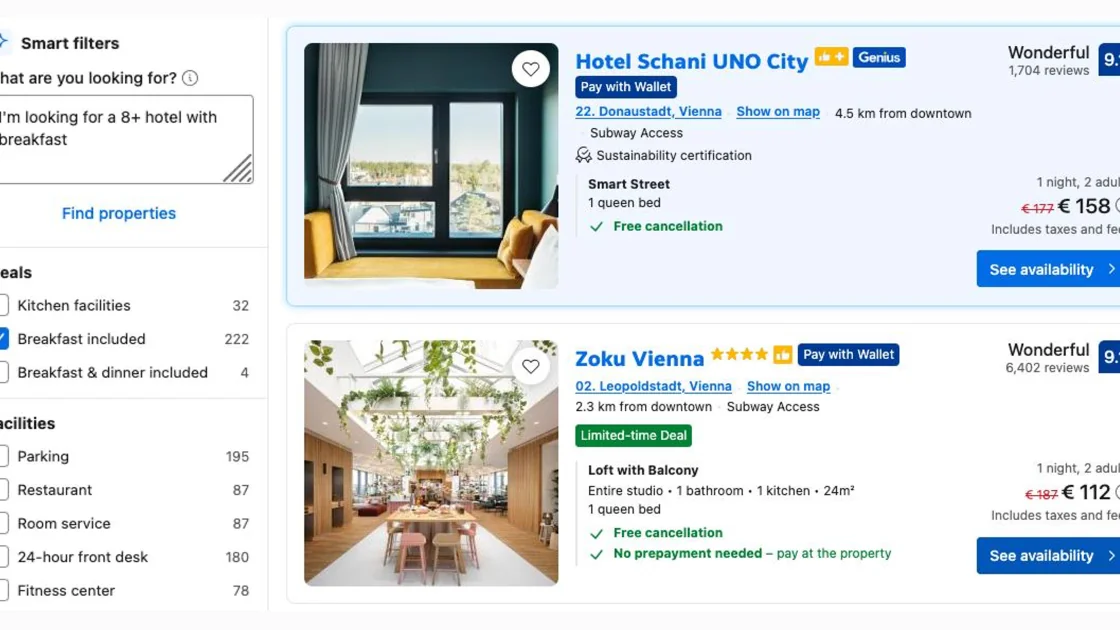
- Smart Filters: ~15× faster for 99% of queries; KD alone closed >90% of the teacher–student quality gap and ~6× inference, then Medusa heads added 2–3.6×.
- AI Trip Planner: +2.9% engagement vs GPT-3.5; accommodation descriptions +1.4% “helpful” at lower cost; ACL Industry Track best paper.
Amazon Science on 29 October 2026 described a Booking.com pipeline that pairs knowledge distillation with Medusa’s parallel token heads. Three surfaces — conversational trip planning, natural-language smart filters, and mass accommodation copy — were gated by latency or cost.
The narrow claim: real-time travel UX is bottlenecked by oversized models plus sequential decode; distillation or Medusa alone is insufficient — joint training is what buys near-teacher quality at order-of-magnitude speed. If gains are benchmark-only, or either technique alone suffices online, the claim is too strong.
[1]They fine-tune a ~70B teacher, then train a 1.1B TinyLlama student with Medusa heads on mixed human and teacher labels. Medusa-1 freezes the backbone then trains heads; Medusa-2 trains jointly — similar speedups, simpler ops, preferred for production. GPUs absorb parallel heads with modest overhead; typical Medusa literature cites 2–4× without large quality loss.
Progression: task-tuned small models already beat few-shot GPT-4o but trail the teacher; KD closes >90% of the gap and ~6× speed; Medusa adds 2–3.6×. Combined: 10–20× vs the teacher by use case.
[1]Product numbers: Smart Filters ~15× for 99% of queries; Trip Planner +2.9% engagement vs GPT-3.5; descriptions +1.4% “helpful” at lower cost than comparators (cost text references under one-third of GPT-4-class spend in places). ACL Industry best-paper status adds peer visibility, not external replication.
Limits: engagement/helpful are in-platform metrics; teacher is Llama-3.1-70B with GPT-3.5/4 comparators — cross-generation care needed. Full latency CDFs and failure cases are not public. Confidence: method and speedup factors high; business-metric portability medium.
[1]Steelman: travel queries are often short and structured, so Medusa’s parallel decode may over-index versus long open-ended prose; guidebook-length generation would need retuned heads and acceptance tests. Another: staying on GPT-4o-class APIs plus caching may win on eng-hours until QPS and tail latency force self-hosting. The post’s “100 ms costs customers” is a commercial premise, not a universal law.
[1]For OTAs and any high-QPS conversational surface, the piece reframes the menu from “buy a bigger model” to “how teacher quality enters the student while killing sequential decode.” For inference teams, KD+Medusa-2 implies a compact per-task checkpoint catalog rather than one shared 70B. For evaluation desks, demand quality-gap closure and percentile latency together — not mean tokens/s alone.
[1]Over six months: whether Booking-like metrics replicate in other verticals; whether Medusa-2 stays stable under tool-use/JSON-constrained decode; and whether KD-only or speculative-decode-only ablations appear. If both stacks remain necessary for p99 latency and quality, the thesis holds; if one technique alone meets product SLOs, rewrite it.
[1]