
要点
- Meta’s OCP 2026 networking slate spans IcePack/IceCube 102.4T liquid-cooled switch racks, Flattened Planar Fabric scale-out, BAG scale-across for Prometheus, and Ethernet scale-up (Tahan/ESUN) for MTIA.
- OSPA (co-led with Microsoft and Alibaba) submits a v1.0 OCP switch-platform reference to standardize the layer above SAI that still forces months of duplicated bring-up.
- MetaRoCE—Meta’s RDMA transport for AI networks—is going open source, starting with user-space libsoftmetaroce (DPDK version forthcoming).
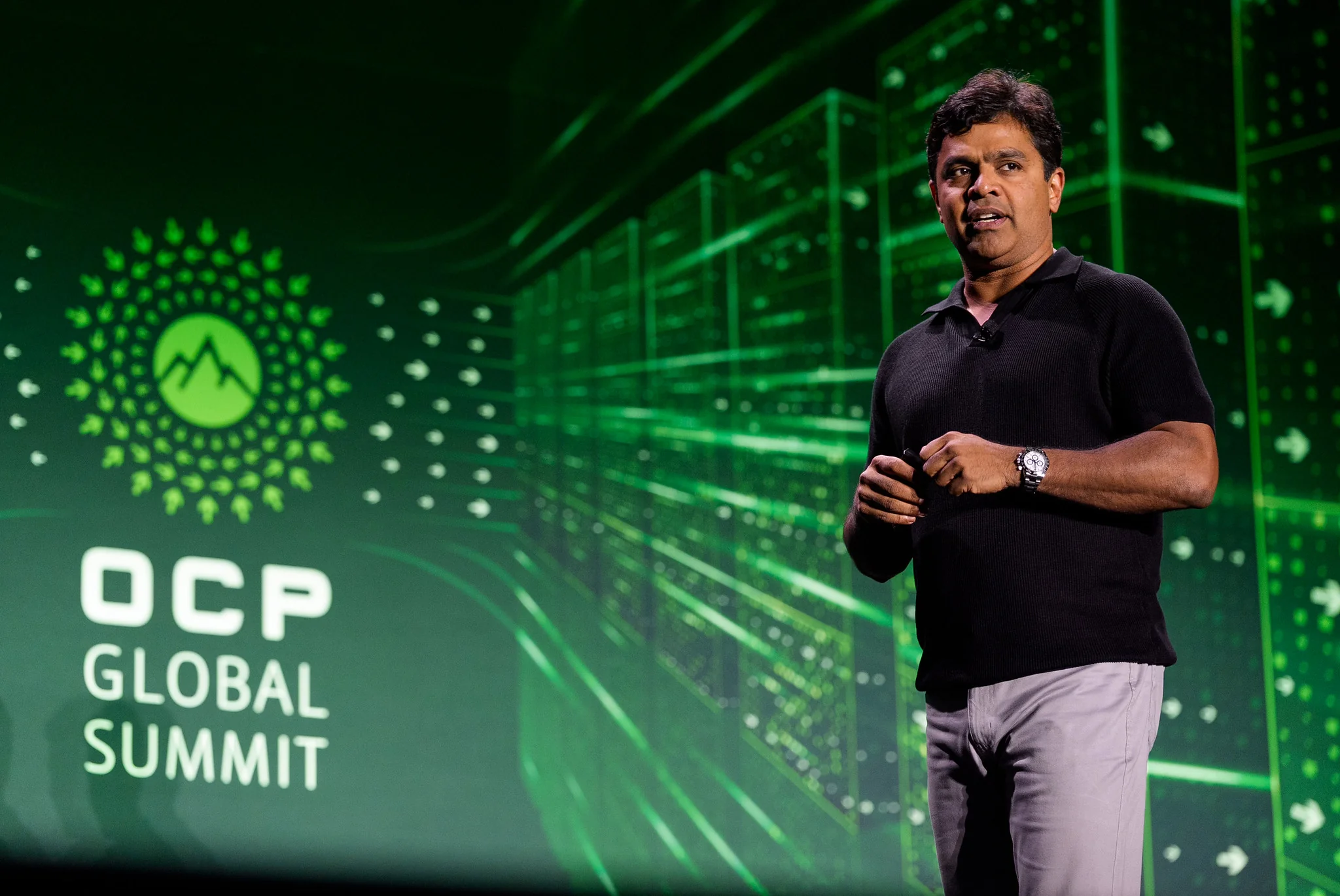
At the 2026 Open Compute Project Global Summit, Meta framed networking talks around Muse Wonder, Muse Spark and the gigawatt-scale Prometheus cluster. The executive line from Omar Baldonado is blunt: AI progress now depends on the network as much as on compute, and the path forward is full-stack openness rather than proprietary walls.
That is not a soft slogan dump. The engineering blog lists concrete hardware and software bets—102.4T switch blades, multi-plane scale-out, petabit-scale building aggregation, Ethernet scale-up for MTIA, and open transport/platform specs—that treat the network as the scarce resource.
[1]Hardware highlights include IcePack & IceCube, Meta’s first liquid-cooled network rack with 102.4T blades (128×800G) on Broadcom Tomahawk 6C or NVIDIA Spectrum-6, running FBOSS. Flattened Planar Fabric moves scale-out toward a 2-tier Clos with eight network planes per GPU, NIC-level packet spraying, and a combined host+switch control plane, built with NVIDIA and shared with cloud partners.
Scale-across centers on BAG, a petabit-scale super-spine joining buildings, campuses and regions in Prometheus, plus SRv6 regional backbones on FBOSS + SAI. Scale-up pushes Ethernet via Tahan for MTIA 300 (Broadcom Tomahawk5), a preview of 72 accelerators per rack on 102.4T silicon, and ESUN progressing from 1.0 to 1.1.
[1]The open-stack levers are OSPA and MetaRoCE. OSPA proposes a unified multi-vendor switch platform reference because SAI made the data plane portable while the platform layer stayed fragmented. Meta, Microsoft and Alibaba co-lead; a v1.0 spec is submitted to OCP. MetaRoCE rethinks RDMA for AI collectives gated by the slowest node across huge accelerator counts; software starts open with libsoftmetaroce on GitHub, DPDK next.
Supporting talks cover CPO validation toward 102.4T, linear pluggable optics without per-module retimer DSP tax, large-scale 800G AECs, and operating reliability from GPUs through FBOSS and schedulers. This is a portfolio disclosure with videos and decks, not a single controlled experiment.
[1]The steelman is that hyperscaler open specs can still encode Meta’s topology and supply-chain choices—vendors and smaller operators may “adopt” OSPA/MetaRoCE and discover the integration tax simply moved. Proprietary scale-up fabrics also still ship performance that Ethernet-for-scale-up must continually re-prove on latency and congestion control.
Also thin in the blog itself: quantitative comparisons of BAG versus alternative DC interconnects, ESUN vs incumbent scale-up on production MTIA jobs, and how much MetaRoCE diverges from standard RoCE in ways that matter to non-Meta NICs. Treat the summit dump as agenda-setting evidence.
[1]For the industry, the fork is whether AI cluster networking consolidates around open Ethernet-ish stacks (ESUN, OSPA, open RDMA software) or remains a quilt of vendor scale-up domains plus closed transports. Meta’s bet couples liquid-cooled 102.4T gear with software openness—hardware density without open platform/transport layers would still lock operators into bring-up hell.
Cloud partners seeing FPF shared outward suggests Meta wants the same recipes off-prem, not only inside Prometheus.
[1]Watch OSPA implementers beyond the co-leads, MetaRoCE third-party NIC support, and whether ESUN 1.1 shows up in non-Meta racks. If those land, “more GPUs” stops being a sufficient scaling story. If they stall, OCP 2026 will read as Meta’s networking catalog with open-source marketing on top.
[1]