
要点
- On 10 November 2026, Amazon Science published a blog by Chris (Luyang) Kong introducing Mitra-v2, together with a technical report, "Mitra-v2 Technical Report," posted on arXiv as 2609.04540 on 3 September 2026. Where the two disagree, we follow the report.
- Mitra-v2 is a tabular foundation model: one pretrained model reads the labeled rows of a previously unseen table and predicts the rest. It is pretrained only on synthetic tables, with no real data and no customer data. The 12-layer Transformer architecture is unchanged from v1. Weights and code are released under Apache-2.0 on Hugging Face.
- TabArena is a public benchmark of 51 real-world datasets, maintained by an independent academic team, and ranks methods by Elo from head-to-head wins under a fixed one-hour budget. On the report's frozen board, Mitra-v2 records 1,774.6 Elo at the top of the single-model field, statistically level with TabFM. It has lower error than v1 on 32 of 33 datasets where both run natively, and it completes all 51 datasets within the hour.
- By default the model is briefly, automatically fine-tuned on each new table and averages eight copies, a method called bagging, so it is not a zero-shot system. The blog says fine-tuned Mitra-v2 ranks first on ScoringBench, a public benchmark for regression models that predict a range of likely outcomes rather than a single number. On TALENT, a suite of roughly 300 datasets, the report places it first on classification tasks with more than 10 classes.
- Amazon Connect Customer is adopting Mitra-v2 for prediction on structured business and customer-experience data. That is an adoption claim, not a measured production lift. Gradient-boosted trees remain the default for many tables, and the automatic fine-tune plus eight-copy bagging is a real compute cost at deployment.
On 10 November 2026, Amazon Science published a blog by Chris (Luyang) Kong introducing Mitra-v2, a tabular foundation model pretrained only on synthetic tables. The accompanying technical report, "Mitra-v2 Technical Report," was posted on arXiv on 3 September 2026, and it is the account we follow where the two disagree. The checkable claim is not that one model now replaces every training run on every business table. It is that Mitra-v2's standing at the top of the single-model field on TabArena comes from widening the mix and size of synthetic pretraining tables, not from a deeper network, and that this result still depends on a brief, automatic fine-tune and on averaging eight copies of the model.
[1][2]What Mitra-v2 actually is
Much of the data businesses run on lives in tables, and the usual tools, including gradient-boosted decision trees, produce a model fitted to one table. A new table means a new training run. A tabular foundation model is meant to break that cycle: one pretrained model reads the labeled rows of a table it has not seen and predicts the unlabeled ones.
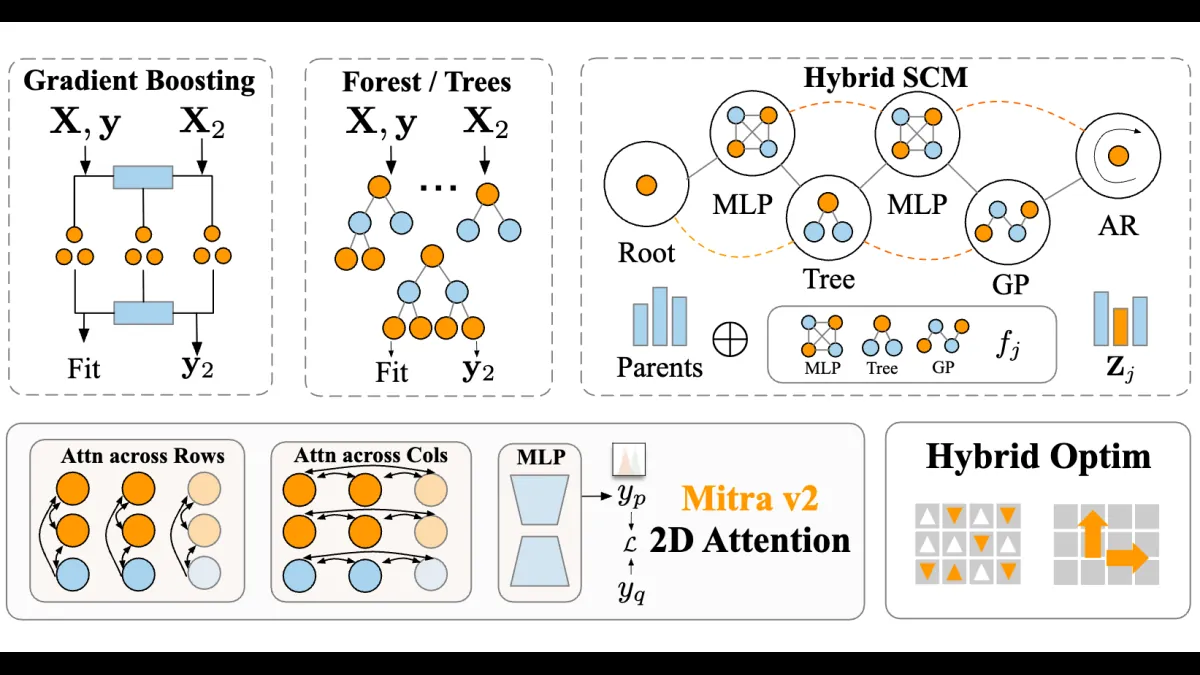
Mitra-v2 is Amazon's second generation of that idea, for classification and regression. Last year's Mitra, the blog says, worked on small and mid-sized tables but ran out of room on large ones, wide ones, and problems with many classes. The new model is pretrained entirely on synthetic tables, with no real data and no customer data. The architecture is the same 12-layer Transformer as v1, attending both across rows and across columns. The released checkpoints have about 77 million parameters, the report says. Weights and fine-tuning code are released under Apache-2.0 on Hugging Face.
The "foundation model" label needs a caveat. By default, Mitra-v2 is briefly, automatically fine-tuned on each new table, and it produces eight copies whose predictions are averaged, a method called bagging. The blog is explicit: it is not quite a zero-shot model. Zero-shot here would mean predicting on a new table from a single forward pass, with no extra fitting. Amazon Connect Customer, which the blog describes as providing agentic-AI systems for core business functions, led the effort and is adopting Mitra-v2 for prediction on structured business and customer-experience data. That is an adoption claim, not a measured production lift.
[1][2]The TabArena and ScoringBench results
TabArena is a public benchmark of 51 real-world datasets, maintained by an independent academic team. It ranks methods by Elo, the rating system used in chess, computed from head-to-head wins under a fixed one-hour budget. The blog says Mitra-v2 leads the single-model field. The report is more precise, and we use its numbers, pinned to the one-hour boards of 3 September 2026.
Across the full 51-dataset board, Mitra-v2 records 1,774.6 Elo at the top of the single-model field. The report reads this as statistically level with TabFM, whose point estimate Mitra-v2 edges by about 1 Elo, and roughly 25 Elo above EXAONE Tabular. It surpasses TabPFN-3 by roughly 137 Elo. Because the leading methods' 95% bootstrap intervals overlap, the authors say close differences should be read as ties. A four-hour AutoGluon AutoML portfolio sits above Mitra-v2, but that system fields many models per dataset and is not a single frozen model inside the one-hour limit. TabFM's artifacts, the report notes, include fits that ran beyond that budget.
The comparison with Mitra-v1 is clearer. On the datasets where v1 actually finished, rather than having scores filled in, v2 has lower mean error on all 26 of 26 classification datasets and on 6 of 7 regression datasets, which is the blog's 32 of 33. Mitra-v2 runs all 51 datasets natively. Mitra-v1 had scores filled in on 12 of 38 classification datasets and 6 of 13 regression datasets, more than a third of the board, after it failed to finish inside the hour.
On ScoringBench, a public benchmark for regression models that predict a range of likely outcomes, the blog says fine-tuned Mitra-v2 ranks first. We did not find ScoringBench results in the technical report, so that ranking is a blog claim. On TALENT, an independent suite of roughly 300 datasets, the report places Mitra-v2 among the leading methods and first on classification with more than 10 classes, a 12-dataset slice, even though pretraining used at most 10 classes. TabFM cannot run those tasks.
[1][2]Synthetic priors, not a deeper net
The design argument is that the network did not have to get deeper. The report says Mitra-v2 keeps v1's 12-layer backbone. TabFM has 1.6 billion parameters, about 21 times more. What changed is the pretraining mix. The blog says v2 saw tables with 10 times as many rows and roughly three times as many columns as v1. The report gives the new range as 160 to 5,120 example rows, with 1 to 50 features.
The authors also added a new family of synthetic tables. The original Mitra was trained on tables from structural causal models, graphs of cause-and-effect relationships between columns, and from tree-based models. Mitra-v2's new hybrid SCM prior builds a single causal graph in which each relationship can be a small neural network, a decision tree, a smooth function drawn from a Gaussian process, or a time-dependent autoregressive process. Classical SCM, gradient-boosting, and forest generators remain in the mix. A new hybrid optimizer, the authors say, keeps training stable across this wider range. For very wide tables, a train-only truncated singular-value decomposition reduces the columns to a budget that fits. The output layer has only 10 class nodes, so tasks with more classes are split into a shallow tree of smaller problems.
The report is honest about what this does not isolate. The authors changed context length, feature range, prior mixture, optimizer, distributed training, and checkpoint at once, and their experiments do not separate each contribution. "Not a deeper network" is supported. A claim that the new synthetic mix alone produced the gain is not.
[1][2]Not zero-shot, and other caveats
The default system on the boards is AutoGluon's bagged fine-tuning recipe, not a single forward pass. The report describes about 50 fine-tuning steps by default, capped at 250 seconds per bagged child under the one-hour limit, with eight-fold bagging. The authors warn that this cost is well above that of zero-shot, forward-pass models, and that the system should not be described as zero-shot. Elo is also a relative score: adding or removing methods can change every rating, and future public rankings may differ from the 3 September 2026 freeze. On classification, the report already reads Mitra-v2, TabFM, and EXAONE Tabular as a statistical tie. The Connect Customer deployment should not be read as evidence of lift. The blog describes an intended use, not a before-and-after metric from production.
[1][2]The fair case
The fair reading starts from the board, not from the foundation-model slogan. Beating v1 on 32 of 33 overlapping datasets, and finishing all 51 TabArena datasets inside an independently hosted one-hour budget, is a hard result if that frozen snapshot still describes the public board. Matching a much larger model with a 77-million-parameter, 12-layer network, if the tie holds, is the design finding: the pretraining distribution can move the score without a deeper net.
The honest limit sits beside that finding. The headline system is fine-tuned and bagged, so "foundation model" here does not mean a free, instant guess on a new table. The top of the single-model field is a statistical tie, not a clean separation. Gradient-boosted trees, and four-hour AutoML portfolios, remain the safer default for many tables. Mitra-v2, the report notes, places first on about 9 of the 51 datasets, more often than the portfolios, which is a different profile, not a reason to retire trees.
[1][2]Who should care, and what to watch
Anyone who today trains a fresh model for every new business table should care, as should readers of claims that tabular foundation models have made that training run unnecessary. The models and code are open on Hugging Face. In the next six months, the tests are whether later TabArena revisions still place Mitra-v2 at the top of the single-model field once the comparison pool moves, whether independent users find the default fine-tune-and-bag recipe worth the compute on their own tables, and whether Amazon Connect Customer's adoption is followed by any public, measured lift rather than a deployment claim.
[1][2]Close
Mitra-v2 shows that a tabular foundation model can move up an independent board by widening synthetic pretraining, without a deeper network. It does not show that the foundation-model label now means a free, instant prediction on a new table. The next board revisions, and the first measured deployments, will say whether that distinction still holds.
[1][2]