
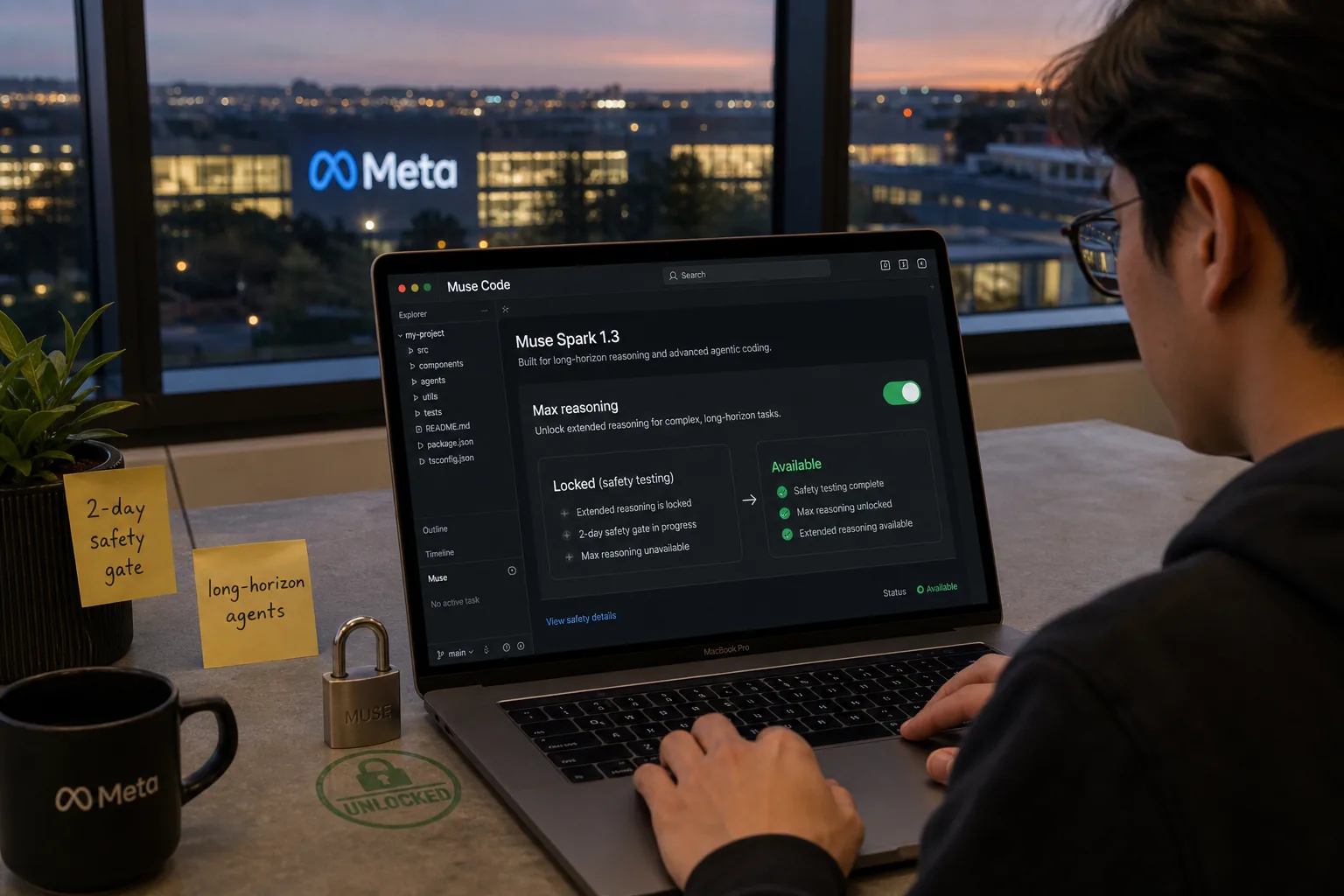
Meta’s September 2 post was unusually plain: Muse Spark 1.3 would land in Muse Code and the Meta Model API with existing reasoning modes first, while max reasoning waited on more safety testing.
Two days later the gate opened. Superpower Daily reports Max is now callable in Muse Code and the API — the configuration behind many of Meta’s strongest published scores, not just a slide in a partner demo. That matters for buyers. If you benchmarked the September 2 shipping tier, your sheet may already be stale. If you sold leadership on Max numbers, you only got the matching dial on September 4.
Meta pitches 1.3 for long-horizon coding and agents: several workflows in one thread, tools that reconcile conflicting context, plan repair, asking for help instead of fake success, and confirmation before irreversible moves. Those claims showed up with the earlier tiers; Max is what lines them up with the scoreboard version.
Cost and latency remain foggy. Superpower Daily notes Max still lacks its own public price and latency figures. Meta’s “about 20% fewer tool calls and 25% fewer tokens versus 1.2” is an internal release comparison, not a Max-specific cost curve. The model stays proprietary; an open-weights Muse Spark is “planned” without a version or date.
The industry pattern is familiar. Anthropic splits permissions with Fable/Mythos. OpenAI gates cyber power through Daybreak. Meta stages reasoning effort behind a safety clock. What is different is the footnote honesty: the launch post itself said the top dial would arrive later. Before writing “shipped,” ask whether the machine on the desk can actually turn Max.
[1][2]