
要点
- Minerva maps GPUs, Spectrum-X/NVLink, storage, NCCL, schedulers and jobs into a live knowledge graph so ops start from shared causal context, not separate inventories.
- Gray failures—hotter peers, load-only NVMe loss, pause-frame storms—often never cross absolute thresholds; peer-comparison and rare-log NLP are the detection claim.
- NVIDIA cites internal cases: one of ~400K NVLink interfaces found in minutes; SuperNIC APEI caught before jobs landed; NVMe power fault ~5,530 job-hours; 81 events collapsed to one pause-frame incident (~54 cluster hours).
AI factories run hundreds of thousands of GPUs, Spectrum-X fabrics, NVLink domains and multi-week training jobs as one production system—even when network, compute and ML teams keep separate telemetry. In synchronous training, the job advances at the pace of its slowest rank. A GPU a few degrees hotter than peers, an NVMe that only fails under sustained load, or a switch pause-frame storm can waste healthy capacity without ever crossing a static threshold.
NVIDIA’s developer post for Minerva frames that gap as the real yield problem: dashboard silos see accurate local signals and still miss the dependency chain. The product claim is an AIOps platform built around factory topology and workloads—not another threshold pack.
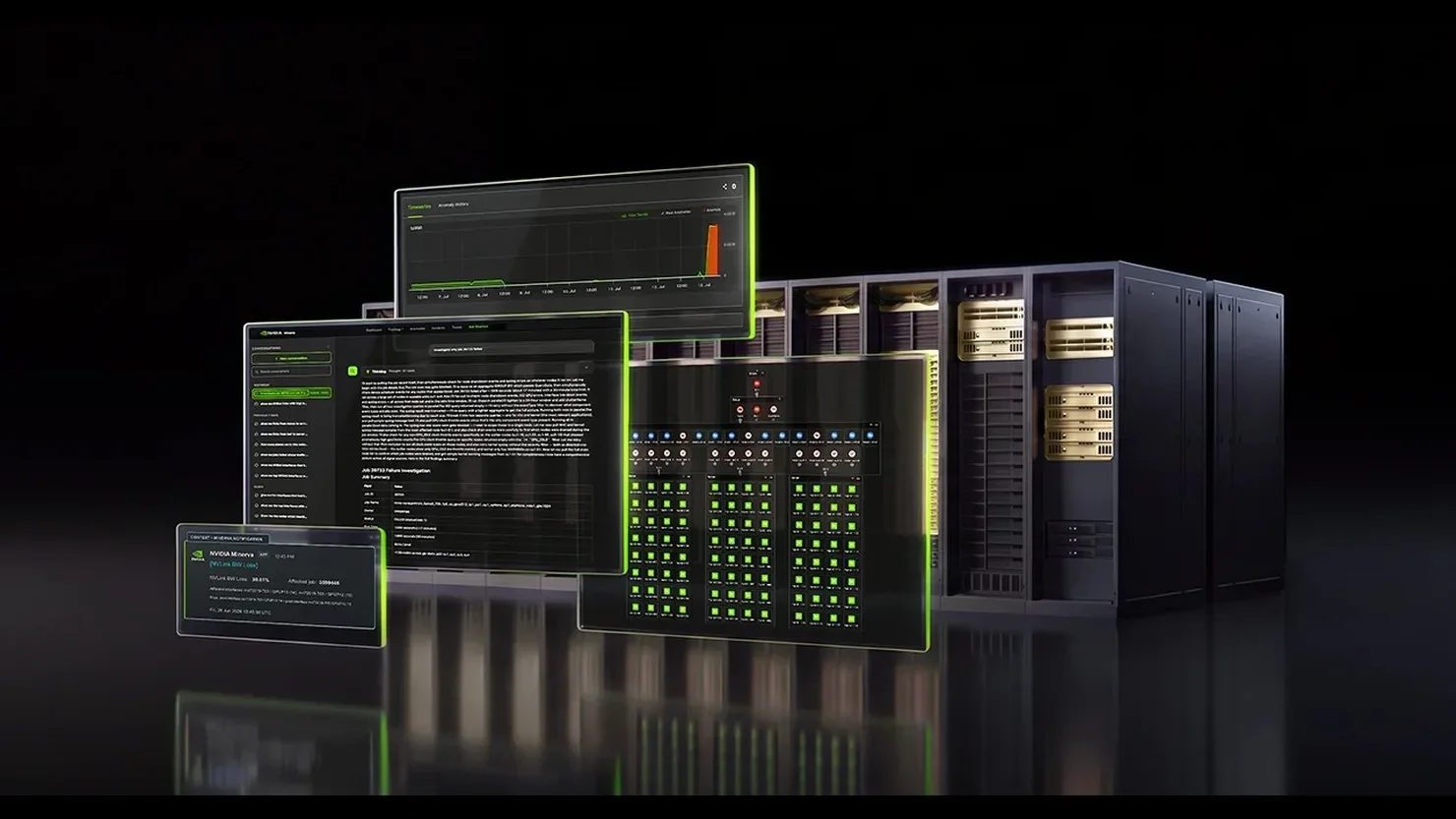
[1]Minerva ingests metrics, logs and topology from GPUs, Spectrum-X and NVLink switches, SuperNICs, DPUs, storage, NCCL, schedulers and jobs. Auto-discovery builds a knowledge graph that updates as jobs start and stop and as nodes drain or return. From an anomalous interface you can walk to node, fabric path and job placement; from a job ID you can walk GPU → host → NIC → switch → logs.
Detection mixes supervised signatures with unsupervised peer comparison and multivariate models (temperature, power, clocks, utilization, workload state). Logs get NLP anomaly detection for never-seen patterns. Topology-aware correlation then collapses dependent symptoms into one incident with affected topology and workloads attached. A native agent (“Sherlock”) and an MCP server expose the same live evidence conversationally or to external tools.
[1]The post’s strongest evidence is NVIDIA’s own factory cases. An SRE watching step time degrade with no hard alert used Minerva to isolate one NVLink connection among roughly 400,000 interfaces and drain affected nodes before the slowdown spread. A rare SuperNIC PCIe/APEI kernel line—too rare for static rules—triggered Slack remediation guidance and removed the node before customer work landed. Full-stack job RCA traced stragglers to an NVMe that could not wake from low power, credited with saving about 5,530 hours of job runtime. A page-fault-driven switch restart produced RX pause frames and as many as 81 noisy events; correlation shipped them as one incident, estimated at about 54 hours of cluster uptime saved.
These are vendor walkthroughs with internal estimates, not third-party MTTR studies. They still specify a coherent doctrine: start from the job or the link, not from eighty dashboards.
[1]The steelman against Minerva is that mature AIOps stacks already do topology graphs, peer baselining and incident clustering. If Minerva’s value is only prettier correlation on NVIDIA-centric telemetry, operators with strong open observability may gain less than the post implies—especially once DSX OS open-sources selected collectors and health components.
Also thin: false-positive rates for unsupervised models, how often Sherlock recommendations are wrong, multi-vendor fabric coverage outside Spectrum-X/NVLink reference paths, and how much of the “significant reduction in notified events” survives outside NVIDIA’s supported scenarios. Treat the case studies as existence proofs of gray-failure recovery, not as transferable SLOs.
[1]For platform teams, the near-term question is whether investigation starts from a shared causal map of jobs and fabric, or from ticket ping-pong between network and compute. For ML owners, the unit that matters is effective GPU hours and token production—not whether a GPU stayed “up.”
NVIDIA positions Minerva as converging with DSX OS, with collectors planned as open modular pieces. That matters if customers want reference-architecture telemetry without locking analytics to one proprietary console forever.
[1]Watch the next six months for published false-alarm rates, time-to-isolate distributions, and deployments outside NVIDIA’s own factories. If peer-comparison plus topology collapse consistently find gray failures before thresholds fire, AI-factory monitoring will have to treat siloed dashboards as the failure mode. If not, Minerva remains a strong NVIDIA-stack AIOps story that still leaves the industry arguing about alert fatigue.
[1]