
要点
- NVIDIA's blog dated 9 November 2026, written by Sasa Docca and timed to the Conference on Robot Learning in Austin, Texas, introduces GR00T 2, Isaac Lab 3.0, and new open industrial benchmarks.
- GR00T 2, an open world action model built on NVIDIA Cosmos, completed 40 of 50 evaluated tasks at least once without task-specific demonstrations. With one demonstration per task it reached 71% average success across 50 tasks, and 95% with five.
- AlphaNIST, trained in Isaac Lab, learns all 20 tasks on the NIST Assembly Task Board with a single policy, meaning one learned control program, and only a yes-or-no success signal. NVIDIA reports more than 98% training success, against 81% when each task has its own policy, and about 39 times less GPU time.
- Isaac Lab 3.0 can switch between the PhysX and Newton physics solvers and can model cables, cloth, and other objects that change shape. NVIDIA says Isaac Lab 3.0 with Newton reached up to 2.5 times the training throughput of Isaac Lab 2.3 with PhysX on a vision-based benchmark for precise finger and gripper work.
- Nexuni is testing GR00T 2 for laundry handling, Foxconn is applying it to factory automation for server manufacturing, and Siemens is evaluating it on industrial use cases. Those are tests and evaluations, not a report of robots finishing paid factory work.
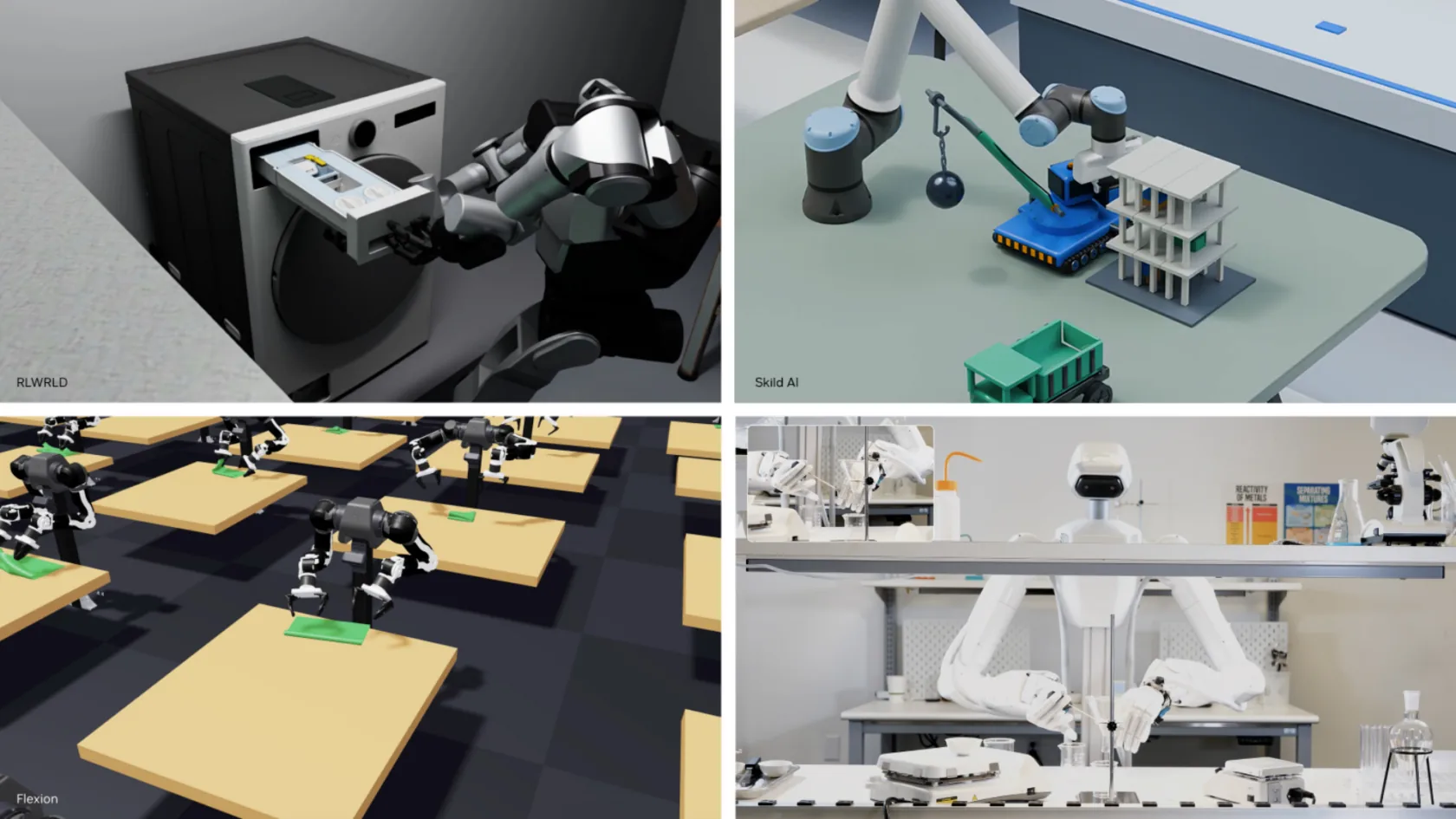
On 9 November 2026, NVIDIA published a blog post by Sasa Docca to coincide with the Conference on Robot Learning, known as CoRL, in Austin, Texas. The company said simulation, long used to teach robots to walk, roll, and hop, is now being used to teach finer work: aligning gears, connecting cables, and assembling small parts. The post introduces GR00T 2, a new open robot model, Isaac Lab 3.0, an update to NVIDIA's open robot-learning simulator, and two industrial benchmarks, DexBench and VABAR. The post is about practice. The numbers on the page tell you how often a learned control program succeeded while it was learning or being tested in simulation. They do not tell you how often a robot completed a paid shift on a factory floor.
[1]What was announced
GR00T 2 is described as an open world action model built on NVIDIA Cosmos. A world action model, in NVIDIA's wording, is meant to see a scene, anticipate how its own actions will change that scene, and then carry out multi-step work with high precision. It was trained on robot data and human data, including 100,000 hours of NVIDIA's open human egocentric video, meaning footage recorded from a person's point of view.
The headline figures for GR00T 2 are these. It completed 40 of 50 evaluated tasks at least once without any demonstration, meaning a recorded example of that task being done, collected for that specific task. With one demonstration per task, average success across the 50 tasks was 71%. With five demonstrations, it was 95%. The model can learn from human demonstrations and transfer skills to different robot bodies without demonstrations collected on those robots. NVIDIA says it ranks among the top three models in the vision-language-action and world-action categories of the RoboCasa365, RoboLab, RoboDojo, and MolmoSpaces benchmarks, with several leaderboard wins. A vision-language-action model takes a camera image and a written instruction and outputs motion.
Isaac Lab 3.0 is the training ground. Researchers can use software agents to set up environments, switch between NVIDIA PhysX and Newton for physics, pick a renderer for vision-based training, and apply a new reinforcement post-training library to foundation models such as GR00T. Reinforcement post-training means further training in which the model improves by trial and error with a reward signal. Newton is an open physics engine. Tighter integration, NVIDIA says, lets Isaac Lab model objects that deform, such as cables and cloth, and a strawberry being squeezed. On a vision-based benchmark for precise finger and gripper work, Isaac Lab 3.0 with Newton reached up to 2.5 times the training throughput of Isaac Lab 2.3 with PhysX, meaning it could run that many more simulated training steps in the same time. NVIDIA's own Isaac Lab release notes list 3.0 as a beta, built for Isaac Sim 6.0.
Two NVIDIA papers are among six finalists for CoRL Best Paper awards: GRAIL, on generating simulator-ready humanoid scenes, and RoboTTT, on scaling the visual and motor context a robot policy can use without slowing inference.
[1][2]What these numbers measure
"Completed 40 of 50 evaluated tasks at least once" is a weak operational claim. A robot that inserts a cable successfully one time has shown that the attempt is possible. A factory needs the same attempt to succeed almost every time, across lighting changes, part variation, and a full shift. The post does not say how many tries each of those 40 tasks required, or how often the model failed after the first success.
The 71% and 95% figures are average success rates across 50 tasks after one or five demonstrations. The post does not publish the spread across tasks, does not say whether those evaluations ran on physical robots or in simulation, and does not define success beyond the rate itself. The leaderboard ranks are similarly compressed. Being in the top three on named simulation benchmarks is a real research result. It is not a cycle-time number, meaning how long each good attempt takes, or a yield number, meaning the share of attempts that produce a good part, from a production line.
AlphaNIST is clearer about what it measures, and that clarity works in both directions. A single policy is trained on all 20 tasks of the NIST Assembly Task Board, which uses millimeter-scale parts. The only feedback is whether a task succeeded or failed. Training success was more than 98%, compared with 81% when each task had its own policy, and training used about 39 times less GPU time. Behind that result is Success-Guided Sampling, developed with the University of Washington, which concentrates practice on tasks the policy currently gets right about half the time. These are training-success and compute figures inside Isaac Lab. They are not transfer rates from simulation to a physical assembly cell.
[1][2]Why simulation is framed as the path to the factory
The reading in favor of the work is that walking was last decade's demonstration, and that factories pay for work the size of a gear tooth or an Ethernet jack. Collecting enough real-robot demonstrations of that work is slow and expensive. If a simulator can model a cable as it bends and a strawberry as it bruises, researchers can try a skill many times before a physical arm moves. NVIDIA says Isaac Lab and Newton can train thousands of simulated robots in parallel, and that Success-Guided Sampling can scale beyond a million parallel environments.
The post also introduces evaluation tools meant to show where a skill fails. Isaac Lab-Arena 0.4, in developer preview at CoRL, runs policies across thousands of variations. DexBench, from RLWRLD and NVIDIA, has 15 tasks in four scenes covering retail, logistics, manufacturing, and hospitality. VABAR, from UC Berkeley and NVIDIA, covers six industrial tasks with standard variations and difficulty tiers. Graph-as-Policy, also from UC Berkeley, uses software agents to stitch skills into programs, test them in NVIDIA's simulation tools, and revise them after failures. Ken Goldberg, a UC Berkeley robotics professor and a lead on VABAR and Graph-as-Policy, called agentic robotics "the most exciting technological development since the internet in 1995."
Named industrial users remain in the trial stage. Nexuni is testing GR00T 2 for robotic laundry. Foxconn is applying it to factory automation for server manufacturing. Siemens is evaluating it across industrial use cases. MicroAGI is using a version trained further with reinforcement learning to swap Ethernet cables on a YAM arm, and will demonstrate that workflow at CoRL.
[1][2]The fair case, and what is missing
NVIDIA sells the chips that run this kind of training. A post that gathers a new model, a simulator update, two benchmarks, and a long partner list is also a booth narrative for CoRL. That does not make the numbers false. It does mean they should be read as the company's own account, not as a factory acceptance test.
The fair case for the work is that fine manipulation in simulation is a real research bottleneck, that Newton addressing cables and cloth is a concrete physics gap, and that publishing open models, open training code, and open industrial benchmarks is more useful to other labs than another walking video. The involvement of the University of Washington on Success-Guided Sampling and of UC Berkeley on VABAR and Graph-as-Policy gives the research claims more than a marketing bench.
What is missing is independent confirmation of the GR00T 2 success rates, a clear statement of whether the 50-task evaluation was on real robots, any factory yield or cycle-time figure, and a definition of success that a process engineer could audit. Isaac Lab 3.0 is still listed as a beta on NVIDIA's documentation. Partner language is "testing," "applying," and "evaluating." Those words should be taken as written.
[1][2]Who should care, and what to watch
Robot-learning labs deciding whether to move manipulation training onto Isaac Lab 3.0 and Newton should care about the 2.5 times throughput claim and about whether cables and cloth now transfer to their own tasks. Factory-automation teams hearing that Foxconn or Siemens is involved should ask whether any result has left the evaluation stage. Benchmark designers should watch whether DexBench and VABAR become the numbers other groups report, or remain preview suites close to NVIDIA.
Over the next six months, look for the GRAIL and RoboTTT papers, for a real-robot table next to the 71% and 95% figures, and for any Foxconn or Siemens report that states how often a GR00T 2 policy completed a production task. Also look for outside groups running DexBench or VABAR and publishing scores NVIDIA did not write.
[1][2]Close
If those factory or real-robot numbers appear and stay close to the simulation practice scores, then NVIDIA's claim about rehearsal will have been the right frame. If they do not, the accurate description of this CoRL post will remain what it is today: a detailed account of how robots are being taught to practice delicate work in simulation, with success rates that measure that practice.
[1]