
要点
- The paper measures decode cost for open-weight models as context grows: 256K vs 16K is about 3.6× (GLM), 5.6× (Kimi), and 7× (Qwen) more per output token (peak throughput at on-demand H100 prices).
- On long-horizon tasks, frequent compaction (e.g. 16K/12K tiers) keeps Opus 4.5 / GPT 5.6 Sol within about 2 percentage points of full-history baselines on most configs; long-input tasks with selective reading often match or beat the full-input baseline.
- Falsify accuracy and peak context under the stated compaction recipes. not a reading that “long-context research should stop.”
NVIDIA researchers including Peter Belcak posted “You don’t need long context” as arXiv:2611.05306 (3 Nov 2026). The paper links to the Project Moonshot / Local Frontier Intelligence lab page. The tension is stated plainly: retail quotes a flat price per million tokens, while later tokens are slower, hungrier for memory, and costlier to serve.
The news core is not “long context is a scam.” A falsifiable reading watches three things: whether shrinking the served window from 256K to 16K lands in the paper’s ~3.6-7× cost band; whether compaction keeps accuracy near full-history / full-input baselines on public suites such as SWE-bench, Terminal-Bench, and LongBench v2; and whether “at most one action per context” holds up as in Table 2 rather than collapsing.
[1]Hard facts (intro, results, Table 2):
- Cost plot: dollar cost to generate 1M output tokens on an existing KV cache rises with window size; 256K vs 16K is about 3.6× (GLM 5.2), 5.6× (Kimi K2.6), and 7× (Qwen 3 Coder Next) at Nebius on-demand H100 pricing ($3.85/GPU-hour, Sept 2026 measurement setup).
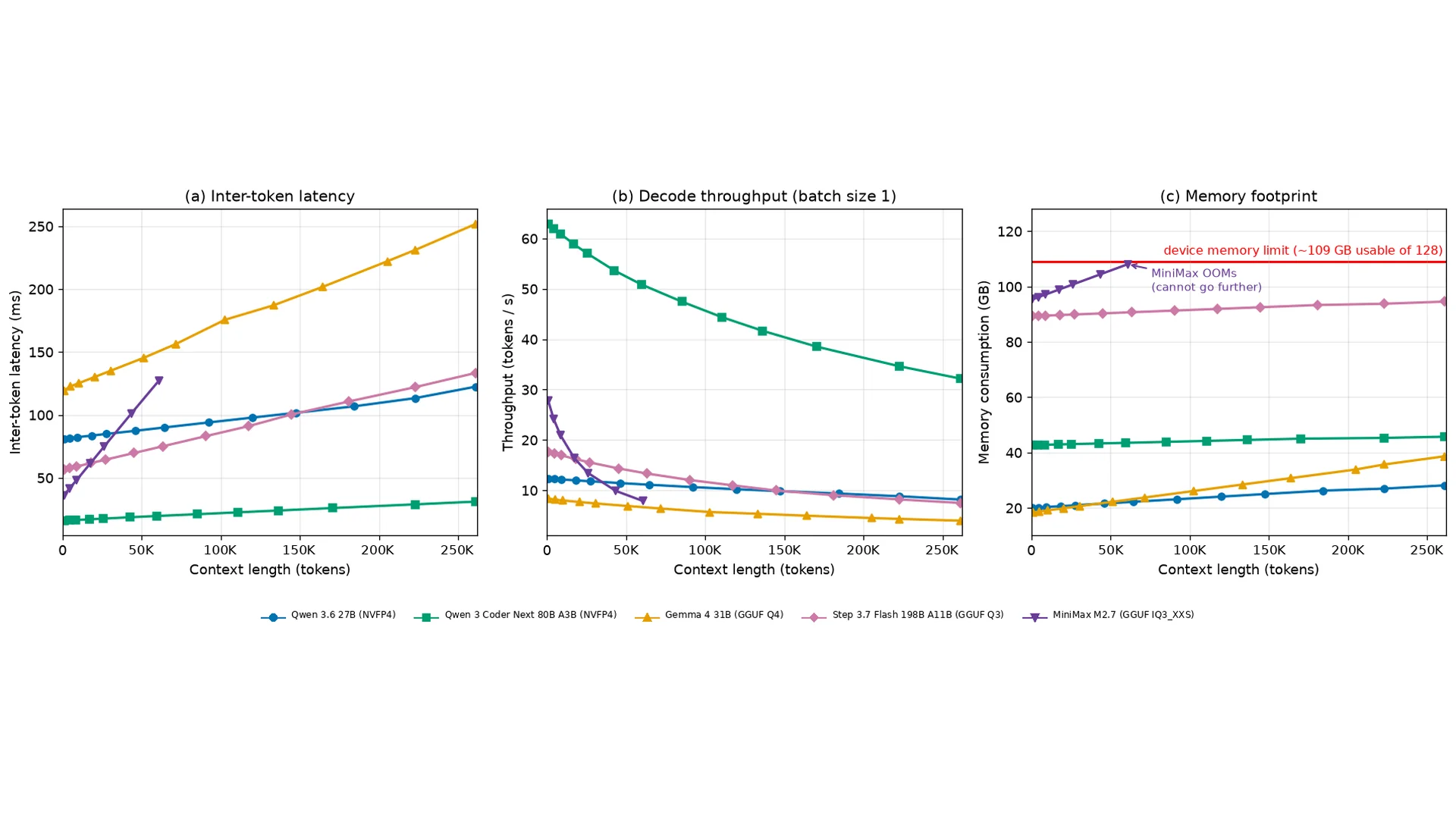
- Local side: for several models, later tokens can take roughly 2× longer as input length grows, with throughput and memory footprint worsening together.
- RQ1 long-horizon: frequent compaction of agent history; Opus 4.5 ranges about −3.7 to +5.6 points vs baseline, with most of 22 configs losing ≤2 points; estimated cost savings about 2.2-8.8×. The authors note tasks where compaction must lose information, but an external history plus selective reading can turn that need into a long-input problem.
- RQ2 long-input: selective file reading (e.g. Bash tools) instead of stuffing the full input; many benches match or beat full-input baselines, with larger estimated savings.
- RQ3 single-action compaction (SAC): Opus 4.5 ≈70.2% on SWE-bench Verified (mini baseline 70.0) and ≈51.8% on Terminal-Bench 2.1 (baseline 47.2); GPT 5.6 Sol ≈82.4% / 84.3%, a few points under its mini baselines. Under SAC, median peak live context is about 7-9K; maxima fall from roughly 130-200K to about 15-37K.
- Concept: Semantic State Space Models (SSSMs). maintain an explainable natural-language semantic state so a separate inference instance can continue the job.
Evidence grade: NVIDIA-authored preprint; most benches are public suites, while compaction and EoCC/SAC are author-defined harness changes. Cost figures are throughput × cloud prices, not a retail invoice. The lab page lists the paper among Local Frontier Intelligence work; it is not a standalone product launch note.
Mechanically, the authors split “long context” into two workloads: growing long-horizon histories, and long inputs dumped in at once. The first need not keep the full transcript every step; the second often becomes “store as an external resource and read on demand.” The title’s bite comes from the plots: accuracy stays near baseline at short-context tiers while serving cost and peak context fall hard.
Steelman: if independent teams rerun SWE-bench Verified / Terminal-Bench 2.1 / LongBench v2 under similar compaction recipes and recover near-baseline accuracy with shorter peak context, the paper supports a narrow claim. at least in these agent and long-input settings, keeping hundreds of thousands of tokens of live history is not required to finish the job, so post-training and harness design should take short-context regimes seriously. Appendix material (as cited in the main text) carries open-weight complements and per-benchmark token spend; the headline plots already show that cost savings and accuracy deltas must be read together, not cherry-picked.
[1]Steelman risks: the authors say the evidence does not rule out tasks that still benefit from long context, and does not prove every task is solvable with short context. Coin-toss-style examples show accuracy must fall if critical bits live only in history that compaction deletes. unless an external store exists. Compaction is lossy; stacked compactions lose more. Closed-model API behavior is not automatically the same as open-weight local measurements. The title is a polemic line; the RQs are the test list.
No separate NVIDIA product blog post was found for this paper; the secondary source used here is the LFI lab page. Reading “you don’t need long context” as “every 1M-window marketing claim is false” overshoots what was measured.
[1][2]For inference platforms and agent frameworks, the six-month check is whether default sessions still pile tool traces without a cap, and whether compaction policies appear in eval reports beside accuracy, total tokens, and peak context. For local / small-accelerator paths (the paper sits under the LFI moonshot), short context translates directly into more tolerable memory and latency. For model vendors, beyond window-size contests, the question is whether post-training ever optimized for “short context + external state.” The paper’s own framing sits under a local-frontier moonshot: if short contexts hold accuracy, then phones and small accelerators face a less impossible memory wall than a 1M-token default implies.
[1][2]Test accuracy and peak context under the compaction recipes, and whether the cost multiples remeasure. not the title alone. If that holds, “you don’t need long context” is an engineering pushback against default long sessions. If not, it remains a sharp preprint argument.
【No.2】
[1]