
要点
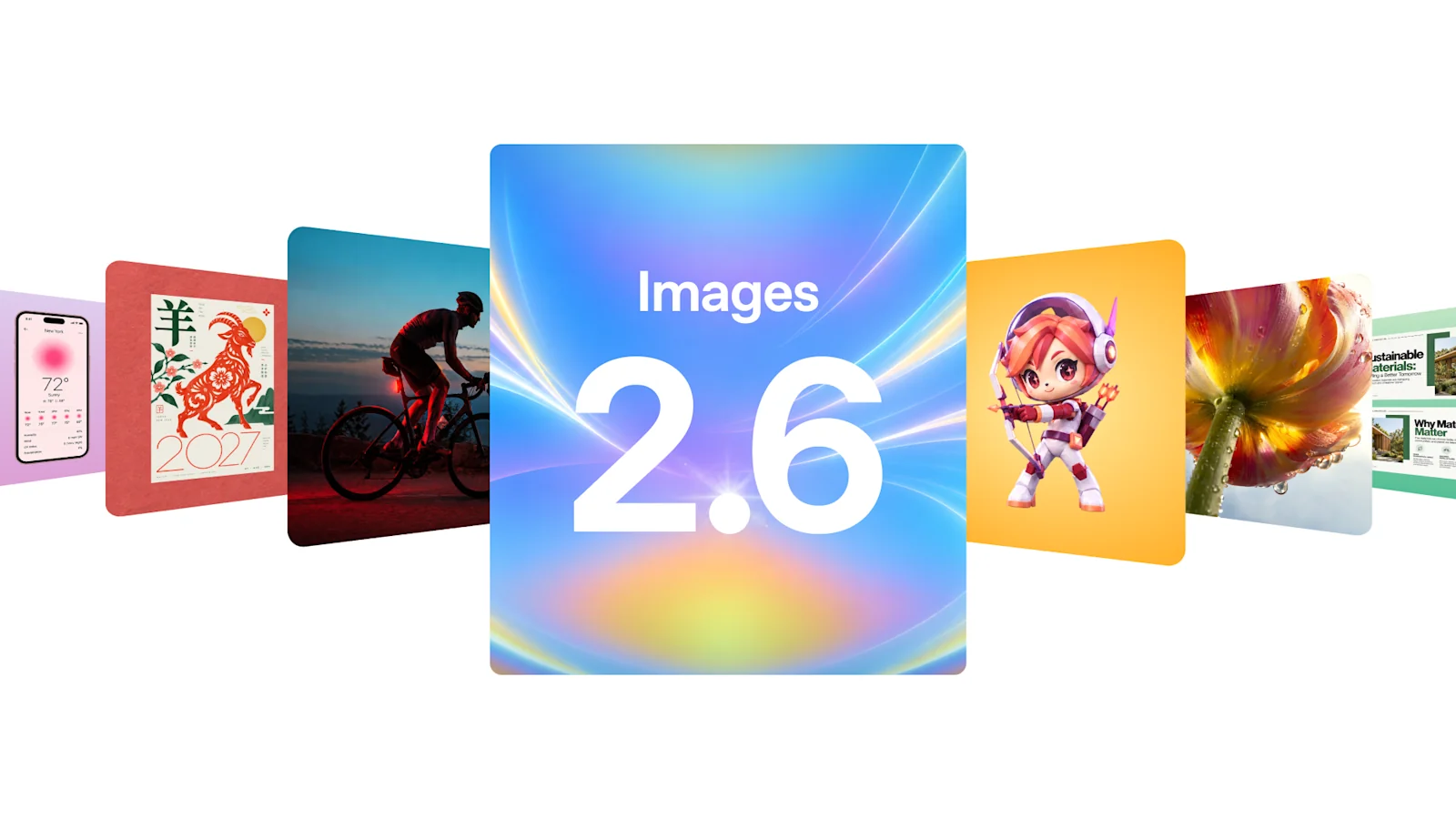
- On 4 Nov 2026 OpenAI launched Images 2.6 in ChatGPT, Codex, and the API; it claims generation is about 50% faster than before.
- The API ships GPT-Image-2.6 Flare and Sunburst: Flare can reach about six seconds at low quality; medium/high routes to Sunburst for detail and cross-edit consistency.
- New controls include image markup, SVG export, and a complexity parameter; GIFs lead the product story. The falsifiable claim is latency and edit control, not “native tongue of social” rhetoric.
On 4 Nov 2026 OpenAI shipped Images 2.6 across ChatGPT, Codex, and the API. The company frames two gains: faster generation, and tighter control of characters, products, and brand detail across edit rounds.
The falsifiable reading should skip partner lines such as “GIFs are the native language of social media.” If independent timing cannot reproduce Flare at roughly six seconds on low quality, if the average speedup versus the prior generation is far below about 50%, or if markup, SVG, and complexity do not change reproducible edit outcomes, discount the post’s extrapolation.
[1]Hard facts (OpenAI blog, 4 Nov 2026):
- Product: Images 2.6; API model names GPT-Image-2.6 Flare and GPT-Image-2.6 Sunburst.
- Speed: generation “50% faster than before”; Flare “as little as six seconds” when quality is low.
- Volume self-report: about 4 billion images per week across ChatGPT, Codex, and the API, more than half a billion per day on average. This is a company usage claim, not a third-party audit.
- Surface: GIFs; image markup already in ChatGPT now reaches the API; SVG export; a complexity parameter for how much planning the model does; quality for visual detail.
- Availability: said to be live globally in ChatGPT and Codex on all subscription tiers (desktop, mobile, web); Flare and Sunburst in the API, with pricing linked from the post.
- Safety: the post points to an Images 2.6 system card and does not reprint evaluation tables in the body.
Evidence strength: first-party product post, with partner quotes (OpenArt CEO Coco Mao; Figma Weave Creative Director Itay Schiff) and early-access samples. Latency and volume figures come from OpenAI; no independent latency benchmark or blind consistency study shipped the same day.
Mechanically, Flare and Sunburst split by quality tier, complexity separates “how long to think” from “how fine to draw,” and markup turns “change that bit” from verbal guessing into a selectable region. That matters for production: posters and product shots need repeatable local edits, not a full redraw each round.
Steelman: if the ~50% speedup and ~6-second low tier hold at common resolutions, and cross-edit consistency measurably improves on medium/high Sunburst, Images 2.6 looks more like a move toward orchestrable production tooling than another sample-gallery race.
[1]Strongest steelman: putting GIFs, markup, and SVG on one API surface cuts the friction of “still frame first, then other tools for motion and vectors.” If the Town customer note is accurate, animated characters are already being tried as workplace-assistant personality.
Steelman risks: 4 billion images a week is usage, not quality or safety proof. Partner quotes do not replace latency distributions, failure rates, or brand-consistency metrics. “Faster” does not name the baseline model, resolution, batch size, or region. The system card needs a separate read; this piece did not verify its red-team numbers. Hard specs for GIF audio, max duration, and commercial copyright bounds are missing from the post.
[1]For developers, the six-month checks are Flare low-tier P50/P95 latency, one-shot success of markup local edits, and whether SVG exports drop into real design pipelines. For safety and copyright teams, watch whether the system card’s abuse evals cover animation and brand impersonation. For general readers, demote the GIF narrative to packaging and promote the parameter and latency claims to the test objects.
[1]The news core of Images 2.6 is a wider production control surface plus a company-claimed generation speedup. The falsifiable focus should be: whether the ~50% speedup and ~6-second low tier survive third-party timing; and whether markup, SVG, and complexity change reproducible edit results. If those hold, GIFs are an on-ramp; if not, this remains launch-day narrative.
【No.2】
[1]