
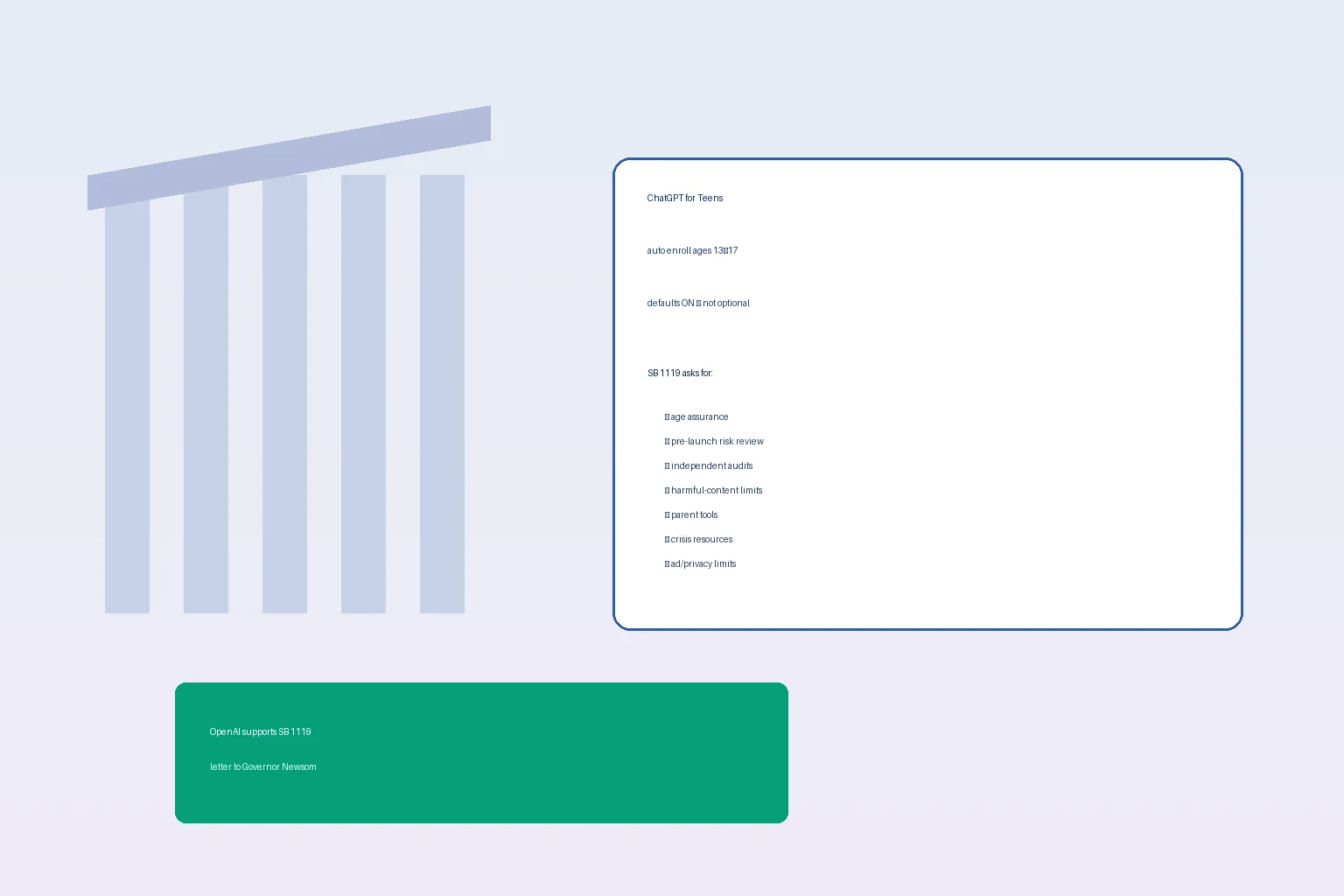
On August 31 Ann O’Leary, OpenAI’s VP of Global Policy, publicly backed California Senate Bill 1119 and urged Governor Newsom to sign it. OpenAI supports California’s bill to advance youth AI safety frames federal inaction as a state opening: California can set an age-appropriate AI framework while national legislation stalls.
Officially, the bill’s asks include age determination; identifying and addressing safety risks before youth access; independent audits; limits on self-harm, sexual exploitation, and other high-risk interactions; parental tools; crisis-resource connections when serious risks arise; and limits on targeted ads plus protection of minors’ personal data. For users identified as 13–17, protections should apply automatically.
[1]How the bill and the product cite each other
OpenAI ties support to Sam Altman’s teen principles, California advocacy, and work around the Parents & Kids Safe AI Act, and attaches a letter to Governor Newsom naming Senator Steve Padilla and Assemblymembers Buffy Wicks and Rebecca Bauer-Kahan, among others.
The product foil is ChatGPT for Teens: if the system estimates under-18 or the user states ages 13–17, they land in that experience automatically; protections are baseline, not optional toggles. OpenAI also cites that nearly nine in ten teens who use ChatGPT turn to it for learning, information, skill-building, or productivity in a given week. Narratively, the bill treats AI as not social media—preserving educational and safety-critical features (including responsible use of memory) while hardening defaults.
[1]Why this is political product work, not only PR
Author’s judgment: endorsing at signing time treats the already-shipped Teens product as a compliance rehearsal, lowering the cost of being dragged by statute. Age estimation plus default protections map closer to bill language than after-the-fact modals; audit and crisis clauses turn platform duties into checklists.
Flashpoints will include privacy costs of age assurance, appeals when adults/minors are misclassified, and whether “AI ≠ social” becomes rhetoric to exempt engagement designs.
[1]Spillover beyond California
If SB 1119 becomes law, other jurisdictions may copy it, turning youth defaults from product features into market access. Rivals including Anthropic face the same school and family surfaces; whoever makes age-tiered experiences auditable wins education and public-sector RFPs more easily.
For families, ChatGPT looks more like a learning tool with a parent panel; for developers, minor traffic brings heavier feature flags and logging duties.
[1]Columnist view
Read this as lobbying with a shipped product shape. The support checklist maps almost line-by-line to Teens’ claimed capabilities—low political risk, high value on Newsom’s desk as the “responsible vendor.” What matters is not the letter’s prose but age-assurance error rates, whether parent tools actually constrain use, and whether crisis handoffs are auditable.
While Washington stays empty, California rules often become de facto national floors. Over 6–12 months, public audits and enforcement cases will define the youth-AI floor more than another principles post.
[1]