
要点
- A teapawt how-to turns Claude Code’s documented features into a seven-layer harness so Opus 5.5 long tasks end in openable files and claim tables.
- Skills, permissions, an evidence-reviewer subagent, `progress.md`, and `/goal` define completion outside chat self-assessment—while shell sandbox gaps and conversation-evaluated goals remain limits.
- Anthropic’s early-tester token-savings figure is theirs, not this harness’s; the piece asks builders to measure accepted work and corrections instead.
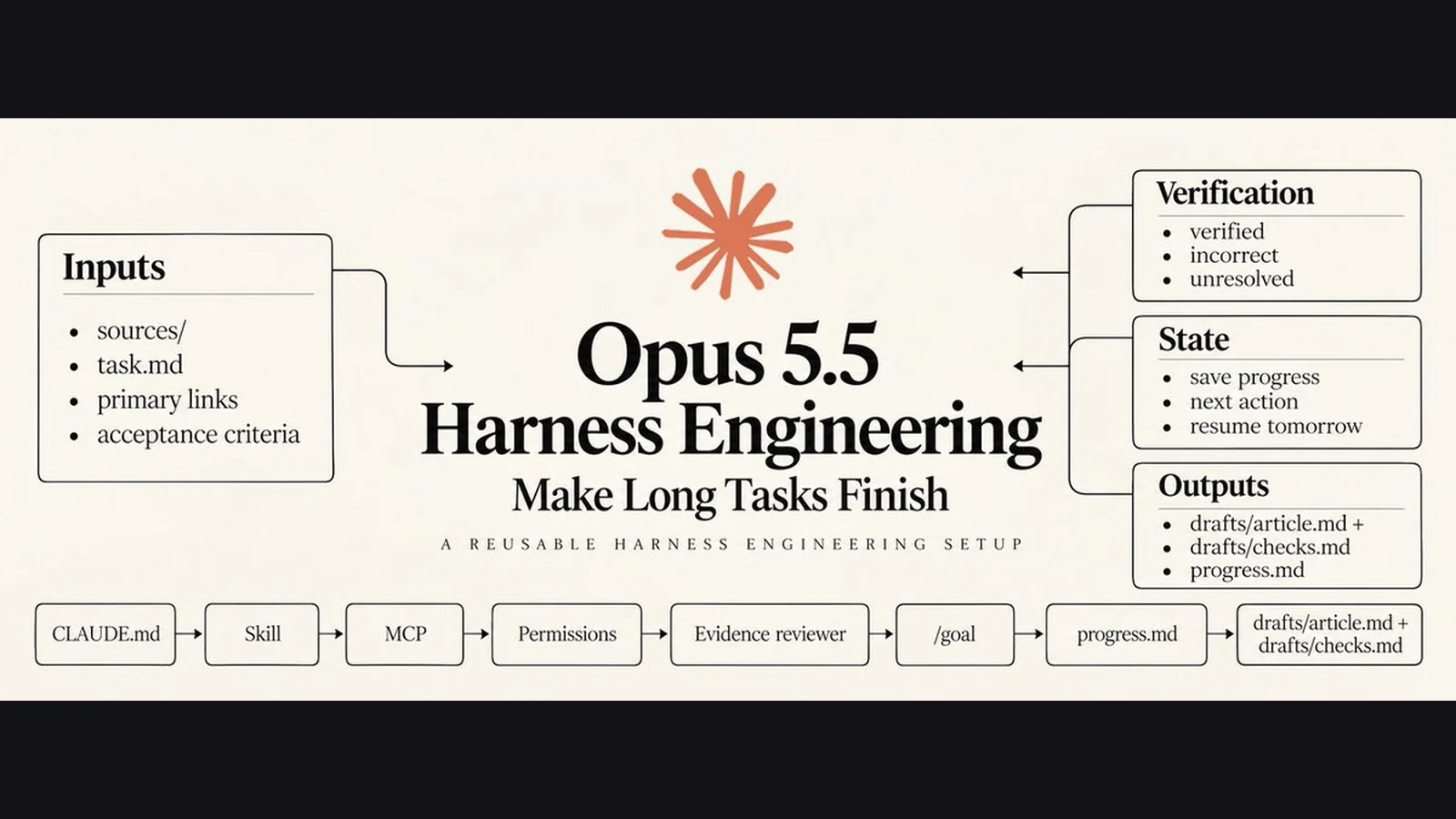
A practitioner post on teapawt, dated October 6 and signed beamnxw, does not announce a new model. It packages Claude Code’s documented surfaces—project instructions, skills, MCP, permissions, subagents, effort, and /goal—into a seven-layer harness so Opus 5.5 finishes long tasks with files you can open tomorrow.
The falsifiable claim is operational, not mystical: long-task reliability for this model family is less about a smarter single chat turn and more about engineering a reusable harness—skills, permissions, an evidence-reviewer subagent, a progress.md handoff, and goal-defined deliverables—so “done” means openable drafts plus claim tables, not a polished summary that evaporates when the context window compresses.
The example workflow is deliberately boring: reference material in sources/, working files in drafts/, approved outputs in published/. Root CLAUDE.md holds standing conventions; ephemeral deadlines stay with the task. A write-draft skill encodes the repeating sequence—read sources, draft, invoke a reviewer, save a claim table, update progress, return paths. An evidence-reviewer subagent gets read and search tools only, and must return a table of claim, verdict (verified / incorrect / unresolved), source URL, and required correction.
Permissions deny reading .env files and editing under published/. Completion is stated as a /goal: both drafts/article.md and drafts/checks.md must exist, incorrect claims corrected, unresolved claims marked, and paths plus verification results shown in the conversation—or stop after twelve turns and report the blocker. A compact progress.md (task, outputs, completed, decisions, open issues, next action) is the handoff for a fresh session in the same workspace.
Effort is assigned by role rather than by vibe: the main drafting session starts at medium; the reviewer requests high. Before the first full run, the post tells operators to inspect /context, /agents, and /permissions so missing components fail early—not after twelve turns of improvisation.
None of this invents APIs. The piece cites Claude Code feature guides for memory, skills, MCP, hooks, permissions, subagents, effort, goals, compaction, usage, and Anthropic’s long-running harness notes. That is its contribution: operationalizing already-documented features into a copyable layout rather than another prompt folklore thread.
It also steelmans the obvious objection. Stronger models do reduce unfinished work; Opus-class models with higher effort already leave fewer orphaned outlines. The harness still matters because completion criteria live outside the model’s self-congratulation. Anthropic’s evaluation guidance, as the post paraphrases, separates an agent’s transcript from outcomes left in the environment. Opening the saved draft and matching claims to opened sources is a different check from rereading a confident closing paragraph in chat.
Two limits are stated honestly. File-tool denylist does not sandbox arbitrary shell or language runtimes—OS sandboxing is required for that. And /goal is conversation-evaluated: the turn clause depends on the agent surfacing evidence; strict spend or wall-clock limits need separate execution controls. The “60% token reduction” figure the post nods at belongs to Anthropic’s early-tester report for the model experiment, not to a measurement on this author’s harness. Reuse, the piece insists, must be measured on accepted work—review time and corrections required—not on announcement slides.
Recovery is treated as part of the harness, not an afterthought. /rewind can restore tracked file edits; shell side effects and most subagent edits need separate recovery, while version control remains the durable history. That is another reason completion is defined on disk: a transcript you cannot replay is a weak audit trail.
As tertiary how-to writing, the post cannot prove that teams adopting the seven layers finish more deliverables than teams that simply buy a larger context window. There are no before/after tables, no independent replays, no cost curves for the high-effort reviewer. The document-workflow metaphor travels well to code and research, but the snippets are article-shaped; porting them means rewriting acceptance criteria, not only renaming folders.
What it does supply—and what many “agent frameworks” still skip—is a definition of done that survives session boundaries: paths on disk, a claim table with unresolved marked, and a next action a cold session can execute. That is a narrower claim than “agents that never quit,” and therefore more testable.
[1]For builders shipping multi-hour research or drafting loops, the six-month implication is cultural. Chat-native completion—the model saying it is finished—will keep producing beautiful leftovers that cannot be handed to a colleague. Harness-native completion—openable files, evidence tables, progress notes—turns model upgrades into incremental improvements on a stable interface rather than a reason to redesign the workflow every quarter.
Vendors will keep selling longer contexts and higher effort knobs. This setup argues that the scarce resource is still the engineering that makes those knobs produce artifacts an editor can reject or accept without reconstructing the conversation.
The immediate practical test is reuse: same skill, new topic and source set, same reviewer and output paths. When a recurring correction appears—confused announcement versus availability dates, for example—the skill gets edited. That feedback loop is how a harness becomes an asset rather than a one-off demo folder.
[1]Watch whether reused skills accumulate the recurring corrections the post predicts—date confusion, missing primary links, reviewer verdicts without conflicting evidence—and whether teams publish their own claim-table schemas the way they once published linters. If those artifacts stay tribal, “long-running agents” remain demos. If they become shared procedures, Opus-class models get a fairer job description: produce inspectable work, not a last message that sounds finished.
[1]